

100% satisfaction guarantee Immediately available after payment Both online and in PDF No strings attached 4.2 TrustPilot
logo-home
Exam (elaborations)

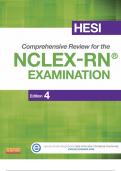
HESI Comprehensive Review for the NCLEX-RN Examination

Rating
-
Sold
-
Pages
402
Grade
A
Uploaded on
23-09-2023
Written in
2022/2023

INTRODUCTION TO TESTING AND THE NCLEX-RN® EXAM 1 Three cheers for you! You have made the wise decision to prepare, in a structured way, for the NCLEX-RN. A. You have already successfully completed a basic nurs- ing program and are well acquainted with your ability to take and pass tests and to perform successfully in the clinical area. B. You have the basic knowledge required to pass the licensing exam. However, it is wise to: 1. Organize your knowledge. 2. Review content learned during the years of your basic nursing curriculum. 3. Identify weaknesses in content knowledge so that you can focus your study time appropriately. 4. Develop test-taking skills so you can demonstrate the knowledge you have. 5. Reduce your level of anxiety by increasing your predictability. 6. Know what to expect. Remember: Knowledge is power. You are powerful when you are well pre- pared and know what to expect. Test-Taking Tips There are no absolute ways to ensure that exam questions will always be answered correctly. These test-taking tips are guidelines to help the student study and understand the exam questions. On the NCLEX-RN exam, many different areas are tested with each question. For example, a ques- tion may on the surface be a medical/surgical or pediatric question but included in the question can be such topics as communication, nutrition, growth and development, medication, client and family education, and safety. A. Understanding the question 1. Determine if the question is written in a positive or negative style. a. A positive style may ask what the nurse should do or ask for the best or first action to implement. HESI Hint • Most questions are written in a positive style. b. A negative style may ask what the nurse should avoid, which prescription the nurse should ques- tion, or which behavior indicates the need for re-teaching the client. HESI Hint • Negative style questions will contain key words that denote the negative style. EXAMPLES 1. “Which response indicates to the nurse a need to re-teach the client about...?” (Which information/ understanding by the client is incorrect?) 2. “Which prescription (order) should the nurse question?” (Which prescription is unsafe, not beneficial, inappropriate to this client situation, etc...?) 2. Find the key words in the question. a. Ask yourself which words or phrases provide the critical information. b. This information may be the age of the client, the setting, the timing, a set of symptoms or behav- iors, or any number of other factors. c. For example, the nursing actions for a 10-year- old 1 day postop are different than those for a 70-year-old 1 hour postop. 3. Rephrase the question in your own words. a. This will help you eliminate nonessential infor- mation in the question and help you determine the correct answer. b. Ask yourself, “What is this question really asking?” c. While keeping the options covered, rephrase the question in your own words. 4. Rule out options. a. Based on your knowledge, you can probably identify one or two options that are clearly incorrect. b. Physically mark through those options on the test booklet if allowed. Mentally mark through those options in your head if using a computer. 1 2 HESI COMPREHENSIVE REVIEW FOR THE NCLEX-RN® EXAMINATION c. Now differentiate between the remaining options, considering your knowledge of the subject and related nursing principles, such as roles of the nurse, the nursing process, the ABCs (airway, breathing, and circulation), CAB (circulation, airway, and breathing for cardiopulmonary resus- citation [CPR]), and Maslow’s Hierarchy of Needs. B. General guidelines about test taking 1. Consider the content of the question and what the question is asking. 2. Generally, an assessment of the client occurs before an action is taken. 3. Identify the least invasive intervention before taking action. 4. Have all the necessary information and take all pos- sible relevant actions before calling the physician or health care provider. 5. Determine which client to assess first (e.g., most at risk, most physiologically unstable). 6. Identify opposites in the answers. a. Example: Prone/supine; elevated/decreased b. Read VERY carefully; one is likely to be the answer, BUT not always c. If you do not know the answer, choose the most likely of the “opposites” and move on. 7. Take into account a client’s lifestyle, culture, and spiritual beliefs when answering a question. C. Use CRITICAL THINKING, reasoning, and common sense to answer questions. 1. DO respond based on... a. ABCs b. CAB for CPR c. Scientific, behavioral, sociologic principles d. Principles of teaching/learning e. Maslow’s Hierarchy of Needs f. Nursing process g. What’s in the stem: No more, no less (Do not read more into the question than is already there.) h. NCLEX-RN ideal hospital i. Basic anatomy and physiology 2. DON’T respond based on... a. YOUR past client care experiences or agency b. A familiar phrase or term c. “Of course, I would have already...” d. What YOU think is REALISTIC e. YOUR children, pregnancies, parents, elders, per- sonal response to a drug, etc. f. The “what ifs” D. Keep memorizing to a minimum. 1. Growth and developmental milestones 2. Death and dying stages 3. Crisis intervention 4. Immunizations schedule 5. Principles of teaching/learning 6. Stages of pregnancy and fetal growth 7. Nurse Practice Act: Standards of Practice and Delegation E. Know commonly used lab ranges (Appendix A), what variations mean, and the BEST nursing actions. 1. H&H 2. WBCs, RBCs, platelets 3. Electrolytes: K+, Na+, Ca++, Mg++, Cl−, PO4− 4. BUN and creatinine 5. Relationship of Ca++ and PO4− 6. ABGs 7. PT, INR, PTT (Don’t get them confused.) F. Nutrition 1. Know commonly used nutrition information. a. High or low Na+ b. High or low K+ c.HighPO4− d. Iron e. Vitamin K f. Proteins g. Carbohydrates h. Fats 2. Foods and diets related to a. Gastrointestinal/genitourinary disturbances b. Chemotherapy diets and restrictions c. Pregnancy and fetal growth needs d. Dialysis e. Burns 3. Remember concepts a. Introducing one food at a time (infants, allergies) b. Progression “AS TOLERATED” (What nurs- ing assessment guides decisions regarding progression?) G. Medications—SAFE medication administration is more than just knowing the name, classification, and action of the medication. 1. “Six Rights,” including techniques of skill execution 2. Drug interactions 3. Vulnerable organs a. What to assess b. Which lab values relate to specific organs 4. Allergies 5. Presence of suprainfections 6. Concepts of peak and trough 7. How you would know a. The drug is working b. There’s a problem 8. Nursing actions 9. Client education should include a. Safety b. Empowerment c. Compliance CHAPTER 1 INTRODUCTION TO TESTING AND THE NCLEX-RN® EXAM 3 The NCLEX-RN® Licensing Exam A. ThemainpurposeofalicensingexamliketheNCLEX- RN is to protect the public. B. The NCLEX-RN: 1. Was developed by the National Council of State Boards of Nursing (the Council; this abbreviation is used to refer to the NCSBN throughout this book) 2. Is administered by the State Board of Nurse Examiners 3. Is designed to test candidates’ a. Capabilities for safe and effective nursing practice b. Essential entry-level nursing knowledge Job Analysis Studies A. Essential knowledge is determined by job analysis studies. HESI Hint • The Council wants to ensure that the licensing exam measures current entry-level nursing behaviors. For this reason, job analysis studies are conducted every 3 years.These studies determine how frequently various types of nursing activities are performed, how often they are delegated, and how critical they are to client safety, with criticality given more value than frequency. B. Job analysis studies indicate that newly licensed regis- tered nurses are using all five categories of the nursing process and that such use is evenly distributed through- out the five nursing process areas. Therefore, equal attention is given to each part of the nursing process in selecting test items (Table 1-1). Nursing Diagnoses A. Nursing diagnoses are formulated during the analysis portion of the nursing process. They give form and direction to the nursing process, promote priority set- ting, and guide nursing actions (Table 1-2). B. To qualify as a nursing diagnosis, the primary responsi- bility and accountability for recognition and treatment rest with the nurse. C. The National Conference of the North American Nursing Diagnosis Association (NANDA) provided the following definition of a nursing diagnosis: “Nurs- ing diagnosis is a clinical judgment about individual, family, or community responses to actual and potential health problems/life processes. Nursing diagnoses pro- vide the basis for selection of nursing interventions to achieve outcomes for which the nurse is accountable” (Box 1-1). TABLE 1-1 The Nursing Process Category Activities Associated with Nursing Process Assessment • Gather objective and subjective data. • Verify data. Analysis • Interpret data. • Collect additional data when necessary. • Identify and communicate nursing diagnoses. • Determine health team’s ability to meet client’s needs. Planning • Determine and prioritize outcomes of care. Include client, significant others, and health team in setting outcomes. • Develop and modify plan for delivery of client’s care. Implementation Evaluation • Organize and manage the client’s care, including assignment and delegation of tasks. • Perform or assist in performance of cli- ent’s care. • Counsel and teach client, significant oth- ers, and health team. • Provide care specifically directed toward achieving outcomes. • Compare actual outcomes with expected outcomes. • Evaluate compliance with the established regimen or plan. • Record and describe client’s response to plan. • Modify plan as indicated and set priorities. TABLE 1-2 Diagnosis Components of a Nursing Component Explanation Response • Includes potential or actual health response • Describes measurable outcomes that can be derived • Cites potential for changes based on nursing actions • Example: Alteration in comfort, pain Etiology • Includes potential or actual health response • Addresses independent, interdependent, and dependent nursing functions • Example: Related to fractured left ankle 4 HESI COMPREHENSIVE REVIEW FOR THE NCLEX-RN® EXAMINATION BOX 1-1 NANDA-Approved Nursing Diagnoses A Activity Intolerance Risk for Activity Intolerance Ineffective Activity Planning Risk for Ineffective Activity Planning Risk for Adverse Reaction to Iodinated Contrast Media Ineffective Airway Clearance Risk for Allergy Response Anxiety Risk for Aspiration Risk for Impaired Attachment Autonomic Dysreflexia Risk for Autonomic Dysreflexia B Disorganized Infant Behavior Risk for Disorganized Infant Behavior Readiness for Enhanced Organized Infant Behavior Risk for Bleeding Risk for Unstable Blood Glucose Level Disturbed Body Image Risk for Imbalanced Body Temperature Insufficient Breast Milk Ineffective Breastfeeding Interrupted Breastfeeding Readiness for Enhanced Breastfeeding Ineffective Breathing Pattern C Decreased Cardiac Output Caregiver Role Strain Risk for Caregiver Role Strain Readiness for Enhanced Childbearing Process Ineffective Childbearing Process Risk for Ineffective Childbearing Process Impaired Comfort Readiness for Enhanced Comfort Readiness for Enhanced Communication Impaired Verbal Communication Acute Confusion Risk for Acute Confusion Chronic Confusion Constipation Perceived Constipation Risk for Constipation Contamination Risk for Contamination Defensive Coping Ineffective Coping Readiness for Enhanced Coping Ineffective Community Coping Readiness for Enhanced Community Coping Compromised Family Coping Disabled Family Coping Readiness for Enhanced Family Coping D Death Anxiety Risk for Sudden Infant Death Syndrome Decisional Conflict Readiness for Enhanced Decision-Making Ineffective Denial Impaired Dentition Risk for Delayed Development Diarrhea Risk for Disuse Syndrome Deficient Diversional Activity Risk for Dry Eye E Risk for Electrolyte Imbalance Disturbed Energy Field Impaired Environmental Interpretation Syndrome F Adult Failure to Thrive Risk for Falls Dysfunctional Family Processes Interrupted Family Processes Readiness for Enhanced Family Processes Fatigue Fear Ineffective Infant Feeding Pattern Readiness for Enhanced Fluid Balance Risk for Imbalanced Fluid Volume Deficient Fluid Volume Risk for Deficient Fluid Volume Excess Fluid Volume G Impaired Gas Exchange Dysfunctional Gastrointestinal Motility Risk for Dysfunctional Gastrointestinal Motility Risk for Ineffective Gastrointestinal Perfusion Grieving Complicated Grieving Risk for Complicated Grieving Risk for Disproportionate Growth Delayed Growth and Development H Deficient Community Health Risk-Prone Health Behavior Ineffective Health Maintenance Impaired Home Maintenance Readiness for Enhanced Hope Hopelessness Risk for Compromised Human Dignity Hyperthermia Hypothermia I Readiness for Enhanced Immunization Status Ineffective Impulse Control Bowel Incontinence Functional Urinary Incontinence Overflow Urinary Incontinence Reflex Urinary Incontinence CHAPTER 1 INTRODUCTION TO TESTING AND THE NCLEX-RN® EXAM 5 BOX 1-1 NANDA-Approved Nursing Diagnoses—cont’d Stress Urinary Incontinence Urge Urinary Incontinence Risk for Urge Urinary Incontinence Risk for Infection Risk for Injury Insomnia Decreased Intracranial Adaptive Capacity J Neonatal Jaundice Risk for Neonatal Jaundice K Deficient Knowledge Readiness for Enhanced Knowledge L Latex Allergy Response Risk for Latex Allergy Response Sedentary Lifestyle Risk for Impaired Liver Function Risk for Loneliness M Risk for Disturbed Maternal-Fetal Dyad Impaired Memory Impaired Bed Mobility Impaired Physical Mobility Impaired Wheelchair Mobility Moral Distress N Nausea Unilateral Neglect Noncompliance Readiness for Enhanced Nutrition Imbalanced Nutrition: Less Than Body Requirements Imbalanced Nutrition: More Than Body Requirements O Impaired Oral Mucous Membrane P Acute Pain Chronic Pain Readiness for Enhanced Parenting Impaired Parenting Risk for Impaired Parenting Risk for Peripheral Neurovascular Dysfunction Disturbed Personal Identity Risk for Disturbed Personal Identity Risk for Poisoning Risk for Perioperative Positioning Injury Post-Trauma Syndrome Risk for Post-Trauma Syndrome Readiness for Enhanced Power Powerlessness Risk for Powerlessness Ineffective Protection R Rape-Trauma Syndrome Readiness for Enhanced Relationship Ineffective Relationship Risk for Ineffective Relationship Readiness for Enhanced Religiosity Impaired Religiosity Risk for Impaired Religiosity Relocation Stress Syndrome Risk for Relocation Stress Syndrome Risk for Ineffective Renal Perfusion Impaired Individual Resilience Readiness for Enhanced Resilience Risk for Compromised Resilience Parental Role Conflict Ineffective Role Performance S Bathing Self-Care Deficit Dressing Self-Care Deficit Feeding Self-Care Deficit Toileting Self-Care Deficit Readiness for Enhanced Self-Care Readiness for Enhanced Self-Concept Chronic Low Self-Esteem Risk for Chronic Low Self-Esteem Situational Low Self-Esteem Risk for Situational Low Self-Esteem Ineffective Self-Health Management Readiness for Enhanced Self-Health Management Self-Mutilation Risk for Self-Mutilation Self-Neglect Sexual Dysfunction Ineffective Sexuality Pattern Risk for Shock Impaired Skin Integrity Risk for Impaired Skin Integrity Sleep Deprivation Readiness for Enhanced Sleep Disturbed Sleep Pattern Impaired Social Interaction Social Isolation Chronic Sorrow Spiritual Distress Risk for Spiritual Distress Readiness for Enhanced Spiritual Well-Being Stress Overload Risk for Suffocation Risk for Suicide Delayed Surgical Recovery Impaired Swallowing T Ineffective Family Therapeutic Regimen Management Risk for Thermal Injury Ineffective Thermoregulation Impaired Tissue Integrity Ineffective Peripheral Tissue Perfusion Continued 6 HESI COMPREHENSIVE REVIEW FOR THE NCLEX-RN® EXAMINATION BOX 1-1 NANDA-Approved Nursing Diagnoses—cont’d Risk for Decreased Cardiac Tissue Perfusion Risk for Ineffective Cerebral Tissue Perfusion Risk for Ineffective Peripheral Tissue Perfusion Impaired Transfer Ability Risk for Trauma U Impaired Urinary Elimination Readiness for Enhanced Urinary Elimination Urinary Retention V Risk for Vascular Trauma Impaired Spontaneous Ventilation Dysfunctional Ventilatory Weaning Response Risk for Other-Directed Violence Risk for Self-Directed Violence W Impaired Walking Wandering TABLE 1-3 Client Needs Category of Client Needs NCLEX-RN (%) Activities Safe and Effective Care Environment • Management of care • Safety and infection control 17%-23% 9%-15% • Coordination of care; quality assurance; goal-oriented care; environmental safety • Preparation for treatments and procedures • Safe and effective treatments and procedures Health Promotion and Maintenance 6%-12% • Continued growth and development • Self-care • Integrity of support systems • Prevention and early treatment of health problems Psychosocial Integrity 6%-12% • Promotion and support of emotional, mental, and social well-being Physiologic Integrity • Basic care and comfort • Pharmacologic and parenteral therapies • Reduction of risk potential • Physiologic adaptation 6%-12% 12%-18% 9%-15% 11%-17% • Physiologic adaptation • Reduction for risk potential • Activities of daily living • Care room temperature, medication administration, and parental therapies • Provision of basic comfort and care Note:The percentage of test questions assigned to each Client Needs category and subcategory of the 2013 NCLEX-RNTest Plan is based on the results of the Report of Findings from the 2011 RN Practice Analysis: Linking the NCLEX-RN Examination to Practice: NCSBN, 2012. Adapted from National Council of State Boards of Nursing. Test plan for the NCLEX-RN examination. Copyright 2013, National Council of State Boards of Nurs- ing, Inc., Chicago. D. NCLEX-RN questions regarding nursing diagnosis can take several forms: 1. You may be given the nursing diagnosis in the stem and asked to select an appropriate nursing interven- tion based on the stated nursing diagnosis. 2. You may be asked to select, from the four choices, an appropriate nursing diagnosis for the described case. 3. You may be asked to choose, from four nursing diag- noses, the one that should have priority based on the data in the stem. HESI Hint • A nursing diagnosis is not a medical diagnosis. It must be subject to oversight by nursing management. The cause may or may not arise from a medical diagnosis. Client Needs A. Job analysis studies have identified categories of care provided by nurses called Client Needs. The test plan is structured according to these categories (Table 1-3). Prioritizing Nursing Care A. Many NCLEX-RN test items are designed to test your ability to set priorities—for example: 1. Identify the most important client needs. 2. Which nursing intervention is most important? 3. Which nursing action should be done first? 4. Which response is best? B. Setting priorities 1. What should be done first or next? 2. Those taking the NCLEX-RN should “Remember Maslow” (Table 1-4). CHAPTER 1 INTRODUCTION TO TESTING AND THE NCLEX-RN® EXAM 7 TABLE 1-4 Maslow’s Hierarchy of Needs Need Definition Nursing Implications Physiologic Biologic needs for food, shelter, water, sleep, oxy- gen, sexual expression The priority biologic need is breathing (i.e., an open airway). Review Table 1-3, Client Needs activities associated with physiologic integrity. If you were asked to identify the most important action, you would identify needs associ- ated with physiologic integrity (e.g., providing an open airway) as the most important nursing action. Safety Avoiding harm; attain- ing security, order, and physical safety Review Table 1-3, the activities associated with Safe and Effective Care Environ- ment. Ensuring that the client’s environment is safe is a priority (e.g., teaching an older client to remove throw rugs that pose a safety hazard when ambu- lating would have a greater priority than teaching him or her how to use a walker).The first priority is safety, then coping skills. Love and Belonging Esteem and Recognition Giving and receiving affec- tion; companionship; and identification with a group Self-esteem and respect of others; success in work; prestige Although these needs are important (described inTable 1-3,Client Needs, activities associated with psychosocial integrity), they are less important than physiologic or safety needs. For example, it is more important for a client to have an open airway and a safe environment for ambulating than it is to assist him or her to become part of a support group. However, assisting the client in becoming a part of a support group would have higher priority than assisting him or her in developing self-esteem.The sense of belonging would come first, and such a sense might help in developing self-esteem. Self-actualization Aesthetic Fulfillment of unique potential Search for beauty and spiritual goals It is important to understand the last two needs in Maslow’s Hierarchy.They could deal with Client Needs associated with Health Promotion and Main- tenance, such as continued growth and development and self-care, as well as those associated with Psychosocial Integrity. However, you will probably not be asked to prioritize needs at this level. Remember, it is the goal of the Council to ensure safe nursing practice, and such practice does not usually deal with the client’s self-actualization or aesthetic needs. 3. The Five Rights of Delegation (see Chapter 2, p. 16) HESI Hint • Answering NCLEX-RN questions correctly often depends on setting priorities properly, on making judgments about priorities, and on analyzing the case and formulating a decision about care (or the correct response) based on priorities. Using Maslow’s Hierarchy of Needs can help you to set priorities. The NCLEX-RN® Computer Adaptive Testing A. Computer adaptive testing (CAT) is used for imple- mentation of the NCLEX-RN. B. The CAT is administered at a testing center selected by the Council. C. Pearson VUE is responsible for adapting the NCLEX- RN to the CAT format, processing candidate applica- tions, and transmitting test results to its data center for scoring. D. The testing centers are located throughout the United States. E. The Council generates the NCLEX-RN test items. The Way It Works A. The NCLEX-RN consists of 75 to 265 multiple-choice or alternative-format questions (15 of which are “pilot items”) presented on a computer screen. B. The candidate is presented with a test item and pos- sible answers. C. If the candidate answers the question correctly, a slightly more difficult item will follow, and the level of difficulty will increase with each item until the candi- date misses an item. D. If the candidate misses an item, a slightly less difficult item will follow, and the level of difficulty will decrease with each item until the candidate has answered an item correctly. E. This process will continue until the candidate has achieved a definite pass or a definite fail score. There will be no borderline pass or fail scores because the adaptive testing method determines the candidate’s level of performance before she or he has finished the exam. F. The fewest number of items a candidate can answer to complete the exam is 75; 15 of them will be pilot items and will not count toward the pass or fail score; 60 of them will determine the candidate’s score. 8 HESI COMPREHENSIVE REVIEW FOR THE NCLEX-RN® EXAMINATION G. The number of the item the candidate is currently answering will appear on the upper right area of the screen. H. When the candidate has answered enough items to determine a definite pass or fail score, a message will appear on the screen notifying the candidate that he or she has completed the exam. I. The most number of items a candidate can answer is 265, and the longest amount of time the candidate can take to complete the exam is 6 hours. J. Candidates will have up to 6 hours to complete the NCLEX-RN examination; total examination time includes a short tutorial, two preprogrammed optional breaks, and any unscheduled breaks they may take. The first optional break is offered after 2 hours of testing. The second optional break is offered after 3.5 hours of testing. The computer will automatically tell candidates when these scheduled breaks begin. 1. All breaks count against testing time. 2. When candidates take breaks, they must leave the testing room, and they will be required to provide a palm vein scan before and after the breaks. K. If a candidate has not obtained a pass/fail score at the end of the 6 hours and has not completed all 265 items in the 6-hour limit but has answered all of the last 60 questions presented correctly, he or she will pass the exam. L. If a candidate has not obtained a pass/fail score at the end of the 6 hours, has not completed all 265 items in the 6-hour limit, and has not answered correctly all of the last 60 questions presented, he or she will fail the exam. M. A specific passing score is recommended by the Coun- cil. All states require the same score to pass, so that if you pass in one state, you are eligible to practice nurs- ing in any other state. However, states do differ in their requirements regarding the number of times a candi- date can take the NCLEX-RN. N. Although the Council has the ability to determine a candidate’s score at the time of completion of the exam, it has been decided that it would be best for candidates to receive their scores from their individual Board of Nurse Examiners. The Council does not want the testing center to be in a position of having to deal with candidates’ reactions to scores, nor does the Coun- cil want those waiting to take their exams to be influ- enced by such reactions. O. You must answer each question in order to proceed. You cannot omit a question or return to an item pre- sented earlier. There is no going back; this works in your favor! P. The examination is written at a 10th-grade reading level. Q. There is no penalty for guessing; with four choices, you have a 25% chance of guessing the correct answer. HESI Hint • One or more of the choices are likely to be very wrong.You usually will be able to rule out two of the four choices rather quickly. Reread the question and choices again if necessary. Ask yourself which choice answers the question being asked. Even if you have absolutely no idea what the correct answer is, you will have a 50/50 chance of guessing the right answer if you follow this process. Your first response will provide an educated guess and will usually be the correct answer. Go with your gut response! Pace yourself from the beginning of the test. Allow approximately 1.5 minutes per question. HESI Hint • The NCSBN Candidate Bulletin is available at . Then select: Examinations/Candidates/Basic Information/Bulletin. Exam Item Formats A. There are a number of different types of exam items presented on the NCLEX-RN examination. The majority of the questions are multiple-choice items with four answers from which the candidate is asked to choose one correct answer. Other format (item types): 1. Multiple-response items require the candidate to select one or more responses. The item will instruct the candidate to choose/select all that apply. 2. Fill-in-the-blank questions require the candidate to calculate the answer and type in numbers. A drop down calculator is provided. 3. Hot-spot items require the candidate to identify an area on a picture or graph and click on the area. 4. Chart or exhibit formats present a chart or exhibit that the candidate must read to be able to solve the problem. 5. Drag-and-drop items require a candidate to rank order or move options to provide the correct order of actions or events. 6. Audio format items require the candidate to listen to an audio clip using headphones and then select the correct option that applies to the audio clip. 7. Graphic format items require the candidate to choose the correct graphic option in response to the question. There is no set percentage of alternative items on the NCLEX-RN examination. All examination items are scored either right or wrong. There is no partial credit in scoring any examination questions. B. CHAPTER 1 INTRODUCTION TO TESTING AND THE NCLEX-RN® EXAM 9 Gentle Reminders of General Principles Take care of yourself. Follow these golden rules for NCLEX- RN success. A. Eat well: Consume lots of fresh fruits, vegetables, and lean protein and avoid high-fat foods. B. Sleep well: Get a good night’s sleep the night before the test. This is not the time to cram or to party. You have done your job. Now enjoy the process. C. Eliminate alcohol and other mind-altering drugs: It goes without saying that such substances can inhibit your performance on the exam. D. Schedule study time: Between now and the exam, 3. Dress comfortably: Dress in layers so that you can take off a sweater or jacket if you become too warm or wear it if you become too cold. F. Avoid negative people: From now until you have com- pleted the exam, stay away from those who share their anxieties with you or project their insecurities onto you. Sometimes this is a fellow classmate or even your best friend. The person will still be there when the exam is over. Right now you need to take care of yourself. Avoid the negative; look for the positive. G. Do not discuss the exam: Avoid talking about the exam during breaks and while waiting to take the exam. H. Avoid distractions: Take earplugs with you and use them if you find that those around you are distracting you, such as those chewing gum, rattling paper, or get- ting up to leave the exam. Think positively: Use the affirmation “I am successful.” Obtain a relaxation and affirmation tape and use it at your hour of sleep PRN (as needed) from now until you take the exam. Use the relaxation tape at night (not on the way to the exam or during breaks while taking the exam; you might fall asleep!). Use the affirmation on the way to the exam or any time you feel the need to boost your confidence. Think, “I have the knowledge to successfully complete the NCLEX-RN.” HESI Hint • The night before taking the NCLEX-RN, allow only 30 minutes of study time.This 30-minute period should be designated for review of test-taking strategies only. Practice these strategies with various practice test items if you wish (for 30 minutes only; do not take an entire test). Spend the night before the exam doing something you enjoy, something that promotes stress reduction, something that does not involve alcohol or other mind-altering drugs. Only you can identify the special something that will work for you. Remember, you can be successful! For more review, go to ier. com/HESI/RN for HESI’s online study exams. review nursing content, focusing on areas that you have identified as your weak points when taking the prac- I. tice tests (review your computer scoring sheets). Use a study schedule to block out the time needed for study. Then be good to yourself, and use that blocked time for yourself: Study. E. Be prepared: Assemble all necessary materials the night before the exam (admission ticket, directions to the testing center, identification, money for lunch, glasses or contacts). 1. Approved items: Candidates are allowed to bring only identification forms into the testing room. Watches, candy, chewing gum, food, drinks, purses, wallets, pens, pencils, beepers, cellular phones, Post- It notes, study materials or aids, and calculators are not allowed. A test administrator will provide each candidate with an erasable note board that may be replaced as needed while testing. Candidates may not take their own note boards, scratch paper, or writing instruments into the exam. A calculator on the computer screen will be available for use. 2. Allow plenty of time: Arrive early; it is better to be early than late. Allow for traffic jams and so forth. The candidate may want to consider spending the night in a hotel or motel near the testing center the night before the exam. LEADERSHIP AND MANAGEMENT 2 Legal Aspects of Nursing Laws Governing Nursing A. Nurse Practice Acts provide the laws that control the practice of nursing in each state. Mandatory Nurse Prac- tice Acts authorize that, under the law, only licensed professionals can practice nursing. All states now have mandatory Nurse Practice Acts. B. Nurse Practice Acts govern the nurse’s responsibility in making assignments. 1. Assignments should be commensurate with the nursing personnel’s educational preparation, experi- ence, and knowledge. 2. The nurse should supervise the care provided by nursing personnel for which he or she is administra- tively responsible. 3. Sterile or invasive procedures should be assigned to or supervised by a professional nurse (registered nurse [RN]). Torts Description: An act involving injury or damage to another (except breach of contract) resulting in civil liability (i.e., the victim can sue) instead of criminal liability (see Crime). Unintentional Torts A. Negligence and malpractice 1. Negligence: Performing an act that a reasonable and prudent person would not perform. The measure of negligence is “reasonableness” (i.e., would a rea- sonable and prudent nurse act in the same manner under the same circumstances?). 2. Malpractice: Negligence by professional personnel (e.g., professional misconduct or unreasonable lack of skill in carrying out professional duties). B. Four elements are necessary to prove negligence or malpractice; if any one element is missing, they cannot be proved. 1. Duty: Obligation to use due care (what a reasonable, prudent nurse would do); failure to care for and/or to protect others against unreasonable risk. The nurse must anticipate foreseeable risks. Example: If a floor has water on it, the nurse is responsible for anticipating the risk for a client’s falling. 2. Breach of duty: Failure to perform according to the established standard of conduct in providing nursing care. 3. Injury/damages: Failure to meet standard of care, which causes actual injury or damage to the client, either physical or mental. 4. Causation: A connection exists between conduct and the resulting injury referred to as “proximate cause” or “remoteness of damage.” C. Hospital policies provide a guide for nursing actions. They are not laws, but courts generally rule against nurses who have violated the employer’s policies. Hos- pitals can be liable for poorly formulated or poorly implemented policies. D. Incident reports alert administration to possible liabil- ity claims and the need for investigation; they do not protect against legal action being taken for negligence or malpractice. E. Examples of negligence or malpractice: 1. Burning a client with a heating pad 2. Leaving sponges or instruments in a client’s body after surgery 3. Performing incompetent assessments 4. Failing to heed warning signs of shock or impending myocardial infarction 5. Ignoring signs and symptoms of bleeding 6. Forgetting to give a medication or giving the wrong medication Intentional Torts A. Assault and battery 1. Assault: Mental or physical threat (e.g., forcing [without touching] a client to take a medication or treatment) 2. Battery: Touching, with or without the intent to do harm (e.g., hitting or striking a client). If a mentally competent adult is forced to have a treatment he or she has refused, battery occurs. 10 CHAPTER 2 LEADERSHIP AND MANAGEMENT 11 B. Invasion of privacy: Encroachment or trespassing on another’s body or personality 1. False imprisonment: Confinement without authorization 2. Exposure of a person: Exposure or discussion of a client’s case. After death, a client has the right to be unobserved, excluded from unwarranted operations, and protected from unauthorized touching of the body. 3. Defamation: Divulgence of privileged information or communication (e.g., through charts, conversations, or observations) C. Fraud: Willful and purposeful misrepresentation that could cause, or has caused, loss or harm to a person or property. Examples of fraud include: 1. Presenting false credentials for the purpose of enter- ing nursing school, obtaining a license, or obtaining employment 2. Describing a myth regarding a treatment (e.g., tell- ing a client that a placebo has no side effects and will cure the disease or telling a client that a treatment or diagnostic test will not hurt, when indeed pain is involved in the procedure) Crime A. An act contrary to a criminal statute. Crimes are wrongs punishable by the state, committed against the state, with intent usually present. The nurse remains bound by all criminal laws. B. Commission of a crime involves the following behaviors: 1. A person commits a deed contrary to criminal law. 2. A person omits an act when there is a legal obliga- tion to perform such an act (e.g., refusing to assist with the birth of a child if such a refusal results in injury to the child). 3. Criminal conspiracy occurs when two or more per- sons agree to commit a crime. 4. Assisting or giving aid to a person in the commission of a crime makes that person equally guilty of the offense (awareness must be present that the crime is being committed). 5. Ignoring a law is not usually an adequate defense against the commission of a crime (e.g., a nurse who sees another nurse taking narcotics from the unit supply and ignores this observation is not adequately defended against committing a crime). 6. Assault is justified for self-defense. However, to be justified, only enough force can be used as to main- tain self-protection. 7. Search warrants are required prior to searching a person’s property. 8. It is a crime not to report suspected child abuse (i.e., the nurse’s legal responsibility is to report suspected child abuse). Nursing Practice and the Law Psychiatric Nursing A. Civil procedures: Methods used to protect the rights of psychiatric clients B. Voluntary admission: Client admits himself or her- self to an institution for treatment and retains civil rights. C. Involuntary admission: Someone other than the client applies for the client’s admission to an institution. 1. This requires certification by a health care provider that the person is a danger to self or others. (Depend- ing on the state, one or two health care provider certifications are required.) 2. Individuals have the right to a legal hearing within a certain number of hours or days. 3. Most states limit commitment to 90 days. 4. Extended commitment is usually no longer than 1 year. D. Emergency admission: Any adult may apply for emer- gency detention of another. However, medical or judi- cial approval is required to detain anyone beyond 24 hours. 1. A person held against his or her will can file a writ of habeas corpus to try to get the court to hear the case and release the person. 2. The court determines the sanity and alleged unlawful restraint of a person. E. Legal and civil rights of hospitalized clients 1. The right to wear their own clothes and to keep personal items and a reasonable amount of cash for small purchases 2. The right to have individual storage space for one’s own use 3. The right to see visitors daily 4. The right to have reasonable access to a telephone and the opportunity to have private conversations by telephone 5. The right to receive and send mail (unopened) 6. The right to refuse shock treatments and lobotomy F. Competency hearing: Legal hearing that is held to determine a person’s ability to make responsible deci- sions about self, dependents, or property 1. Persons declared incompetent have the legal status of a minor—they cannot: a. Vote. b. Make contracts or wills. c. Drive a car. d. Sue or be sued. e. Hold a professional license. 2. A guardian is appointed by the court for an incom- petent person. Declaring a person incompetent can be initiated by the state or the family. G. Insanity: Legal term meaning the accused is not crimi- nally responsible for the unlawful act committed because he or she is mentally ill 12 HESI COMPREHENSIVE REVIEW FOR THE NCLEX-RN® EXAMINATION H. Inability to stand trial: Person accused of committing a crime is not mentally capable of standing trial. He or she: 1. Cannot understand the charge against himself or herself 2. Must be sent to psychiatric unit until legally deter- mined to be competent for trial 3. Once mentally fit, must stand trial and serve any sentence, if convicted HESI Hint • Often an NCLEX-RN® question asks who should explain a surgical procedure to the client. The answer is the health care provider. Remember that it is the nurse’s responsibility to be sure that the operative permit is signed and is on the chart. It is not the nurse’s responsibility to explain the procedure to the client. Patient Identification A. The Joint Commission has implemented new patient identification requirements to meet safety goals (http:// B. Use at least two patient identifiers whenever taking blood samples, administering medications, or adminis- tering blood products. C. The patient room number may not be used as a form of identification. Surgical Permit Consent A. Consent to operate (surgical permit) must be obtained prior to any surgical procedure, however minor it might be. A. B. Legally, the surgical permit must be: 1. Written. 2. Obtained voluntarily. 3. Explained to the client (i.e., informed consent must B. be obtained). C. Informed consent means the operation has been fully explained to the client, including: 1. Possible complications and disfigurements. 2. Removal of any organs or parts of the body. D. Surgery permits must be obtained as follows: 1. They must be witnessed by an authorized person, such as the health care provider or a nurse. 2. They protect the client against unsanctioned sur- gery, and they protect the health care provider and surgeon, hospital, and hospital staff against possible claims of unauthorized operations. 3. Adults and emancipated minors may sign their own operative permits if they are mentally competent. 4. Permission to operate on a minor child or an incom- petent or unconscious adult must be obtained from a legally responsible family member or guardian. A. The law does not require written consent to perform medical treatment. 1. Treatment can be performed if the client has been fully informed about the procedure. 2. Treatment can be performed if the client voluntarily consents to the procedure. 3. If informed consent cannot be obtained (e.g., cli- ent is unconscious) and immediate treatment is required to save life or limb, the emergency laws can be applied. (See the subsequent section, Good Samaritan Act.) Verbal or written consent 1. When verbal consent is obtained, a notation should be made. a. It describes in detail how and why verbal consent was obtained. b. It is placed in the client’s record or chart. c. It is witnessed and signed by two persons. 2. Verbal or written consent can be given by: a. Alert, coherent, or otherwise competent adults. b. A parent or legal guardian. c. A person in loco parentis (a person standing in for a parent with a parent’s rights, duties, and responsibilities) in cases of minors or incompe- tent adults. Consent of minors 1. Minors 14 years of age and older must agree to treat- ment along with their parents or guardians. 2. Emancipated minors can consent to treatment themselves. Be aware that the definition of an eman- cipated minor may change from state to state. B. C. Emergency Care Good Samaritan Act: Protects health practitioners against malpractice claims for care provided in emer- gency situations (e.g., the nurse gives aid at the scene to an automobile accident victim). A nurse is required to perform in a “reasonable and prudent manner.” HESI Hint • Often questions are asked regarding the Good Samaritan Act, which is the means of protecting a nurse when she or he is performing emergency care. Prescriptions and Health Care Providers A. A nurse is required to obtain a prescription (order) to carry out medical procedures from a health care provider. B. Although verbal telephone prescriptions should be avoided, the nurse should follow the agency’s policy and procedures. Failure to follow such rules CHAPTER 2 LEADERSHIP AND MANAGEMENT 13 could be considered negligence. The Joint Commis- sion requires that organizations implement a process for taking verbal or telephone orders that includes a read-back of critical values. The employee receiving the prescription should write the verbal order or crit- ical value on the chart or record it in the computer and then read back the order or value to the health care provider. C. If a nurse questions a health care provider’s pre- scription because he or she believes that it is wrong (e.g., the wrong dosage was prescribed for a medica- tion), the nurse should do the following: 1. Inform the health care provider. 2. Record that the health care provider was informed and record the health care provider’s response to such information. 3. Inform the nursing supervisor. 4. Refuse to carry out the prescription. pain is not, in the nurse’s judgment, severe enough to warrant the dosage prescribed, the nurse cannot reduce the amount without first checking with the health care provider. Remember, nursing judgment cannot be sub- stituted for medical judgment. HESI Hint • Assignments are often tested on the NCLEX-RN.The Nurse Practice Acts of each state govern policies related to making assignments. Usually, when determining who should be assigned to do a sterile dressing change, for example, a licensed nurse should be chosen—that is, an RN or licensed practical nurse (LPN) who has been checked off on this procedure. Restraints D. If the nurse believes that a health care provider’s pre- A. scription was made with poor judgment (e.g., the nurse believes the client does not need as many tranquiliz- ers as the health care provider prescribed), the nurse should: 1. Record that the health care provider was notified and that the prescription was questioned. B. 2. Carry out the prescription because nursing judg- ment cannot be substituted for a health care pro- vider’s judgment. If a nurse is asked to perform a task for which he or she has not been prepared educationally (e.g., obtain C. a urine specimen from a premature infant by needle aspiration of the bladder) or does not have the neces- sary experience (e.g., a nurse who has never worked in labor and delivery is asked to perform a vaginal exam and determine cervical dilation), the nurse should do the following: 1. Inform the health care provider that he or she does not have the education or experience necessary to carry out the prescription. 2. Refuse to carry out the prescription. HESI Hint • If the nurse carries out a health care provider’s prescription for which he or she is not prepared and does not inform the health care provider of his or her lack of preparation, the nurse is solely liable for any damages. If the nurse informs the health care provider of his or her lack of preparation in carrying out a prescription and carries out the prescription anyway, the nurse and the health care provider are liable for any damages. The nurse cannot, without a health care provider’s pre- scription, alter the amount of drug given to a client. For example, if a health care provider has prescribed pain medication in a certain amount and the client’s E. Clients may be restrained only under the following circumstances: 1. In an emergency 2. For a limited time 3. For the purpose of protecting the client from injury or from harm Nursing responsibilities with regard to restraints 1. The nurse must notify the health care provider immediately that the client has been restrained. 2. The nurse should document the facts regarding the rationale for restraining the client. When restraining a client, the nurse should do the following: 1. Use restraints (physical or chemical) after exhaust- ing all reasonable alternatives. 2. Apply the restraints correctly and in accordance with facility procedures. 3. Check frequently to see that the restraints do not impair circulation or cause pressure sores or other injuries. 4. Allow for nutrition, hydration, and stimulation at frequent intervals. 5. Remove restraints as soon as possible. 6. Document the need for and application, monitoring, and removal of restraints. HESI Hint • Restraints of any kind may constitute false imprisonment. Freedom from unlawful restraint is a basic human right and is protected by law. Health Insurance Portability and Accountability Act of 1996 Congress passed the Health Insurance Portability and Accountability Act of 1996 (HIPAA) to create a national patient-record privacy standard. F. 14 HESI COMPREHENSIVE REVIEW FOR THE NCLEX-RN® EXAMINATION A. HIPAA privacy rules pertain to health care provid- ers, health plans, and health clearinghouses and their business partners who engage in computer-to-com- puter transmission of health care claims, payment and remittance, benefit information, and health plan eligibility information and who disclose personal health information that specifically identifies an indi- vidual and is transmitted electronically, in writing, or verbally. B. Patient privacy rights are of key importance. Patients must provide written approval of the disclosure of any of their health information for almost any purpose. Health care providers must offer specific information to patients that explains how their personal health information will be used. Patients must have access to their medical records, and they can receive copies of them and request that changes be made if they identify inaccuracies. C. Health care providers who do not comply with HIPAA regulations or make unauthorized disclosures risk civil and criminal liability. D. For further information, use this link to the DHHS Website, Office of Civil Rights, which contains fre- quently asked questions about HIPAA Standards for Privacy of Individually Identifiable Health Information: Review of Legal Aspects of Nursing 1. What types of procedures should be assigned to professional nurses? 2. Negligence is measured by reasonableness.What question might the nurse ask when determining such reasonableness? 3. List the four elements that are necessary to prove negligence. 4. Define an intentional tort, and give one example. 5. Differentiate between voluntary and involuntary admission. 6. List five activities a person who is declared incompetent cannot perform. 7. Name three legal requirements of a surgical permit. 8. Who may give consent for medical treatment? 9. What law protects the nurse who provides care or gives aid in an emergency situation? 10. What actions should the nurse take if he or she questions a health care provider’s prescription—that is, believes the prescription is wrong? 11. Describe the nurse’s legal responsibility when asked to perform a task for which he or she is unprepared. 12. Describe nursing care of the restrained client. 13. Describe six patient rights guaranteed under HIPAA regulations that nurses must be aware of in practice. Answers to Review 1. Sterile or invasive procedures 2. Would a reasonable and prudent nurse act in the same manner under the same circumstances? 3. Duty: Failure to protect client against unreasonable risk. Breach of duty: Failure to perform according to established standards. Causation: A connection exists between conduct of the nurse and the resulting damage. Damages: Damage is done to the client, physical or mental. 4. Conduct causing damage to another person in a willful or intentional way without just cause. Example: Hitting a client out of anger, not in a manner of self-protection. 5. Voluntary: Client admits self to an institution for treatment and retains his or her civil rights; he or she may leave at any time. Involuntary: Someone other than client applies for the client’s admission to an institution (a relative, a friend, or the state); requires certification by one or two health care providers that the person is a danger to self or others; the person has a right to a legal hearing (habeas corpus) to try to be released, and the court determines the justification for holding the person. 6. Vote, make contracts or wills, drive a car, sue or be sued, hold a professional license 7. Voluntary,informed,written 8. Alert, coherent, or otherwise competent adults; a parent or legal guardian; a person in loco parentis of minors or incompetent adults 9. The Good Samaritan Act 10. Inform the health care provider; record that the health care provider was informed and the health care provider’s response to such information; inform the nursing supervisor; refuse to carry out the prescription. CHAPTER 2 LEADERSHIP AND MANAGEMENT 15 11. Inform the health care provider or person asking the nurse to perform the task that he or she is unprepared to carry out the task; refuse to perform the task. 12. Apply restraints properly; check restraints frequently to see that they are not causing injury and record such monitoring; remove restraints as soon as possible; use restraints only as a last resort 13. A patient must give written consent before health care providers can use or disclose personal health information; health care providers must give patients notice about providers’ responsibilities regarding patient confidentiality; patients must have access to their medical records; providers who restrict access must explain why and must offer patients a description of the complaint process; patients have the right to request that changes be made in their medical records to correct inaccuracies; health care providers must follow specific tracking procedures for any disclosures made that ensure accountability for maintenance of patient confidentiality; patients have the right to request that health care providers restrict the use and disclosure of their personal health information, though the provider may decline to do so. Leadership and Management Description: Nurses act in both leadership and manage- ment roles. A. A leader is an individual who influences people to accomplish goals. B. A manager is an individual who works to accomplish the goals of the organization. C. A nurse manager acts to achieve the goals of safe, effec- tive client care within the overall goals of a health care facility. Skills of the Nurse Manager Refer to Box 2-1. Communication Skills Assertive communication: A. Includes clearly defined goals and expectations BOX 2-1 Skills and Characteristics of the Nurse Manager B. C. Includes verbal and nonverbal messages that are congruent Is critical to the directing aspect of management HESI Hint • Assertive communication starts with “I need” rather than with “You must.” HESI Hint • Motivation comes from within an individual. A nurse leader can provide an environment that will promote motivation through positive feedback, respect, and seeking input. Look for responses that demonstrate these behaviors. Skills of the Nurse Manager Communication Act as a liaison between clients and others. Engage in conflict resolution as needed with staff. Organization Plan overall strategies to address client problems. Review management outcomes. Delegation Identify roles/responsibilities of health care team members. Supervision Supervise care provided by others (e.g., LPN/VN[vocational nurse], assistive personnel, other RNs). Critical thinking Serve as resource person to other staff. Characteristics of the Nurse Manager Authority Accountability Responsibility Leadership Commitment to quality HESI Hint • NCLEX-RN questions often include examples of nursing interventions that do or do not demonstrate these skills and characteristics. Organizational Skills Organizational skills encompass management of: A. People B. Time C. Supplies HESI Hint • Effective leadership involves assertive management skills. Look for responses that demonstrate that the nurse is using assertive communication skills. Classic Leadership Styles Democratic (participative) Authoritarian (autocratic) Laissez-faire (permissive) Behavior Associated With Leadership Styles Assertive Aggressive Passive 16 HESI COMPREHENSIVE REVIEW FOR THE NCLEX-RN® EXAMINATION Delegation Skills A. The authority, accountability, and responsibility of the RN are based on the state Nurse Practice Act, standards of professional practice, the policies of the health care organization, and ethical-legal models of behavior. B. Definitions 1. Delegation is the process by which responsibility and authority are transferred to another individual. 2. Responsibility is the obligation to complete a task. 3. Authority is the right to act or command the actions of others. 4. Accountability is the ability and willingness to assume responsibility for actions and related consequences. C. The nurse transfers responsibility and authority for the completion of delegated tasks, but the nurse retains accountability for the delegation process. This account- ability involves ensuring that the five rights of delega- tion have been achieved. D. Five Rights of Delegation (as defined by the National Council of State Boards of Nursing) 1. Right task: Is this a task that can be delegated by a nurse? 2. Right circumstance: Considering the setting and available resources, should delegation take place? 3. Right person: Is the task being delegated by the right B. Evaluation/monitoring 1. Frequent check-in 2. Open communication lines 3. Achievement of outcome C. Follow-up 1. Communication of evaluation findings to the LPN or unlicensed assistive personnel (UAP) and other appropriate personnel 2. Need for teaching or guidance HESI Hint • The RN is accountable for adhering to the three basic aspects of supervision when delegating to other health care personnel, such as LPNs, graduate nurses, inexperienced nurses, student nurses, and UAPs. HESI Hint • Remember the nursing process: Assessments, analysis, diagnosis, planning, and evaluation (any activity requiring nursing judgment) may not be delegated to UAP. Delegated activities fall within the implementation phase of the nursing process. Critical Thinking Skills person to the right person? A. 4. Right direction/communication: Is the nurse provid- ing a clear, concise description of the task, including limits and expectations? B. 5. Right supervision: Once the task has been delegated, is appropriate supervision maintained? HESI Hint • Delegating to the right person requires that the nurse be aware of the qualifications of the delegatee: Appropriate education, training, skills, experience, and demonstrated and documented competence. HESI Hint • UAPs generally do not perform invasive or sterile procedures. Supervision Skills A. Direction/guidance 1. Clear, concise directions 2. Expected outcome 3. Time frame 4. Limitations 5. Verification of assignment Nurses are accustomed to using the nursing pro- cess as the model for problem-solving in client care situations. Use this model to think critically in leadership and management situations. 1. Assessment: What are the needs or problems? 2. Analysis: What has the highest priority? 3. Planning a. What outcomes and goals must be accomplished? b. What are the available resources? (1) Nursing staff (2) Interdisciplinary team members (3) Time (4) Equipment (5) Space(clientrooms,homeenvironment,etc.) 4. Implementation a. Communicating expectations b. Is documentation complete? 5. Evaluation a. Were the desired outcomes achieved? b. Was safe, effective care provided? HESI Hint • Priorities often center on which client should be assessed first by the nurse. Ask yourself: Which client is the most critically ill? Which client is most likely to experience a significant change in condition? Which client requires assessment by an RN? CHAPTER 2 LEADERSHIP AND MANAGEMENT 17 HESI Hint • The nurse manager must analyze all the desired outcomes involved when assigning rooms for clients or assigning client care responsibilities. A client with an infection should not be assigned to share a room with a surgical or immunocompromised client. A nurse’s client care management should be based on the nurse’s abilities, the individual client’s needs, and the needs of the entire group of assigned clients. Safety and infection control are high priorities. Skills Needed by Change Agents A. Problem-solving B. Decision-making C. Interpersonal relationships (Table 2-1) Nurse Leaders and Managers as Collaborators A. Collaborative health care teams require: 1. Shared goals, commitment, and accountability. 2. Open and clear communication. 3. Respect for the expertise of all team members. B. Critical pathways: 1. Are interdisciplinary plans of care. 2. Are used for diagnoses and care that can be standardized. 3. Are guides to track client progress. 4. Do not replace individualized care. TABLE 2-1 Nurse Leaders and Managers as Change Agents Lewin’s Change Theory Unfreezing Moving Refreezing Nurses Act as Change Agents,Which Involves: Initiation of a change Motivation toward a change Implementation of a change C. Case management: 1. Coordination of care provided by an interdisciplinary team 2. Manages resources effectively 3. Uses critical pathways to organize care D. Quality assurance: 1. Involves continuous quality improvement (CQI)/ total quality management (TQM) 2. Is an organized approach to the improvement of: a. Outcome achievement b. Quality of care provided HESI Hint • Change causes anxiety. An effective nurse change agent uses problem-solving skills to recognize factors such as anxiety that contribute to resistance to change and uses decision-making and interpersonal skills to overcome that resistance. Interventions that demonstrate these skills include seeking input, showing respect, valuing opinions, and building trust. Review of Leadership and Management 1. By what authority may RNs delegate nursing care to others? 2. A UAP may perform care that falls within which component of the nursing process? 3. Which type of communication is necessary to implement a democratic leadership style? 4. What are the five rights of delegation? 5. Which tasks can be delegated to a UAP? A. Inserting a Foley catheter B. Measuring and recording the client’s output through a Foley catheter C. Teaching a client how to care for a catheter after discharge D. Assessing for symptoms of a urinary tract infection 6. What are the essential steps of effective supervision? 7. Which of the following is an example of assertive communication? A. “You need to improve the way you spend your time so that all of your care gets performed.” B. “I’ve noticed that many of your clients did not get their care today.” Answers to Review 1. State Nurse Practice Act 2. Implementation 3. Assertive communication skills 4. Right task, right circumstance, right person, right direction or communication, and right supervision 18 HESI COMPREHENSIVE REVIEW FOR THE NCLEX-RN® EXAMINATION 5. Delegation is as follows: A. Is a sterile invasive procedure and should not be delegated to a UAP B. Falls within the implementation phase of the nursing process and does not require nursing judgment. Evaluation of the intake and output (I&O) must be done by the nurse. C. Client teaching requires the abilities of a nurse and should not be delegated.The UAP may be instructed to report anything unusual that is observed and any symptoms reported by the client, but this does not replace assessment by the nurse. D. Assessment must be performed by the nurse and should not be delegated.The UAP may be instructed to report anything unusual that is observed, or any symptoms reported by the client, but this does not replace assessment by the nurse. 6. Direction, evaluation, and follow-up 7. Examples: A. This is an aggressive communication, which causes

Show more Read less


Whoops! We can’t load your doc right now. Try again or contact support.

Document information

Uploaded on
September 23, 2023
Number of pages
402
Written in
2022/2023
Type
Exam (elaborations)
Contains
Questions & answers

Subjects

Content preview

, HESI COMPREHENSIVE REVIEW
FOR THE NCLEX-RN ® EXAMINATION, FOURTH EDITION,
Register today and gain access to:
Seven online study exams
Fundamentals
Maternity
Medical-Surgical
Pediatrics
Pharmacology
Psychiatric
Comprehensive Exam
700 NCLEX examination-style practice
questions total
Rationales for correct and incorrect answer options
IMPORTANT NOTE: This book cannot be returned for credit or refund if this access code has
been used. The access code can only be used once. If you fail, drop, or retake the course for
any reason and have already used this code, you will need to purchase a new access code at
http://evolve.elsevier.com/HESI/RN.


HESI/RN

, HESI
Comprehensive Review for the

NCLEX-RN ®

EXAMINATION
Edition 4

, This page intentionally left blank

Get to know the seller

Seller avatar
Reputation scores are based on the amount of documents a seller has sold for a fee and the reviews they have received for those documents. There are three levels: Bronze, Silver and Gold. The better the reputation, the more your can rely on the quality of the sellers work.
ExamsExpert (self)
View profile
Follow You need to be logged in order to follow users or courses
Sold
617
Member since
2 year
Number of followers
313
Documents
2838
Last sold
16 hours ago
ExamsExpert

We as a team provide best and Latest Test Banks that helps students to get A Grade we have vast range of test banks you can order us any test bank that you need

4.5

85 reviews

5
58
4
15
3
9
2
1
1
2

Recently viewed by you

Why students choose Stuvia

Created by fellow students, verified by reviews

Quality you can trust: written by students who passed their exams and reviewed by others who've used these revision notes.

Didn't get what you expected? Choose another document

No problem! You can straightaway pick a different document that better suits what you're after.

Pay as you like, start learning straight away

No subscription, no commitments. Pay the way you're used to via credit card and download your PDF document instantly.

Student with book image

“Bought, downloaded, and smashed it. It really can be that simple.”

Alisha Student

Frequently asked questions

