Summary oncology
Cancer epidemiology
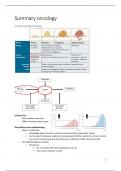
Lifetime risk
- Risk increases over time
- Differs amongst cancer types
Descriptive cancer epidemiology
- Why is it important
o Knowledge about trends in incidence and survival/mortality after cancer
o Can be used to develop, implement and evaluate effective policies for cancer control
(e.g. cancer screening, preventive measures, education health care personnel)
- Key epidemiological concepts
o Prevalence
▪ No. of people with cancer/population at risk
▪ At a certain moment in time
1
, ▪ E.g. 5-year prevalence at 1 January 2019 in the NL: all living cancer patients
who have been diagnoses in the previous 5 years in the NL
o Incidence
▪ No. of newly diagnosed cases of cancer/population at risk
▪ In a certain time period
▪ E.g. incidence in 2018 in the NL: number of newly diagnosed cancer cases in
2018 in the NL
▪ Number: absolute number of new cases in a certain period
▪ CR (crude rate): number of new cases per 100,000 persons per year
▪ ESR (European standardized rate): number of new cases per 100,000
persons per year, standardized for the age composition of Europe
▪ WSR (World standardized rate): number of new cases per 100,000 persons
per year, standardized for the age composition of the world
o Mortality
▪ No. of cases that died from cancer/population at risk
▪ In a certain time period
▪ E.g. mortality in 2018 in the NL: number of cases that died from cancer in
2018 in the NL
▪ Also expressed as number, CR, ESR, WSR (similar to incidence)
o Relative survival
▪ % of cancer cases alive/% of people of same age and sex expected to be
alive in the general population
▪ The percentage of cancer cases alive at a certain time period after diagnosis
(not including those who died from other diseases)
▪ E.g. 5-year relative survival: percentage of cancer cases who survived 5 years
Worldwide differences in cancer incidence
Cancer survival
- Depends on type of cancer and cancer stage
2
,Etiologic cancer epidemiology (risk factors)
- Age (most important)
o Time needed for accumulation of damage to daughter cells
o Mutations in regulatory genes
▪ Spontaneous
▪ Chemical substances
▪ Radiation
▪ Viruses
o Protective tools
▪ Repair of blueprint (DNA repair)
▪ Clean suicide (apoptosis)
▪ Mitosis stops (senescence)
o Cancer at older age
▪ Accumulation of damage/mutations in regulatory genes
▪ More damage to repair tools/repair tools less effective
▪ Less control by micro-environment
o ‘Grey’ pressure = number 65+ / number 20-64 → increasing
o Enormous public health problem
▪ Double ageing phenomenon → people have a longer life expectancy and we
get more elderly people → number of old people increases
▪ Better survival because of
• Early detection
• Improved treatment
▪ More expensive health care
• Diagnosis
• Treatment
▪ Focus on prevention!
- How to identify causes of cancer
o Accidental finding/keep alert
▪ Examples:
3
, • Nuns have high risk of breast cancer → high hormonal exposure
because they don’t get kids
• Radiology → X-ray related to cancer
• Radium poisoning of watch dial painters
o Systematic counting/trends
▪ Examples:
• Retinoblastoma → 1 hit/2 hit theory
• Migrant studies → environmental factors
are important
• Trend in melanoma → caused by more sun
exposure
o Focused research
▪ Human observational studies
• Design of a case-control study
• Design of a prospective cohort study
▪ Experimental studies
4
Cancer epidemiology
Lifetime risk
- Risk increases over time
- Differs amongst cancer types
Descriptive cancer epidemiology
- Why is it important
o Knowledge about trends in incidence and survival/mortality after cancer
o Can be used to develop, implement and evaluate effective policies for cancer control
(e.g. cancer screening, preventive measures, education health care personnel)
- Key epidemiological concepts
o Prevalence
▪ No. of people with cancer/population at risk
▪ At a certain moment in time
1
, ▪ E.g. 5-year prevalence at 1 January 2019 in the NL: all living cancer patients
who have been diagnoses in the previous 5 years in the NL
o Incidence
▪ No. of newly diagnosed cases of cancer/population at risk
▪ In a certain time period
▪ E.g. incidence in 2018 in the NL: number of newly diagnosed cancer cases in
2018 in the NL
▪ Number: absolute number of new cases in a certain period
▪ CR (crude rate): number of new cases per 100,000 persons per year
▪ ESR (European standardized rate): number of new cases per 100,000
persons per year, standardized for the age composition of Europe
▪ WSR (World standardized rate): number of new cases per 100,000 persons
per year, standardized for the age composition of the world
o Mortality
▪ No. of cases that died from cancer/population at risk
▪ In a certain time period
▪ E.g. mortality in 2018 in the NL: number of cases that died from cancer in
2018 in the NL
▪ Also expressed as number, CR, ESR, WSR (similar to incidence)
o Relative survival
▪ % of cancer cases alive/% of people of same age and sex expected to be
alive in the general population
▪ The percentage of cancer cases alive at a certain time period after diagnosis
(not including those who died from other diseases)
▪ E.g. 5-year relative survival: percentage of cancer cases who survived 5 years
Worldwide differences in cancer incidence
Cancer survival
- Depends on type of cancer and cancer stage
2
,Etiologic cancer epidemiology (risk factors)
- Age (most important)
o Time needed for accumulation of damage to daughter cells
o Mutations in regulatory genes
▪ Spontaneous
▪ Chemical substances
▪ Radiation
▪ Viruses
o Protective tools
▪ Repair of blueprint (DNA repair)
▪ Clean suicide (apoptosis)
▪ Mitosis stops (senescence)
o Cancer at older age
▪ Accumulation of damage/mutations in regulatory genes
▪ More damage to repair tools/repair tools less effective
▪ Less control by micro-environment
o ‘Grey’ pressure = number 65+ / number 20-64 → increasing
o Enormous public health problem
▪ Double ageing phenomenon → people have a longer life expectancy and we
get more elderly people → number of old people increases
▪ Better survival because of
• Early detection
• Improved treatment
▪ More expensive health care
• Diagnosis
• Treatment
▪ Focus on prevention!
- How to identify causes of cancer
o Accidental finding/keep alert
▪ Examples:
3
, • Nuns have high risk of breast cancer → high hormonal exposure
because they don’t get kids
• Radiology → X-ray related to cancer
• Radium poisoning of watch dial painters
o Systematic counting/trends
▪ Examples:
• Retinoblastoma → 1 hit/2 hit theory
• Migrant studies → environmental factors
are important
• Trend in melanoma → caused by more sun
exposure
o Focused research
▪ Human observational studies
• Design of a case-control study
• Design of a prospective cohort study
▪ Experimental studies
4