100% satisfaction guarantee Immediately available after payment Both online and in PDF No strings attached 4.6 TrustPilot
logo-home
Exam (elaborations)

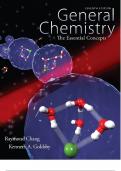
Test Bank For General Chemistry The Essential Concept 7Th Edition Raymond By Chang

Rating
-
Sold
-
Pages
398
Grade
A+
Uploaded on
23-09-2023
Written in
2022/2023

Chapter 01: Introduction 1. A tentative explanation for a set of observations that can be tested by further experimentation is referred to as A) a hypothesis. B) a law. C) a theory. D) none of the above. Ans: A Category: Easy Section: 1.2 2. A concise verbal or mathematical statement of a relationship between phenomena that is always the same under the same conditions is referred to as A) a hypothesis. B) a law. C) a theory. D) none of the above. Ans: B Category: Easy Section: 1.2 3. A unifying principle that explains a body of facts and relations is referred to as A) a hypothesis. B) a law. C) a theory. D) none of the above. Ans: C Category: Easy Section: 1.2 4. Complete the following sentence. A hypothesis is A) a tentative explanation for a set of observations that can be tested by further experimentation. B) a statement describing a relationship between phenomena that is always the same under the same conditions. C) a unifying principle that explains a body of facts and relations. D) a model used to visualize the invisible. Ans: A Category: Easy Section: 1.2 5. Complete the following sentence. A scientific law is A) a tentative explanation for a set of observations that can be tested by further experimentation. B) a statement describing a relationship between phenomena that is always the same under the same conditions. C) a unifying principle that explains a body of facts and relations. D) a model used to visualize the invisible. Ans: B Category: Easy Section: 1.2 6. Complete the following sentence. A theory is A) a tentative explanation for a set of observations that can be tested by further experimentation. B) a statement describing a relationship between phenomena that is always the same under the same conditions. C) a unifying principle that explains a body of facts and relations. D) a model used to visualize the invisible. Ans: C Category: Easy Section: 1.2 Page 1 Chapter 01: Introduction 7. Choose the response that includes all the items listed below that are pure substances. i. orange juice ii. steam iii. ocean water iv. oxygen v. vegetable soup A) i, iii, v B) ii, iv C) i, iii, iv D) iv only E) all of them are pure Ans: B Category: Easy Section: 1.2 8. Which of the following is an example of a physical property? A) corrosiveness of sulfuric acid B) toxicity of cyanide C) flammability of gasoline D) neutralization of stomach acid with an antacid E) lead becomes a liquid when heated to 601C Ans: E Category: Easy Section: 1.4 9. Which one of the following is an example of a physical property? A) dynamite explodes D) ice floats on top of liquid water B) meat rots if it is not refrigerated E) a silver platter tarnishes C) gasoline burns Ans: D Category: Easy Section: 1.4 10. Which one of the following represents a physical change? A) water, when heated to 100C, forms steam B) bleach turns hair yellow C) sugar, when heated, becomes brown D) milk turns sour E) apples, when exposed to air, turn brown Ans: A Category: Easy Section: 1.4 11. All of the following are properties of sodium. Which one is a physical property of sodium? A) It is a surface turns black when first exposed to air. B) It is a solid at 25C and changes to a liquid when heated to 98C. C) When placed in water it sizzles and a gas is formed. D) When placed in contact with chlorine it forms a compound that melts at 801C. E) Sodium is never found as the pure metal in nature. Ans: B Category: Easy Section: 1.4 12. All of the following are properties of tin. Which one is a chemical property of tin? A) Tin can be hammered into a thin sheet. B) At –40C a sheet of tin crumbles to a gray powder. C) Tin melts at 231.9C. D) When a bar of tin is bent, it emits an audible “cry”. E) Tin erodes when added to hydrochloric acid, and a clear gas forms. Ans: E Category: Medium Section: 1.4 Page 2 13. Which one of the following represents a chemical change? A) boiling water to form steam B) burning a piece of coal C) heating lead until it melts D) mixing iron filings and sand at room temperature E) breaking glass Ans: B Category: Medium Section: 1.4 14. Which of the following does not represent a chemical change? A) a freshly cut apple turns brown B) milk turns sour on standing at room temperature C) when cooled to 0C, liquid water becomes ice D) frying an egg E) fermentation of sugar to alcohol Ans: C Category: Easy Section: 1.4 15. The SI prefixes nano and deci represent, respectively: –9–6 9–6 Chapter 01: Introduction A) 10 and 10 . D) 10 and 10 . 6–3 –9–1 B) 10 and 10 . E) 10 and 10 . 3–3 C) 10 and 10 . Ans: E Category: Easy Section: 1.7 16. The SI prefixes milli and mega represent, respectively: 6–6 –39 A) 10 and 10 . D) 10 and 10 . –36 –6–3 B) 10 and 10 . E) 10 and 10 . 3–6 C) 10 and 10 . Ans: B Category: Easy Section: 1.7 17. The SI prefixes kilo and centi represent, respectively: 3–2 –62 A) 10 and 10 . D) 10 and 10 . 6–1 2–3 B) 10 and 10 . E) 10 and 10 . –3 –2 C) 10 and 10 . Ans: A Category: Easy 18. A nanometer corresponds to: A) 10– 2 meters. B) 10– 3 meters. C) 10– 6 meters. Ans: D Category: Easy Section: 1.7 Section: 1.7 D) E) 10– 9 meters. 10– 12 meters. D) 10– 9 liters. 19. A microliter corresponds to: A) 10– 2 liters. B) 10– 3 liters. C) 10– 6 liters. Ans: C Category: Easy Section: 1.7 E) 10– 12 liters. Page 3 20. 6.0 km is how many micrometers? A) 6.0106 μm D) B) 1.710–7 μm E) C) 6.0  109 μm Ans: C Category: Medium Section: 1.7 21. 2.4 km is how many millimeters? A) 2,400 mm D) B) 2.4104 mm E) C) 2.4  105 mm Ans: D Category: Medium Section: 1.7 1.710–4 μm 6.0  103 μm 2.4  106 mm 2.410–5 mm 22. How many milliliters is 0.005 L? A) 0.5 mL B) 5 mL C) 0.50 mL D) 0.000005 mL Ans: B Category: Medium Section: 1.7 E) 200 mL 23. Express 7,500 nm as picometers. A) 7.50 pm B) 75.0 pm C) 750 pm D) 7.5106 pm Ans: D Category: Medium Section: 1.7 Chapter 01: Introduction E) 7.51012 pm 24. The diameter of Earth is 12.7 Mm. Express this diameter in centimeters. A) 1.27105 cm B) 1.27106 cm C) 1.27  107 cm Ans: E Category: Medium D) 1.27108 cm E) 1.27109 cm Section: 1.7 25. In 1828, the diameter of the U.S. dime was changed to approximately 18 mm. What is this diameter when expressed in nanometers? A) 1.8109 nm B) 1.8107 nm C) 1.8  101 nm Ans: B Category: Medium D) 1.810–5 nm E) 1.810– 10 nm Section: 1.7 26. Which of the following represents the largest mass? A) 2.0102 mg B) 0.0010 kg C) 1.0  105 ng Ans: D Category: Medium D) 2.0102 cg E) 10.0 dg Section: 1.7 27. Lead melts at 601.0C. What temperature is this in oF? A) 302F B) 365F C) 1,050F D) 1,082F E) 1,114F Ans: E Category: Medium Section: 1.7 Page 4 Chapter 01: Introduction 28. The element gallium melts at 29.8C. What temperature is this in F? A) –54.1F B) –7.8F C) +13.5F D) +51.3F E) +85.6F Ans: E Category: Medium Section: 1.7 29. Many home freezers maintain a temperature of 0F. Express this temperature in C. A) –32C B) –18C C) 0C D) 18C E) 57.6C Ans: B Category: Medium Section: 1.7 30. The highest temperature ever recorded in Phoenix, Arizona, was 122F. Express this temperature in C. A) 50.0C B) 64.4C C) 67.8C D) 162.0C E) 219.6C Ans: A Category: Medium Section: 1.7 31. Dry ice (carbon dioxide) changes from a solid to a gas at –78.5C. What is this temperature in F? A) –173F B) –12.6F C) –109F D) –75.6F E) none of them are within 2F of the right answer Ans: C Category: Medium Section: 1.7 32. Liquid nitrogen boils at –195.8C. Express the boiling point of liquid nitrogen in kelvin. A) –469.0 K B) –77.4 K C) all temperatures are 0 K on the Kelvin scale D) 77.4 K E) 469.0 K Ans: D Category: Medium Section: 1.7 33. Liquid nitrogen boils at –195.8C. Express the boiling point of liquid nitrogen in F. A) –384.4F B) –352.4F C) –320.4F D) –140.8F E) –76.8F Ans: C Category: Medium Section: 1.7 34. Express the number 26.7 in scientific notation. A) 2.67  10–2 B) 2.67  10–1 C) 2.67  101 D) 2.67  102 E) 26.7 is already written in scientific notation Ans: C Category: Easy Section: 1.6 35. Express the number 0.000053 in scientific notation. A) 5.310-2 B) 5.310-3 C) 5.310-4 D) 5.310-5 E) 5.310-6 Ans: D Category: Easy Section: 1.6 Page 5 A) 2  10–2.00 B) 2.0  10–2.00 C) 1.96  10–2 Ans: C Category: Medium D) 1.97  10–2 E) 2.00  10–2 Section: 1.6 Chapter 01: Introduction 36. The number 1.050  109 has how many significant figures? A)2 B)3 C)4 D)9 E)13 Ans: C Category: Easy Section: 1.6 37. How many significant figures are there in 1.3070 g? A)6 B)5 C)4 D)3 E)2 Ans: B Category: Easy Section: 1.6 38. Express the fraction 1/23 as a decimal to 4 significant figures. A) 0.0434 B) 0.0435 C) 0.04347 D) 0.04348 E) 0.04350 Ans: D Category: Medium Section: 1.6 39. Express the fraction 1/51 in scientific notation to 3 significant figures. 40. After carrying out the following operations, how many significant figures are appropriate to show in the result? (13.7 + 0.027)  8.221 A)1 B)2 C)3 D)4 E)5 Ans: C Category: Medium Section: 1.6 41. How many significant figures does the result of the following operation contain? 8.52010  7.9 A)2 B)3 C)4 D)5 E)6 Ans: A Category: Easy Section: 1.6 42. How many significant figures does the result of the following sum contain? 8.5201 + 1.93 A)1 B)2 C)3 D)4 E)5 Ans: D Category: Easy Section: 1.6 43. How many significant figures does the result of the following sum contain? 8.520 + 2.7 A)1 B)2 C)3 D)4 E)5 Ans: C Category: Easy Section: 1.6 44. How many significant figures does the difference 218.7201 – 218.63 contain? A)1 B)2 C)3 D)5 E)7 Ans: A Category: Easy Section: 1.6 Page 6 A)1 B)2 C)3 D)4 E)5 Ans: C Category: Medium Section: 1.6 47. How many cubic inches are in 1.00 liter? A) 61.0 in3 B) 155 in3 C) 394 in3 D) 1.64104 in3 Ans: A Category: Medium Section: 1.7 48. Convert 500. milliliters to quarts. (1L = 1.06 qt) A) 1.88 qt B) 0.472 qt C) 0.528 qt D) 4.72105 qt Ans: C Category: Medium Section: 1.7 E) none of them E) 5.28105 qt A) 1.5108 km B) 1.5105 km C) 5.6  107 km Ans: A Category: Medium D) 1.710– 8 km E) 1.51011 km Section: 1.7 Chapter 01: Introduction 45. Do the indicated arithmetic and give the answer to the correct number of significant figures. (1.5  10–4  61.3) + 2.01 = A) 2.0192 B) 2.0 C) 2.019 D) 2.02 E) 2.019195 Ans: D Category: Medium Section: 1.6 46. When 7.02oC is converted to the Fahrenheit scale, how many significant figures are there in the F result? 49. A US barrel is 4.21 cubic feet. Express this volume in liters. A) 3.9910–5 L B) 1.9910–2 L C) 19.9 L D) 105 L E) 119 L Ans: E Category: Medium Section: 1.7 50. A barrel of oil contains 42.0 gallons. How many liters is this? (1L = 1.06 qt) A) 9.9 L B) 11 L C) 142 L D) 158 L E) 178 L Ans: D Category: Easy Section: 1.7 51. The average distance from Earth to the sun is 9.3  107 miles. How many kilometers is this? 52. What is the area, in square centimeters, of an 8.5 inch by 11 inch sheet of paper? A) 94 cm2 B) 240 cm2 C) 420 cm2 D) 6.0102 cm2 E) 1.2 104 cm2 Ans: D Category: Medium Section: 1.7 53. Suppose a house has a floor area of 2,250 square feet. What is this area in units of square centimeters? A) 2.42 cm2 B) 2.09  106 cm2 C) 5.02  104 cm2 Ans: B Category: Medium D) 6.86  104 cm2 E) 101 cm2 Section: 1.7 Page 7 A) 2.8510–9 km2 B) 2.85  10–6 km2 C) 285 km2 Ans: A Category: Medium D) 2.8510–4 km2 E) none of these B) 4.89 Gg C) 5.0510–9 Gg Ans: B Category: Medium E) 5.0510– 3 Gg Section: 1.7 Chapter 01: Introduction 54. What is the volume, in cubic inches, of a brick that is 4.0 in  2.7 in  8.0 in? A) 15 in3 B) 51 in3 C) 78 in3 D) 87 in3 E) 150 in3 Ans: D Category: Easy Section: 1.7 55. What is the volume, in cubic centimeters, of a brick that is 4.0 in  2.7 in  8.0 in? A) 5.3 cm3 B) 53 cm3 C) 87 cm3 D) 4.8102 cm3 E) 1.4103 cm3 Ans: E Category: Medium Section: 1.7 56. How many square kilometers are equivalent to 28.5 cm2? Section: 1.7 57. How many cubic centimeters are there in exactly one cubic meter? A) 110–6 cm3 B) 110–3 cm3 C) 110–2 cm3 Ans: E Category: Easy D) 1104 cm3 E) 1106 cm3 Section: 1.7 58. If a car has an EPA mileage rating of 30 miles per gallon, what is this rating in kilometers per liter? (1 L = 1.06 qt) A) 200 km/L B) 180 km/L C) 70 km/L D) 13 km/L E) 11 km/L Ans: D Category: Medium Section: 1.7 59. If the price of gasoline is $2.99 per U.S. gallon, what is the cost per liter? (1 L = 1.06 qt) A) $0.30/L B) $0.79/L C) $1.27/L D) $2.99/L E) $12.66/L Ans: B Category: Medium Section: 1.7 60. An aluminum beverage can contains 12.0 fluid ounces of liquid. Express this volume in liters. (1 fl oz = 29.6 mL) A) 4.0710-2 L B) 0.355 L C) 0.407 L D) 2.46 L E) 3.55102 L Ans: B Category: Easy Section: 1.7 61. 157.2  106 troy oz of silver were used in the United States in 1980. How many gigagrams is this? (1 troy oz = 31.1 g) A) 4.89  109 Gg D) 3.12 Gg 62. A piece of metal with a mass of 611 g is placed into a graduated cylinder that contains 25.1 mL of water, raising the water level to 56.7 mL. What is the density of the metal? A) 2.70 g/cm3 B) 7.13 g/cm3 C) 8.96 g/cm3 D) 10.5 g/cm3 E) 19.3 g/cm3 Ans: E Category: Medium Section: 1.7 Page 8 Chapter 01: Introduction 63. A piece of a metal alloy with a mass of 114 g was placed into a graduated cylinder that contained 25.0 mL of water, raising the water level to 42.5 mL. What is the density of the metal? A) 0.154 g/cm3 B) 0.592 g/cm3 C) 2.68 g/cm3 Ans: D Category: Medium Section: 1.7 64. A block of iron has a mass of 826 g. What is the mass of a block of magnesium that has the same volume as the block of iron? The following densities at 25C are provided: 333 magnesium, 1.7 g/cm ; graphite, 1.8 g/cm ; iron, 7.9 g/cm . A) 1,400 g B) 3,800 g C) 830 g D) 180 g E) none of them are within 10 g of the right answer. Ans: D Category: Medium Section: 1.7 65. A block of iron has a mass of 483 g. What is the mass of a block of graphite that has the same volume as the block of iron? The following densities at 25C are provided: 333 magnesium, 1.7 g/cm ; graphite, 1.8 g/cm ; iron, 7.9 g/cm . A) 110 g B) 2120 g C) 6870 g D) 34 g E) none of them are within 10 g of the right answer. Ans: A Category: Medium Section: 1.7 66. Calculate the mass of the air contained in a room that measures 2.50 m  5.50 m  3.00 m (density of air = 1.29 g/dm3 at 25C). A) 3.1310–5 g B) 32.0 kg C) 53.2 kg D) 53.2 g E) None of the above. Ans: C Category: Medium Section: 1.7 67. The density of lead is 11.4 g/cm3 at 25C. Calculate the volume occupied by 25.0 g of lead. A) 2.19 cm3 B) 0.456 cm3 C) 285 cm3 D) 1.24 cm3 E) 6.05 cm3 Ans: A Category: Easy Section: 1.7 3 68. Iron has a density of 7.86 g/cm . The volume occupied by 55.85 g of iron is A) 0.141 cm . 3 B) 7.11 cm . 3 C) 2.8 cm . Ans: B Category: Easy D) 439 cm . E) None of the above. 33 Section: 1.7 Page 9 D) 6.51 g/cm3 E) 7.25 g/cm3 Chapter 01: Introduction 69. Iridium is essentially tied with osmium for the distinction of being called the “densest 3 element” with a density of 22.5 g/cm . What would be the mass in pounds of a 1.0 ft  1.0 ft  1.0 ft cube of iridium? (1 lb = 453.6 g) A) 1.5 lb B) 5.2 lb C) 6.20 lb D) 1.4103 lb E) 6.4105 lb Ans: D Category: Medium Section: 1.7 3 70. Bromine is a red liquid at 25C. Its density is 3.12 g/cm . What is the volume of 28.1 g of liquid bromine? A) 87.7 cm3 B) 0.111 cm3 C) 9.01 cm3 Ans: C Category: Easy D) 28.1 cm3 E) None of the above. Section: 1.7 71. The Hope diamond weighs 44.0 carats. Determine the volume occupied by the diamond, given that its density is 3.5 g/cm3 at 20C, and that 1 carat = 0.200 g. A) 2.5 cm3 B) 0.40 cm3 C) 0.016 cm3 D) 63 cm3 E) 150 cm3 Ans: A Category: Medium Section: 1.7 72. What is the volume of a 2.5 g block of metal if its density is 4.75 g/cm3? A) 0.53 cm3 B) 1.9 cm3 C) 2.5 cm3 D) 4.75 cm3 E) 11.9 cm3 Ans: A Category: Easy Section: 1.7 3 73. The density of mercury is 13.6 g/cm . What is the mass in pounds of 1.0 gallons of mercury? (1 lb = 453.6 g; 1 gal = 3.785 L) A) 0.11 lb B) 30. lb C) 51 lb D) 83 lb E) 110 lb Ans: E Category: Medium Section: 1.7 3 74. The density of mercury is 13.6 g/cm . What volume (in quarts) is occupied by 100. g of Hg? (1 L = 1.06 qt) A) 144 qt B) 7.35 qt C) 7.79 qt D) 7.7910– 3 qt E) 1.4410– 4 qt Ans: D Category: Medium Section: 1.7 75. The "escape velocity" from Earth (the speed required to escape Earth's gravity) is 2.5  104 miles per hour. What is this speed in m/s? (1 mile = 1609 m) A) 4.210–3 m/s B) 6.9 m/s C) 4.2102 m/s Ans: D Category: Medium D) 1.1104 m/s E) 4.0  107 m/s Section: 1.7 76. Which of the following speeds is the greatest? (1 mile = 1609 m) A) 40 mi/h B) 2.0  105 mm/min C) 40 km/h Ans: A Category: Medium D) 0.74 km/min E) 400 m/min Section: 1.7 Page 10 A) 6.4103 lb B) 6.4104 lb C) 1.0  105 lb Ans: C Category: Difficult D) 4.7107 lb E) 4.7108 lb Section: 1.7 Chapter 01: Introduction 3 77. Iron has a density of 7.87 g/cm . What mass of iron would be required to cover a football playing surface of 120 yds 60 yds to a depth of 1.0 mm? (1 inch = 2.54 cm; 1 lb = 453.6 g) 78. Americans combined drive about 4.0109 miles per day and their vehicles get an average of 20 miles per gallon of fuel used. For each 1 kg of gasoline that is burned, about 3.0 kg of carbon dioxide are produced. How many kilograms of CO2 are emitted into the atmosphere each day by cars in the U.S.? One gallon of gas weighs about 3.5 kg. A) 2.1  109 kg B) 8.4  1011 kg C) 1.7  108 kg Ans: A Category: Difficult D) 93 kg E) none of these Section: 1.7 79. How many cubic centimeters of an ore containing only 0.22% gold (by mass) must be processed to obtain $100 worth of gold? The density of the ore is 8.0 g/cm3 and the price of gold is $818 per troy ounce. (14.6 troy oz = 1.0 ordinary pound, called an avoirdupois pound; 1 lb = 454 g) A) 0.48 cm3 B) 220 cm3 C) 1.4  103 cm3 Ans: B Category: Difficult 80. Radio waves travel at the speed of light, which is 3.00  108 m/s. How many minutes does it take for a radio message to reach Earth from Saturn if Saturn is 7.9  108 km from Earth? A) 4.4  10 –2 min D) 44 min B) 1.6  105 min E) 2.6 min C) 4.0  1015 min Ans: D Category: Medium Section: 1.7 81. Radio waves travel at the speed of light, which is 3.00  108 m/s. How many kilometers will radio messages travel in exactly one year? A) 9.46  1015 km D) B) 7.30108 km E) C) 7.10  1010 km Ans: D Category: Medium Section: 1.7 9.46  1012 km 3.3310– 3 km Section: 1.7 Page 11 D) 1.7  103 cm3 E) 1.8  104 cm3 Chapter 01: Introduction 82. The city of Los Angeles is now approximately 2400 miles south of Alaska. It is moving slowly northward as the San Andreas fault slides along. If Los Angeles is to arrive near Anchorage, Alaska, in 76 million years, at what average rate will it have to move in mm per month? A) 2.0  10 – 10 mm/mo. D) 9.5 mm/mo. B) 6.6  10 – 6 mm/mo. E) 51 mm/mo. C) 4.2 mm/mo. Ans: C Category: Medium Section: 1.7 83. The recommended daily allowance (RDA) of calcium is 1.2 g. Calcium carbonate contains 12.0% calcium by mass. How many grams of calcium carbonate are needed to provide the RDA of calcium? A) 0.10 g B) 0.14 g C) 1.2 g D) 10 g E) 14 g Ans: D Category: Medium Section: 1.7 84. The radius of the Earth is approximately 6370 km. If one could dig down straight towards the center of the Earth, one would find that the outermost 2890 km (the crust and 3 the mantle) has an average density of about 4.5 g/cm . Farther down is the core. If the 3 average density of the Earth is 5.5 g/cm , what is the average density of the Earth's core? 3 (Recall that the volume of a sphere is given by V = (4/3)r .) A) 11. g/cm3 B) 57. g/cm3 C) 6.2 g/cm3 Ans: A Category: Difficult D) 1.9 g/cm3 E) not enough data is provided Section: 1.7 85. The radius of the Earth is approximately 6370 km. If one could dig down straight towards the center of the Earth, one would find that the innermost 3480 km (the core) has 3 an average density of about 11. g/cm . Above that are the mantle and crust. If the 3 average density of the Earth is 5.5 g/cm , what is the average density of the Earth's 3 mantle and crust? (Recall that the volume of a sphere is given by V = (4/3)r .) A) 57. g/cm3 B) 4.5 g/cm3 C) 8.7 g/cm3 Ans: B Category: Difficult D) 5.3 g/cm3 E) not enough data is provided Section: 1.7 86. An object sinks when placed in water if the mass of the object is greater than the mass of the water that the object displaces. Which of the following objects will sink when dropped into a bucket of water? (Given: density of water = 1.00 g/cm3) A) a cube of aluminum (density = 2.702 g/cm3) B) a diamond (density = 3.51 g/cm3) C) a chunk of dry ice (density = 1.56 g/cm3) D) a chunk of sodium (density = 0.91 g/cm3) E) a sphere of magnesium (density = 1.74 g/cm3) Ans: D Category: Easy Section: 1.7 Page 12 A) 0.7894 g/mL B) 0.7923 g/mL C) 0.7908 g/mL Ans: A Category: Medium D) 1.303 g/mL E) 0.7674 g/mL Section: 1.7 Chapter 01: Introduction 87. An object will float at the surface of a liquid if the mass of the object is less than the mass of the liquid that it displaces. A spherical vessel (diameter = 2.00 cm) when empty has a mass of 2.00 g. What is the greatest volume of water that can be placed in the vessel and still have the vessel float at the surface of water? (Given: density of water = 1.00 g/cm3) A) 2.00 mL B) 31.5 mL C) 2.19 mL D) 4.19 mL E) the vessel will not float even when empty Ans: C Category: Difficult Section: 1.7 88. An object will float at the surface of a liquid if the mass of the object is less than the mass of the liquid that it displaces. A spherical vessel (diameter = 5.00 cm) when empty has a mass of 12.00 g. What is the greatest volume of water that can be placed in the vessel and still have the vessel float at the surface of benzene? (Given: density of water = 1.00 g/cm3; density of benzene = 0.879 g/cm3) A) 45.5 mL B) 448 mL C) 53.4 mL D) 57.5 mL E) 65.4 mL Ans: A Category: Difficult Section: 1.7 89. One of the common intravenous fluids, called physiological saline, is a homogeneous mixture of NaCl in water. In this mixture, 0.89% of the mass is contributed by the NaCl. What mass of NaCl is found in 450. mL of physiological saline? (Given: density of physiological saline = 1.005 g/cm3) A) 2.0 g B) 4.0 g C) 5.1 g D) 508 g E) 400 g Ans: B Category: Medium Section: 1.7 90. A special flask used in the determination of densities, called a pycnometer, has a mass of 16.3179 g when empty, and it has a mass of 48.0250 g when filled with water at 20.0C. When this same pycnometer is filled with ethyl alcohol at 20.0C, it is found to have a mass of 41.3934 g. Find the density of ethyl alcohol at 20.0C. (Given: at 20.0C, the density of water is 0.9982 g/mL) 91. A particular flask has a mass of 17.4916 g when empty. When filled with ordinary water at 20.0°C (density = 0.9982 g/mL), the mass of the flask is now 43.9616 g. The density of so-called “heavy water” at 20.0°C is 1.1053 g/mL. What will the mass of the flask be when filled with heavy water at 20.0°C? A) 29.2573 g B) 46.8016 g C) 46.7489 g D) 29.3100 g E) 43.9140 g Ans: B Category: Medium Section: 1.7 Page 13 Chapter 01: Introduction 92. Define matter. Ans: Matter is anything that occupies space and has mass. Category: Easy Section: 1.4 93. What are the three states of matter? Ans: Solid, liquid, and gas Category: Easy Section: 1.5 94. What are the common names for the three states of the compound water? Ans: Ice, water, and steam Category: Easy Section: 1.5 95. Define pure substance. Ans: Something that has a definite composition Category: Easy Section: 1.4 96. Give three examples of pure substances. Ans: (Answers will vary.) Gold, sugar, oxygen, argon, water, methane Category: Easy Section: 1.4 97. Define mixture. Ans: A mixture is a combination of two or more substances in which the substances retain their distinct identities. Category: Easy Section: 1.4 98. Name two types of mixtures. Ans: Homogeneous mixture and heterogeneous mixture Category: Easy Section: 1.4 99. Give three examples of mixtures. Ans: (Answers will vary.) Air, gasoline, sea water, salt and sand, iron filings and sand Category: Easy Section: 1.4 100. Define element. Ans: An element is a substance that cannot be separated into simpler substances by chemical means. Category: Easy Section: 1.4 101. Define compound. Ans: A compound is a substance composed of atoms of two or more elements chemically united in fixed proportions. Category: Easy Section: 1.4 Page 14 Chapter 01: Introduction 102. Give examples of three physical properties. Ans: (Answers will vary.) Melting point, boiling point, density, color Category: Easy Section: 1.4 103. Give an example of an extensive property. Ans: (Answers will vary.) Mass, length, and volume Category: Easy Section: 1.4 104. Give an example of an intensive property. Ans: (Answers will vary.) Temperature, density, melting point, boiling point Category: Easy Section: 1.4 105. Identify the following as a physical or chemical change: Bacteria convert milk to yogurt. Ans: Chemical Category: Easy Section: 1.4 106. Identify the following as a physical or chemical change: Water is broken down into hydrogen and oxygen. Ans: Chemical Category: Easy Section: 1.4 107. Identify the following as a physical or chemical change: Formation of snowflakes. Ans: Physical Category: Easy Section: 1.4 108. Identify the following as a physical or chemical change: Rusting of a piece of iron. Ans: Chemical Category: Easy Section: 1.4 109. Identify the following as a physical or chemical change: Ripening of fruit. Ans: Chemical Category: Easy Section: 1.4 110. Identify the following as a physical or chemical change: Fashioning a table leg from a piece of wood. Ans: Physical Category: Easy Section: 1.4 111. Identify the following as a physical or chemical change: Fermenting grapes. Ans: Chemical Category: Easy Section: 1.4 Page 15 Chapter 01: Introduction 112. Classify the following as a physical or chemical change: Antifreeze boils out of a radiator. Ans: Physical Category: Easy Section: 1.4 113. Classify the following as a physical or chemical change: Food spoils. Ans: Chemical Category: Easy Section: 1.4 114. Classify the following as a physical or chemical change: Alcohol evaporates. Ans: Physical Category: Easy Section: 1.4 115. Classify the following as either a physical or a chemical property: Ice melts at 0oC. Ans: Physical Category: Easy Section: 1.4 116. Classify the following as either a physical or a chemical property: Newspaper burns. Ans: Chemical Category: Easy Section: 1.4 117. Classify the following as either a physical or a chemical property: The vitamin content of foods in contact with air falls. Ans: Chemical Category: Easy Section: 1.4 118. Classify the following as a pure substance or a mixture: Ice cream. Ans: Mixture Category: Easy Section: 1.4 119. Classify the following as a pure substance or a mixture: Bread. Ans: Mixture Category: Medium Section: 1.4 120. Classify the following as a pure substance or a mixture: Seven-Up®. Ans: Mixture Category: Easy Section: 1.4 121. Classify the following as an element, a compound, or a mixture: Air. Ans: Mixture Category: Easy 122. Classify the following as an element, a compound, or a mixture: Table salt (non-iodized). Ans: Compound Category: Medium Page 16 Chapter 01: Introduction 123. Classify the following as an element, a compound, or a mixture: Chicken broth. Ans: Mixture Category: Easy 124. Classify the following as an element, a compound, or a mixture: Oxygen gas. Ans: Element Category: Easy 125. Classify the following as a mixture, a compound, or an element: Brewed coffee, ready to drink. Ans: Mixture Category: Easy Section: 1.4 126. Classify the following as a mixture, a compound, or an element: Sugar to put in a cup of coffee. Ans: Compound Category: Easy Section: 1.4 127. Classify the following as a mixture, a compound, or an element: Orange juice. Ans: Mixture Category: Easy Section: 1.4 128. A pure yellow crystalline substance, when heated in a vacuum, releases a greenish gas and a red powder. Is the original yellow crystalline substance a compound or element? Ans: Compound Category: Medium Section: 1.4 129. In the process of fixing breakfast you: 1. break open the egg 2. fry it 3. cut the fried egg into pieces 4. toast a slice of bread 5. cut the toast in half Which of these are chemical processes? Ans: 2 (frying the egg) and 4 (toasting the bread) Category: Medium Section: 1.4 3 130. An organic liquid has a density of 0.8 g/cm . What is the mass of a 42.0 mL sample of this liquid? Ans: 30 g Category: Easy Section: 1.7 131. What is the density of copper if 11.8 cm3 of copper has a mass of 105.2 g? Ans: 8.92 g/cm3 Category: Easy Section: 1.7 Page 17 Chapter 01: Introduction 3 132. An automobile engine has a piston displacement of 1,600 cm . Express this volume in liters. Ans: 1.6 L Category: Easy Section: 1.7 3 133. An automobile engine has a piston displacement of 1,600 cm . Express this volume in cubic inches. (1 in = 2.54 cm) Ans: 98 in3 Category: Easy Section: 1.7 134. An investor paid market price for a chunk of gold that he was told was pure. The gold bar had a mass of 440 g, but was slightly irregular so an exact volume could not be calculated. The investor filled a large graduated cylinder with water, immersed the chunk of gold, and observed an increase in the apparent volume of material in the graduated 3 cylinder of 25.0 mL. Pure gold has a density of 19.3 g/cm . Did the investor get her money's worth? Why or why not? Ans: No. The investor's metal density is 17.6 g/cm , thus the bar must not be pure gold. Category: Medium Section: 1.7 135. An American engineer who had been transferred to Europe was asked to build bridge pilings exactly as he had in the United States. Each piling required 20.0 cubic yards of concrete in the United States. How many cubic meters of concrete are required for each piling? Given: 1 yd = 0.914 m. Ans: 15.3 m3 Category: Medium Section: 1.7 136. A soft drink costs 75 cents for a 12-oz can. A two-liter bottle costs $1.25. In which form is the soft drink more expensive? How much more expensive? (1.0 L = 1.057 qt, 1 qt = 32 oz) Ans: The two-liter bottle is the better value. The can is over three times more expensive by volume. Category: Medium Section: 1.7 137. A person weighs 150 lb, and the correct dosage of a drug is given as 1.50 mg per kilogram of body weight. How many milligrams of the drug should be given? (2.20 lb = 1 kg) Ans: 102 mg Category: Medium Section: 1.7 Page 18 3 Chapter 01: Introduction 138. You just measured a block of wood and obtained the following information: mass = 55.120 g length = 8.5 cm height = 4.3 cm width = 3.3 cm Determine the volume and density of the wood block. 33 Ans: Volume of the wood block = 120 cm ; density of the wood block = 0.46 g/cm . Category: Medium Section: 1.7 139. You just measured a metal cylinder and obtained the following information: mass = 3.543 g diameter = 0.53 cm height = 4.4 cm Determine the volume (V) and density of the cylinder. (V=r2 h, where r = radius, h = height,  = 3.14) Ans: Volume of the cylinder = 0.97 cm ; density of the cylinder = 3.7 g/cm . Category: Medium Section: 1.7 140. You just measured a sugar cube and obtained the following information: mass = 3.48 g height = length = width = 1.3 cm Determine the volume and density of the cube. Suppose the sugar cube was added to a cup of water. Before it dissolves, will the sugar cube float or sink to the bottom? 33 Ans: Volume of the sugar cube = 2.2 cm ; density of the sugar cube = 1.6 g/cm . Before dissolving, the sugar cube will sink in a cup of water. Category: Medium Section: 1.7 141. An archeologist finds a huge monolith in the desert. In order to estimate the weight of this object; he estimates the dimensions of the monolith and removes some chips from the rock with his hammer, collecting the following data: dimensions of the monolith = 1.5 m  5.2 m  13 m mass of rock chips = 41.73 g volume of rock chips = 15.2 cm3 Determine the mass of the monolith in pounds, assuming it is of uniform composition. (1 lb = 453.6 g) Ans: 6.1  105 lb Category: Difficult Section: 1.7 142. What is the density of a salt solution if 50.0 mL of the solution has a mass of 57.0 g? Ans: 1.14 g/mL Category: Easy Section: 1.7 33 Page 19 Chapter 01: Introduction 143. An excavator is preparing to dig a basement for a new house. Part of his contract reads that he must dispose of all the dirt he removes while digging the basement in an EPA approved landfill. He will dig a hole that is 40 feet wide by 50 feet long and 7.5 feet deep. He first uses his shovel and scoops up 1.00 kg of dirt, and then determines that the dirt 3 has a volume of 600 cm . The excavator knows that his dump truck can only carry 8,000 kg of dirt. How many dump-truck loads will it take to haul the dirt away? Ans: 89 dump-truck loads Category: Difficult Section: 1.7 144. How many significant figures does the number 30.340 contain? Ans: 5 Category: Easy Section: 1.6 145. How many significant figures does the number 0.00721 contain? Ans: 3 Category: Easy Section: 1.6 146. The number 9.64870  105 contains how many significant figures? Ans: 6 Category: Easy Section: 1.6 147. What will be the cost of gasoline for a 3,700-mile trip in a car that gets 23 miles per gallon, if the average price of gas is $2.90 per gallon? Ans: $470 Category: Medium Section: 1.7 148. What will be the cost of gasoline for a 4,700-mile automobile trip if the car gets 41 miles per gallon, and the average price of gas is $2.79 per gallon? Ans: $320 Category: Medium Section: 1.7 149. The volume of a sphere is given by V = (4/3)r3 where r is the radius. What is the mass of a magnesium sphere with a radius of 0.80 cm? (The density of magnesium is 1.74 3 g/cm .) Ans: 3.7 g Category: Medium Section: 1.7 3 150. The density of lead is 11.4 g/cm . Express this density in pounds per cubic foot. Ans: 711 lbs/ft3 Category: Medium Section: 1.7 33 151. What is the mass of 1.00 dm of mercury? The density of mercury is 13.6 g/cm . Ans: 1.36104g Category: Medium Section: 1.7 Page 20 Chapter 01: Introduction 152. The weight of a body varies according to the force of gravity exerted on the body. Ans: True Category: Medium Section: 1.7 153. The mass of a body varies according to the force of gravity exerted on the body. Ans: False Category: Medium Section: 1.7 154. The SI base unit of length is the centimeter. Ans: False Category: Easy Section: 1.7 155. Mass, length, and volume are extensive properties, but density is an intensive property. Ans: True Category: Easy Section: 1.4 156. 20oC is colder than 40F. Ans: False Category: Medium Section: 1.7 157. 16 megagrams (Mg) is equal to 1.6  107 g. Ans: True Category: Easy Section: 1.7 158. The conversion of water into steam is an example of a chemical change. Ans: False Category: Easy Section: 1.4 Page 21 Chapter 02: Atoms Molecules and Ions A periodic table is required to work many of the problems in this chapter. 1. In a cathode ray tube A) electrons pass from the anode to the cathode. B) electrons pass from the cathode to the anode. C) protons pass from the anode to the cathode. D) protons pass from the cathode to the anode. Ans: B Category: Medium Section: 2.2 2. The elements in a column of the periodic table are known as A) metalloids. B) a period. C) noble gases. D) a group. E) nonmetals. Ans: D Category: Easy Section: 2.4 3. Which of the following elements is most likely to be a good conductor of electricity? A)N B)S C)He D)Cl E)Fe Ans: E Category: Easy Section: 2.4 4. An anion is defined as A) a charged atom or group of atoms with a net negative charge. B) a stable atom. C) a group of stable atoms. D) an atom or group of atoms with a net positive charge. Ans: A Category: Easy Section: 2.5 5. The scientist who determined the magnitude of the electric charge of the electron was A) John Dalton. B) Robert Millikan. C) J. J. Thomson. Ans: B Category: Easy D) Henry Moseley. E) R. Chang. Section: 2.2 6. When J. J. Thomson discovered the electron, what physical property of the electron did he measure? A) its charge, e D) its mass, m B) its charge-to-mass ratio, e/m E) its atomic number, Z C) its temperature, T Ans: B Category: Easy Section: 2.2 7. Which of the following scientists developed the nuclear model of the atom? A) John Dalton B) Robert Millikan C) J. J. Thomson Ans: E Category: Easy D) Henry Moseley E) Ernest Rutherford Section: 2.2 Page 23 Chapter 02: Atoms, Molecules, and Ions 8. Rutherford's experiment with alpha particle scattering by gold foil established that A) protons are not evenly distributed throughout an atom. B) electrons have a negative charge. C) electrons have a positive charge. D) atoms are made of protons, neutrons, and electrons. E) protons are 1840 times heavier than electrons. Ans: A Category: Medium Section: 2.2 9. Atoms of the same element with different mass numbers are called A) ions. B) neutrons. C) allotropes. D) chemical families. E) isotopes. Ans: E Category: Easy Section: 2.3 10. How many neutrons are there in an atom of uranium whose mass number is 235? A)92 B)143 C)235 D)238 E)327 Ans: B Category: Easy Section: 2.3 11. How many protons are there in an atom of uranium whose mass number is 235? A)92 B)143 C)235 D)238 E)327 Ans: A Category: Easy Section: 2.3 12. An atom of the isotope chlorine-37 consists of how many protons, neutrons, and electrons? (p = proton, n = neutron, e = electron) A) 17 p, 18.45 n, 17 e B) 17 p, 20 n, 7 e C) 17 p, 20 n, 17 e Ans: C Category: Medium D) 17 p, 37 n, 17 e E) 20 p, 17 n, 20 e Section: 2.3 13. Give the number of protons (p), electrons (e), and neutrons (n) in one atom of nickel-62. A) 28 p, 28 e, 28 n B) 28 p, 28 e, 34 n C) 28 p, 28 e, 62 n Ans: B Category: Medium D) 62 p, 28 e, 28 n E) 62 p, 62 e, 28 n Section: 2.3 14. Which one of the following is an ion? A) B3+ B) NaCl C) He D) 14C E) none of the above Ans: A Category: Easy Section: 2.5 15. Which one of the following elements is most likely to form a 2+ ion? A) beryllium B) carbon C) fluorine D) oxygen E) sodium Ans: A Category: Medium Section: 2.5 16. Which one of the following elements is most likely to form a 2– ion? A) scandium B) selenium C) silicon D) strontium E) iodine Ans: B Category: Medium Section: 2.5

Show more Read less


Whoops! We can’t load your doc right now. Try again or contact support.

Document information

Uploaded on
September 23, 2023
Number of pages
398
Written in
2022/2023
Type
Exam (elaborations)
Contains
Questions & answers

Subjects

Content preview

,Chapter 01: Introduction
1. A tentative explanation for a set of observations that can be tested by further
experimentation is referred to as
A) a hypothesis. B) a law. C) a theory. D) none of the above.
Ans: A Category: Easy Section: 1.2

2. A concise verbal or mathematical statement of a relationship between phenomena that is
always the same under the same conditions is referred to as
A) a hypothesis. B) a law. C) a theory. D) none of the above.
Ans: B Category: Easy Section: 1.2

3. A unifying principle that explains a body of facts and relations is referred to as
A) a hypothesis. B) a law. C) a theory. D) none of the above.
Ans: C Category: Easy Section: 1.2

4. Complete the following sentence. A hypothesis is
A) a tentative explanation for a set of observations that can be tested by further
experimentation.
B) a statement describing a relationship between phenomena that is always the same
under the same conditions.
C) a unifying principle that explains a body of facts and relations.
D) a model used to visualize the invisible.
Ans: A Category: Easy Section: 1.2

5. Complete the following sentence. A scientific law is
A) a tentative explanation for a set of observations that can be tested by further
experimentation.
B) a statement describing a relationship between phenomena that is always the same
under the same conditions.
C) a unifying principle that explains a body of facts and relations.
D) a model used to visualize the invisible.
Ans: B Category: Easy Section: 1.2

6. Complete the following sentence. A theory is
A) a tentative explanation for a set of observations that can be tested by further
experimentation.
B) a statement describing a relationship between phenomena that is always the same
under the same conditions.
C) a unifying principle that explains a body of facts and relations.
D) a model used to visualize the invisible.
Ans: C Category: Easy Section: 1.2


Page 1

, Chapter 01: Introduction


7. Choose the response that includes all the items listed below that are pure substances.
i. orange juice ii. steam iii. ocean water iv. oxygen v. vegetable soup
A) i, iii, v B) ii, iv C) i, iii, iv D) iv only E) all of them are pure
Ans: B Category: Easy Section: 1.2

8. Which of the following is an example of a physical property?
A) corrosiveness of sulfuric acid
B) toxicity of cyanide
C) flammability of gasoline
D) neutralization of stomach acid with an antacid
E) lead becomes a liquid when heated to 601C
Ans: E Category: Easy Section: 1.4

9. Which one of the following is an example of a physical property?
A) dynamite explodes D) ice floats on top of liquid water
B) meat rots if it is not refrigerated E) a silver platter tarnishes
C) gasoline burns
Ans: D Category: Easy Section: 1.4

10. Which one of the following represents a physical change?
A) water, when heated to 100C, forms steam
B) bleach turns hair yellow
C) sugar, when heated, becomes brown
D) milk turns sour
E) apples, when exposed to air, turn brown
Ans: A Category: Easy Section: 1.4

11. All of the following are properties of sodium. Which one is a physical property of
sodium?
A) It is a surface turns black when first exposed to air.
B) It is a solid at 25C and changes to a liquid when heated to 98C.
C) When placed in water it sizzles and a gas is formed.
D) When placed in contact with chlorine it forms a compound that melts at 801C.
E) Sodium is never found as the pure metal in nature.
Ans: B Category: Easy Section: 1.4

12. All of the following are properties of tin. Which one is a chemical property of tin?
A) Tin can be hammered into a thin sheet.
B) At –40C a sheet of tin crumbles to a gray powder.
C) Tin melts at 231.9C.
D) When a bar of tin is bent, it emits an audible “cry”.
E) Tin erodes when added to hydrochloric acid, and a clear gas forms.
Ans: E Category: Medium Section: 1.4


Page 2

, Chapter 01: Introduction


13. Which one of the following represents a chemical change?
A) boiling water to form steam
B) burning a piece of coal
C) heating lead until it melts
D) mixing iron filings and sand at room temperature
E) breaking glass
Ans: B Category: Medium Section: 1.4

14. Which of the following does not represent a chemical change?
A) a freshly cut apple turns brown
B) milk turns sour on standing at room temperature
C) when cooled to 0C, liquid water becomes ice
D) frying an egg
E) fermentation of sugar to alcohol
Ans: C Category: Easy Section: 1.4

15. The SI prefixes nano and deci represent, respectively:
A) 10– 9 and 10– 6. D) 109 and 10– 6.
6 –3
B) 10 and 10 . E) 10– 9 and 10– 1.
C) 103 and 10– 3.
Ans: E Category: Easy Section: 1.7

16. The SI prefixes milli and mega represent, respectively:
A) 106 and 10– 6. D) 10– 3 and 109.
B) 10– 3 and 106. E) 10– 6 and 10– 3.
3 –6
C) 10 and 10 .
Ans: B Category: Easy Section: 1.7

17. The SI prefixes kilo and centi represent, respectively:
A) 103 and 10– 2. D) 10– 6 and 102.
B) 106 and 10– 1. E) 102 and 10– 3.
–3 –2
C) 10 and 10 .
Ans: A Category: Easy Section: 1.7

18. A nanometer corresponds to:
A) 10– 2 meters. D) 10– 9 meters.
–3
B) 10 meters. E) 10– 12 meters.
C) 10– 6 meters.
Ans: D Category: Easy Section: 1.7

19. A microliter corresponds to:
A) 10– 2 liters. B) 10– 3 liters. C) 10– 6 liters. D) 10– 9 liters. E) 10– 12 liters.
Ans: C Category: Easy Section: 1.7


Page 3

Get to know the seller

Seller avatar
Reputation scores are based on the amount of documents a seller has sold for a fee and the reviews they have received for those documents. There are three levels: Bronze, Silver and Gold. The better the reputation, the more your can rely on the quality of the sellers work.
ExamsExpert (self)
View profile
Follow You need to be logged in order to follow users or courses
Sold
628
Member since
2 year
Number of followers
313
Documents
2838
Last sold
6 days ago
ExamsExpert

We as a team provide best and Latest Test Banks that helps students to get A Grade we have vast range of test banks you can order us any test bank that you need

4.5

87 reviews

5
60
4
15
3
9
2
1
1
2

Recently viewed by you

Why students choose Stuvia

Created by fellow students, verified by reviews

Quality you can trust: written by students who passed their exams and reviewed by others who've used these revision notes.

Didn't get what you expected? Choose another document

No problem! You can straightaway pick a different document that better suits what you're after.

Pay as you like, start learning straight away

No subscription, no commitments. Pay the way you're used to via credit card and download your PDF document instantly.

Student with book image

“Bought, downloaded, and smashed it. It really can be that simple.”

Alisha Student

Frequently asked questions