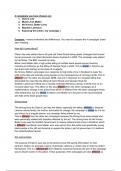
Exploration and Absolutism Test 2023 with complete
solution
Prince Henry the Navigator
Founded a navigation school in Sagres, Portugal; had idea to sail around Africa to reach
Asia
Bartholomeo Dias
Portugese, reached Cape of Good Hope (tip of Africa) in 1488
Vasco da Gama
Portugese, reaches India in 1497
Ferdinand Magellan
Spanish, First voyage to circumnavigate the globe, 1519-1522
Hernando Cortes
Spaniard who conquered the Aztec Empire
Francisco Pizarro
Spaniard who subdued the Incas and became the 1st governor of Peru
Encomedia System
System similar to feudalism set up by the Spanish to maintain order in their New World
Colonies
Line of Demarcation
1493, imaginary line that divided South America into West (Spain) and East (Portugal)
Treaty of Tordesillas
1494, Papal decree that set the Line of Demarcation
Jacques Cartier
explores Canada and St. Lawrence Basin
Samuel de Champlain
establishes Quebec in 1608
John Cabot
English explorer who claimed Newfoundland for England while looking for Northwest
Passage
Privateering
a system by which privately-owned and operated vessels were used to raid enemy
shipping (legal piracy)
Mercantilism
colonies exist to provide raw materials; exports must exceed imports; system is reliant
on massive imports of gold and silver; Problem: leads to massive inflation in mother
country
Salutary Neglect
English policy that allowed for independent economic development in their colonies
Triangular Trade
A three way system of trade during 1600-1800s; Aferica sent slaves to America,
America sent Raw Materials to Europe, and Europe sent Guns and Rum to Africa
Columbian Exchange
Transfer of products, ideas, and customs from old to new worlds and vice versa
Cardinal Richelieu
solution
Prince Henry the Navigator
Founded a navigation school in Sagres, Portugal; had idea to sail around Africa to reach
Asia
Bartholomeo Dias
Portugese, reached Cape of Good Hope (tip of Africa) in 1488
Vasco da Gama
Portugese, reaches India in 1497
Ferdinand Magellan
Spanish, First voyage to circumnavigate the globe, 1519-1522
Hernando Cortes
Spaniard who conquered the Aztec Empire
Francisco Pizarro
Spaniard who subdued the Incas and became the 1st governor of Peru
Encomedia System
System similar to feudalism set up by the Spanish to maintain order in their New World
Colonies
Line of Demarcation
1493, imaginary line that divided South America into West (Spain) and East (Portugal)
Treaty of Tordesillas
1494, Papal decree that set the Line of Demarcation
Jacques Cartier
explores Canada and St. Lawrence Basin
Samuel de Champlain
establishes Quebec in 1608
John Cabot
English explorer who claimed Newfoundland for England while looking for Northwest
Passage
Privateering
a system by which privately-owned and operated vessels were used to raid enemy
shipping (legal piracy)
Mercantilism
colonies exist to provide raw materials; exports must exceed imports; system is reliant
on massive imports of gold and silver; Problem: leads to massive inflation in mother
country
Salutary Neglect
English policy that allowed for independent economic development in their colonies
Triangular Trade
A three way system of trade during 1600-1800s; Aferica sent slaves to America,
America sent Raw Materials to Europe, and Europe sent Guns and Rum to Africa
Columbian Exchange
Transfer of products, ideas, and customs from old to new worlds and vice versa
Cardinal Richelieu