Rachel Aubrey
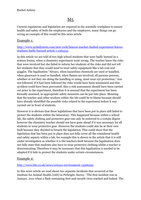
M5
Current regulations and legislation are required in the scientific workplace to ensure
health and safety of both the employees and the employers, many things can go
wrong an example of this would be this news article
Example 1:
http://www.nydailynews.com/new-york/beacon-teacher-faulted-experiment-leaves-
students-badly-burned-article-1.1565533
In this article we are told of two high school students that were badly burned in a
science lesson, when a chemistry experiment went wrong. The teacher knew the risks
that were involved but she failed to inform her students of the risks and did not tell
her students that they would need to wear safety equipment like a lab coat and
goggles. The legalisation “Always, when hazardous chemicals are used or handled,
when glassware is used or handled, when flames are involved, all persons present,
whether or not they are doing the handling or using, must wear eye protection,” was
not followed, if it had been followed the risks would have been minimised and this
accident could have been prevented. Also a risk assessment should have been carried
out prior to the experiment, therefore it is assured that the experiment has been
formally assessed, so appropriate safety measures can be put into place. Meaning
that the teacher and other workers within the lab could be to blame because should
have already identified the possible risks related to the experiment before it was
carried out in front of students.
However it is obvious that these legislations that have been put in place still failed to
protect the students within the laboratory. This happened because within a school
lab, the safety clothing and protective gear can only be enforced to a certain degree
however the chemistry teacher should not have gone ahead if it was necessary for all
students to wear protective gear. However the students could also be at their own
fault because they decided to breach the legislation. This could show that the
legislation that has been put in place does not fully cover all the considered health
and safety aspects within a lab, for example this is shown in the article that it is still
under investigation as whether it is the teachers fault because the legalisation does
not fully state that students also have to wear protective clothing whilst a teacher is
demonstrating. Therefore it may be necessary that this legalisation is needed to be
adapted if it fails to protect the students under certain circumstances.
Example 2:
http://www.bbc.co.uk/news/science-environment-13566593
In this news article we read about two separate incidents that occurred at the
Institute for Animal Health (IAH) in Pirbright, Surrey. “The first incident was in
January, 2011 when a flask containing foot-and-mouth virus cracked and leaked. The
M5
Current regulations and legislation are required in the scientific workplace to ensure
health and safety of both the employees and the employers, many things can go
wrong an example of this would be this news article
Example 1:
http://www.nydailynews.com/new-york/beacon-teacher-faulted-experiment-leaves-
students-badly-burned-article-1.1565533
In this article we are told of two high school students that were badly burned in a
science lesson, when a chemistry experiment went wrong. The teacher knew the risks
that were involved but she failed to inform her students of the risks and did not tell
her students that they would need to wear safety equipment like a lab coat and
goggles. The legalisation “Always, when hazardous chemicals are used or handled,
when glassware is used or handled, when flames are involved, all persons present,
whether or not they are doing the handling or using, must wear eye protection,” was
not followed, if it had been followed the risks would have been minimised and this
accident could have been prevented. Also a risk assessment should have been carried
out prior to the experiment, therefore it is assured that the experiment has been
formally assessed, so appropriate safety measures can be put into place. Meaning
that the teacher and other workers within the lab could be to blame because should
have already identified the possible risks related to the experiment before it was
carried out in front of students.
However it is obvious that these legislations that have been put in place still failed to
protect the students within the laboratory. This happened because within a school
lab, the safety clothing and protective gear can only be enforced to a certain degree
however the chemistry teacher should not have gone ahead if it was necessary for all
students to wear protective gear. However the students could also be at their own
fault because they decided to breach the legislation. This could show that the
legislation that has been put in place does not fully cover all the considered health
and safety aspects within a lab, for example this is shown in the article that it is still
under investigation as whether it is the teachers fault because the legalisation does
not fully state that students also have to wear protective clothing whilst a teacher is
demonstrating. Therefore it may be necessary that this legalisation is needed to be
adapted if it fails to protect the students under certain circumstances.
Example 2:
http://www.bbc.co.uk/news/science-environment-13566593
In this news article we read about two separate incidents that occurred at the
Institute for Animal Health (IAH) in Pirbright, Surrey. “The first incident was in
January, 2011 when a flask containing foot-and-mouth virus cracked and leaked. The