Orbital region
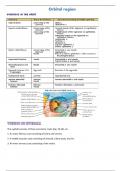
The eyeball consists of three concentric coats (Fig. 19.19), viz.
1. An outer fibrous coat consisting of sclera and cornea.
2. A middle vascular coat consisting of choroid, ciliary body, and iris.
3. An inner nervous coat consisting of the retina.
, outer fibrous coat of the eyeball
Content Functions Features
Sclera 1. Helps to maintain the shape of the eyeball.
2. Protects internal structures.
3. Provides attachment to muscles that move the
eyeball.
Cornea 1. It is avascular and nourished by permeation of nutrients
from loops of capillaries at the limbus, aqueous humour,
and lacrimal fluid.
2. It not only permits the light to enter the eye but also
reflects the entering light.
3. It is highly sensitive and supplied by the ophthalmic
division of trigeminal nerve.
4. The nerves of cornea form the afferent limb of the corneal
reflex (closure of the eyelids on stimulation of the cornea).
middle vascular coat of eyeball
The middle coat is often called vascular coat because it contains most of the blood vessels of the eyeball. It is
frequently known as uveal tract by the clinicians. This coat also contains a large number of melanin-containing
cells. It consists of three parts; from behind forwards these are: choroid, ciliary body, and iris. These three
parts together form uvea or uveal tract.
The eyeball consists of three concentric coats (Fig. 19.19), viz.
1. An outer fibrous coat consisting of sclera and cornea.
2. A middle vascular coat consisting of choroid, ciliary body, and iris.
3. An inner nervous coat consisting of the retina.
, outer fibrous coat of the eyeball
Content Functions Features
Sclera 1. Helps to maintain the shape of the eyeball.
2. Protects internal structures.
3. Provides attachment to muscles that move the
eyeball.
Cornea 1. It is avascular and nourished by permeation of nutrients
from loops of capillaries at the limbus, aqueous humour,
and lacrimal fluid.
2. It not only permits the light to enter the eye but also
reflects the entering light.
3. It is highly sensitive and supplied by the ophthalmic
division of trigeminal nerve.
4. The nerves of cornea form the afferent limb of the corneal
reflex (closure of the eyelids on stimulation of the cornea).
middle vascular coat of eyeball
The middle coat is often called vascular coat because it contains most of the blood vessels of the eyeball. It is
frequently known as uveal tract by the clinicians. This coat also contains a large number of melanin-containing
cells. It consists of three parts; from behind forwards these are: choroid, ciliary body, and iris. These three
parts together form uvea or uveal tract.