Biology Spec Led Revision Booklet
Chapter 18 - Neural Communication
Neurones generate and transmit electrical impulses, organised in a way to give us senses,
coordinated moment, memories, logic and intelligence.
The coordination of different organs and systems in the body requires a communication system
too. For example during exercise the muscle cells being used require more oxygen and glucose to
perform more respiration to increase levels of ATP. The cells themselves need to use the neural
communication system to instruct the heart to increase the heart rate to increase the flow of
oxygenated blood around the body, and the lungs need to be instructed to obtain more oxygen
from the air by dilating the alveoli decreasing the distance of exchange between the oxygen and
blood intaking more oxygen in.
Communication
• Multicellular organisms require a constant internal environment for processes to occur effectively.
This requires extensive communication between detectors and effectors.
• Cell signalling is the process by which one or a group of cells communicate to a different (set of)
cells.
• A living organism must act as a integrated whole
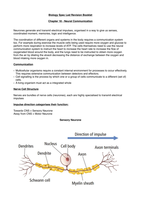
Nerve Cell Structure
Nerves are bundles of nerve cells (neurones), each are highly specialised to transmit electrical
impulses
Impulse direction categorises their function:
Towards CNS = Sensory Neurone
Away from CNS = Motor Neurone
Sensory Neurone
, Motor Neurone
Comparisons between motor and sensory neurones
Motor Neurone Sensory Neurone
Cell body is at one end of the cell Cell body is not at the end of the cell
Cell body has dendrites Cell body does not have dendrites
Impulse travels towards the CNS from a sensory
Impulse travels away from the CNS to the effector
receptor
• The cell body contains the nucleus
• The cell body of a motor neurone has processes the connect the cell to other neurones in the
CNS
•
• The axon which carries nerve impulses is surrounded by the myelin sheath
• The myelin sheath consists of Schwann cells, which wrap themselves around the axon
• The myelin is composed of lipids and proteins and has electrical insulating properties
• There is gaps in between the myelin sheaths, called Nodes of Ranvier down the length of the
axon
• Here the surface membrane is directly exposed to the extracellular fluid and is uninsulated
• When the axon of a MOTOR NEURONE meets the effector organ (muscle or gland) it splits to
form a number of axon terminals, which transmit impulses to the effector to bring about a
response
• The axon of a sensory neurone also has axon terminals, but these connect to other neurones in
the CNS or directly to a motor neurone in some reflex arcs
• Sensory receptors detect and the sensory neurones transmit impulses to the CNS
Other types of Neurone
• Relay neurones (interneurones) are cells with SHORT axons that transmit signals from one
neurone to another in the CNS
• The sensory and motor neurones described above are myelinated - their axons have a myelin
sheath - but some neurones int he nervous system are NON-MYELINATED and have bare axons
, • Myelination helps transmit electrical impulses at greater speed however this is of no benefit to
shorter neurones like interneurones which do not have to pass impulses long distances.
Sensory Neurone
Sensory receptors are able to convert one form of detected energy into a nerve impulse which is
sent to the CNS via a sensory neurone.
Receptors are then acting as a transducer
Types of sensory neurone
Photoreceptors - Detect light
Chemoreceptors - Detect Chemicals
Mechanoreceptors - Detect mechanical strain or stretching
Proprioceptors - Detect body position
Baroreceptors - Blood pressure
Osmoreceptors - Detect concentration of bodily fluids
Nociceptors - Detect damage going the sensation of pain
Sensory Receptor - Example
• Pressure is detected in the skin by sensory neurones known as
Pacinian corpuscles.
• Pressure distorts the lamellae (fibrous connective tissues) and
transferred to the naked axon ending of a sensory neurone
• This distortion causes ion channels to OPEN which initiates a
nerve impulse in the neurone
• The frequency of the nerve impulses is related to the amount of
pressure upon the Pacinian corpuscles, so the brain knows of
pressure existing and its intensity
• The number of Pacinian corpuses’ which are distressed allows the
detention of weight and size without visual cues
• If you actually lift the object then extra information can be provided
by the mechanoreceptors (stretch receptors) in arm muscles.
Chapter 18 - Neural Communication
Neurones generate and transmit electrical impulses, organised in a way to give us senses,
coordinated moment, memories, logic and intelligence.
The coordination of different organs and systems in the body requires a communication system
too. For example during exercise the muscle cells being used require more oxygen and glucose to
perform more respiration to increase levels of ATP. The cells themselves need to use the neural
communication system to instruct the heart to increase the heart rate to increase the flow of
oxygenated blood around the body, and the lungs need to be instructed to obtain more oxygen
from the air by dilating the alveoli decreasing the distance of exchange between the oxygen and
blood intaking more oxygen in.
Communication
• Multicellular organisms require a constant internal environment for processes to occur effectively.
This requires extensive communication between detectors and effectors.
• Cell signalling is the process by which one or a group of cells communicate to a different (set of)
cells.
• A living organism must act as a integrated whole
Nerve Cell Structure
Nerves are bundles of nerve cells (neurones), each are highly specialised to transmit electrical
impulses
Impulse direction categorises their function:
Towards CNS = Sensory Neurone
Away from CNS = Motor Neurone
Sensory Neurone
, Motor Neurone
Comparisons between motor and sensory neurones
Motor Neurone Sensory Neurone
Cell body is at one end of the cell Cell body is not at the end of the cell
Cell body has dendrites Cell body does not have dendrites
Impulse travels towards the CNS from a sensory
Impulse travels away from the CNS to the effector
receptor
• The cell body contains the nucleus
• The cell body of a motor neurone has processes the connect the cell to other neurones in the
CNS
•
• The axon which carries nerve impulses is surrounded by the myelin sheath
• The myelin sheath consists of Schwann cells, which wrap themselves around the axon
• The myelin is composed of lipids and proteins and has electrical insulating properties
• There is gaps in between the myelin sheaths, called Nodes of Ranvier down the length of the
axon
• Here the surface membrane is directly exposed to the extracellular fluid and is uninsulated
• When the axon of a MOTOR NEURONE meets the effector organ (muscle or gland) it splits to
form a number of axon terminals, which transmit impulses to the effector to bring about a
response
• The axon of a sensory neurone also has axon terminals, but these connect to other neurones in
the CNS or directly to a motor neurone in some reflex arcs
• Sensory receptors detect and the sensory neurones transmit impulses to the CNS
Other types of Neurone
• Relay neurones (interneurones) are cells with SHORT axons that transmit signals from one
neurone to another in the CNS
• The sensory and motor neurones described above are myelinated - their axons have a myelin
sheath - but some neurones int he nervous system are NON-MYELINATED and have bare axons
, • Myelination helps transmit electrical impulses at greater speed however this is of no benefit to
shorter neurones like interneurones which do not have to pass impulses long distances.
Sensory Neurone
Sensory receptors are able to convert one form of detected energy into a nerve impulse which is
sent to the CNS via a sensory neurone.
Receptors are then acting as a transducer
Types of sensory neurone
Photoreceptors - Detect light
Chemoreceptors - Detect Chemicals
Mechanoreceptors - Detect mechanical strain or stretching
Proprioceptors - Detect body position
Baroreceptors - Blood pressure
Osmoreceptors - Detect concentration of bodily fluids
Nociceptors - Detect damage going the sensation of pain
Sensory Receptor - Example
• Pressure is detected in the skin by sensory neurones known as
Pacinian corpuscles.
• Pressure distorts the lamellae (fibrous connective tissues) and
transferred to the naked axon ending of a sensory neurone
• This distortion causes ion channels to OPEN which initiates a
nerve impulse in the neurone
• The frequency of the nerve impulses is related to the amount of
pressure upon the Pacinian corpuscles, so the brain knows of
pressure existing and its intensity
• The number of Pacinian corpuses’ which are distressed allows the
detention of weight and size without visual cues
• If you actually lift the object then extra information can be provided
by the mechanoreceptors (stretch receptors) in arm muscles.