

100% satisfaction guarantee Immediately available after payment Both online and in PDF No strings attached 4.2 TrustPilot
logo-home
Exam (elaborations)

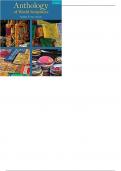
Anthology of World Scriptures 9th Edition by Robert E. Van Voorst - Test Bank

Rating
-
Sold
-
Pages
66
Grade
A
Uploaded on
15-09-2023
Written in
2022/2023

Chapter 1 TRUE/FALSE 1. Scriptures all have the same function. ANS: F PTS: 1 REF: p. 6 / sec.1-2 2. Most scriptures originated in oral tradition. ANS: T PTS: 1 REF: p.7/sec.1-2 3. For moderns, the written word predominates. ANS: T PTS: 1 REF: p.7/sec.1-2 4. Scriptures, by definition, are especially sacred. ANS: T PTS: 1 REF: p.7/sec.1-2 5. One mark of scriptures’ holiness is their use in ritual. ANS: T PTS: 1 REF: p.8/sec.1-2 6. The Musgrave Ritual is a scriptural rite. ANS: F PTS: 1 REF: p.10/sec.1-3 7. Scriptures lack the authority of some other religious writings. ANS: F PTS: 1 REF: p.8/sec.1-2 8. In the Western “religions of the book,” scriptures regulate much of life. ANS: T PTS: 1 REF: p.8/sec.1-2 9. The Talmud is the Hebrew Bible. ANS: F PTS: 1 REF: p.8/sec.1-2 10. World religions typically venerate their scriptures. ANS: T PTS: 1 11. Scripture is barred from public worship. ANS: F PTS: 1 12. Scriptures can be used doctrinally. ANS: T PTS: 1 13. The newest type of cognitive use of scripture is in interfaith dialogue. ANS: T PTS: 1 REF: p.10/sec.1-3 14. Scripture can only be used cognitively. ANS: F PTS: 1 REF: p.11/sec.1-3 15. Informative uses of scripture impart knowledge to believers. ANS: T PTS: 1 REF: p.11/sec.1-3 MULTIPLE CHOICE 1. The first anthology of world scriptures for popular use was edited by a. Ballou c. Van der Leeuw REF: p.8/sec.1-2 REF: p.10/sec.1-3 REF: p. 9 / sec.1-3 b. Conway d. V ogt ANS: B PTS: 1 REF: p.3/sec.1-1 2. How many times has Ballou’s book been revised? a. Never b. Once ANS: A 3. How many stages has the study of scripture passed through in the last 150 years? a. Van der Leeuw’s b. Vogt’s c. Lessa’s d. Eliade’s PTS: 1 REF: p.3/sec.1-1 a. Two b. Three ANS: B 4. How many chapters in Religion in Essence and Manifestation deal with scripture? PTS: 1 REF: p.3/sec.1-1 a. One b. Two ANS: A 5. Whose book was first published under the title From Primitives to Zen? PTS: 1 REF: p.3/sec.1-1 c. Three Times d. Six Times c. Four d. Six c. Four d. Six PTS: 1 a. The Bible of the World b. A World Religions Bible ANS: A PTS: 1 7. The present work (Anthology of World Scriptures) is representative of which stage of scripture ANS: D 6. Which book has remained in print continually since 1939? study? a. First b. Third c. Fifth d. Sixth REF: p.5/sec.1-1 c. the reality of nature d. God’s foreknowledge REF: p.5/sec.1-2 c. Scriptures d. Djinns REF: p.5/sec.1-2 c. Word d. Scripture REF: p.7/sec.1-2 ANS: B 8. The Upanishads include philosophy about a. The nature of reality b. The nature of plants ANS: A PTS: 1 9. Genres are also known as a. Devotionals b. Literary Forms ANS: B 10. What term do Coburn and Folkert reject? a. Canon b. Gospel ANS: D PTS: 1 PTS: 1 PTS: 1 REF: p.3/sec.1-1 c. Religions in Essence and Manifestation d. Reader in Comparative Religions REF: p.3/sec.1-1 11. The passing down of material by word of mouth only is known as a. Scriptural tradition b. Oral tradition ANS: B PTS: 1 12. Who argued that Israelite scripture originated as a support for an educational program? a. Carr b. Folkert ANS: A 13. For whom does the written word predominate over the oral word? a. The 1800s b. The 2000s ANS: C COMPLETION PTS: 1 c. The 1900s d. In 2015 REF: p.6/sec.1-2 PTS: 1 REF: p.7/sec.1-2 a. Moderns b. Ancients ANS: A 14. When was the last addition to the Latter-day Saint Church’s canon? PTS: 1 REF: p. 7 sec. 1-2 1. Rudolf ______ wrote the classic study of religion, The Idea of the Holy. ANS: Otto PTS: 1 REF: p. 7 / sec. 1-2 2. Dao means ______. ANS: Way PTS: 1 REF: p. 8 / sec. 1-2 3. The Christian Bible is often still bound in ______. ANS: leather PTS: 1 REF: p. 8 / sec. 1-2 4. The _______ is wrapped in silk. ANS: Qur’an PTS: 1 REF: p. 8 / sec. 1-2 5. _______ in Judaism and Christianity means “The Book.” ANS: Bible PTS: 1 REF: p. 2 / sec. Introduction 6. There are three Abrahamic ______. ANS: monotheisms PTS: 1 REF: p. 6 / sec. 1-2 7. The canon is ________ in the three Abrahamic monotheisms. ANS: closed PTS: 1 REF: p. 6 / sec. 1-2 c. Judaic tradition d. Mythic tradition REF: p.7/sec.1-2 c. Coburn d. V ogt c. Medievals d. Aboriginals 8. ______ has 1,200 sacred texts. ANS: Daoism PTS: 1 REF: p. 6 / sec. 1-2 9. The use of holy books to foresee the future is known as ______. ANS: bibliomancy PTS: 1 REF: p. 11 / sec. 1-3 10. An ______ is a holy picture. ANS: icon PTS: 1 REF: p. 11 / sec. 1-3 11. Scripture is held to be able to keep away ______. ANS: evil PTS: 1 REF: p. 11 / sec. 1-3 12. ______ use of scripture means doing something with it. ANS: Performative PTS: 1 REF: p. 11 / sec. 1-3 13. The authority of scripture is often established and maintained by a special class of scholars who are the guardians of scripture and recognized experts in its _____________. ANS: interpretation PTS: 1 REF: p. 9 / sec. 1-2 14. Scriptures typically reflect only the patriarchal and ______ perspectives of their traditions. ANS: elite PTS: 1 REF: p. 12 / sec. 1-4 15. The effort to collect, edit, and publish the literature of world religions is an academic enterprise from the _________ part of the world. ANS: Western PTS: 1 REF: p. 15 / sec. 1-5 ESSAY 1. What does the practice of bibliomancy tell us about the importance of scriptures for believers? Do all religions have this practice? If not, why do you think that they lack it? ANS: Answers may vary. PTS: 1 REF: p. 11 / sec. 1-3 2. In what ways can scriptures be used noncognitively? ANS: Answers may vary. PTS: 1 REF: p. 11 / sec. 1-3 3. Which cognitive use of scripture do you believe to be the most important, and why? ANS: Answers may vary. PTS: 1 REF: p. 9-10 / sec. 1-3 4. What advantages are there in studying religions through their scriptures? Could there be any disadvantages to this approach to studying religions? If so, what are they? ANS: Answers may vary. PTS: 1 REF: pp. 13-14 / sec. 1-4 5. Are there any special problems with reading scriptures in translation? If so, what are they? Explain your answer. ANS: Answers may vary. PTS: 1 REF: p. 12 / sec. 1-4 6. How does the use of scripture in new religions differ from its use in older religions? ANS: Answers may vary. PTS: 1 REF: pp. 15-16 / sec. 1-5 Chapter 2 TRUE/FALSE 1. The Upanishads form the final part of the Shruti. ANS: T PTS: 1 REF: p. 25 / sec. Introduction 2. Ravana was the husband of the monkey-god. ANS: F PTS: 1 REF: p. 25 / sec. Introduction 3. The Ramayana contains the famous section called the Bhagavad-Gita. ANS: F PTS: 1 REF: p. 25 / sec. Introduction 4. The Great Story of the Bharatas is the longest epic in the world. ANS: T PTS: 1 REF: p. 25 / sec. Introduction 5. The Puranas belong to the Smriti category of Hindu scripture. ANS: T PTS: 1 REF: p. 25 / sec. Introduction 6. Yoga is a practice of mental and spiritual discipline that primarily promotes physical and emotional power. ANS: F PTS: 1 REF: p. 26 / sec. Introduction 7. There are three things that are said to define a practicing Hindu. ANS: F PTS: 1 REF: p. 26 / sec. Introduction 8. Practicing Hindus must perform caste duty. ANS: T PTS: 1 REF: p. 26 / sec. Introduction 9. The English word for “recognized expert” comes from a Hindu term. ANS: T PTS: 1 REF: p. 26 / sec. Introduction 10. Much of the ancient Vedic form of Sanskrit is still in use today. ANS: F PTS: 1 REF: p. 26 / sec. Introduction 11. The Vedas were orally passed through many generations. ANS: T PTS: 1 REF: p. 26 / sec. Introduction 12. Brahmins always understand what they are saying as they chant the Vedas. ANS: F PTS: 1 REF: p. 27 / sec. Introduction 13. Hindus believe that concentrating on the mantra allows one to tap into the cosmic power of creative speech. ANS: T PTS: 1 REF: p. 27 / sec. Introduction 14. For Hindu men of the upper three castes, there are three possible stages of life. ANS: F PTS: 1 REF: p. 39 / sec. 2-2d 15. After her husband’s death, a practicing Hindu widow is encouraged to remarry. ANS: F PTS: 1 REF: p. 43 / sec. 2-2e MULTIPLE CHOICE 1. Hindus wash away the negative effects of what in the Ganges? a. Karma b. Dogma ANS: A PTS: 1 c. Disease d. Rebirth REF: p. 22 / sec. Introduction 2. Of all world religions, Hinduism is the most a. Internally diverse b. Cosmopolitan ANS: A 3. Hindu scripture is divided into a. Two classes b. Three classes ANS: A 4. What is the primary revelation in Hindu scripture? a. What is heard b. What is seen ANS: A 5. Who are the rishis? a. Ancient seers b. Modern priests a. Karma b. Dogma c. Brahman d. Atman ANS: D 9. How many books are there in the Rig-Veda? PTS: 1 c. Liberal d. Internally coherent REF: p. 23 / sec. Introduction c. Four classes d. Six classes PTS: 1 REF: p. 23 / sec. Introduction c. What is given d. What is thought REF: p. 23 / sec. Introduction c. Living prophets d. Unmarried women REF: p. 24 / sec. Introduction c. Six d. Twelve REF: p. 24 / sec. Introduction c. Religious knowledge d. Headaches ANS: A 8. The individual self or soul hidden at the center of every human is called the ANS: A 6. How many Vedas are there in the Shruti? a. Two b. Four ANS: B 7. Soma in the Vedic age produced a. Hallucinations b. Sound sleep PTS: 1 PTS: 1 PTS: 1 PTS: 1 REF: p. 48 / sec. 2-4c PTS: 1 a. Two b. Ten ANS: B 10. Talk of what is found in the Rig-Veda text for funeral cremations? PTS: 1 REF: p. 24 / sec. Introduction a. The deceased going to ancestors b. Weeping of family mourners ANS: A PTS: 1 11. For many Hindus, faithful reading of the Bhagavad-Gita is the route to REF: p. 29 / sec. Introduction c. One Hundred and twenty d. One Thousand and twenty-eight c. Mention of heaven and hell d. Eventual reincarnation REF: p. 51 / sec. 2-4e a. Heaven b. Salvation ANS: B 12. Some of the Hindu scriptures have been in existence for a. 1,000 years b. 2,000 years c. 3,000 years d. 4,000 years PTS: 1 REF: p. 22 / sec. Introduction ANS: C 13. The world’s largest religious festival is held in 1 ANS: D 14. How many of the Upanishads have been most influential in Hindu history? a. Chennai b. Madras c. Bombay d. Hardwar a. 13 b. 101 ANS: A 15. How many a. 2 b. 4 ANS: B COMPLETION V edas are PTS: 1 there? PTS: 1 c. 123 d. 327 REF: p. 25 / sec. Introduction c. 6 d. 8 REF: p. 24 / sec. Introduction PTS: REF: p. 23 / sec. Introduction PTS: 1 REF: p. 23 / Introduction 1. Hindus’ use of scripture depends on their class and ______. ANS: occupation PTS: 1 REF: p. 27 / sec. Introduction 2. All Hindus have reverence for the threefold ______. ANS: Veda PTS: 1 REF: p. 27 / sec. Introduction 3. For Hindus, the years 2000 – 1000 B.C.E. are known as ______ times. ANS: V edic PTS: 1 REF: p. 28 / sec. Introduction 4. There are ______ principal Upanishads. ANS: thirteen PTS: 1 REF: p. 28 / sec. Introduction 5. The Upanishads make a shift from Vedic world-affirming religion to a religion that many scholars consider world- ______. ANS: negating PTS: 1 REF: p. 29 / sec. Introduction 6. Eighteen of the ancient stories of the ______ are especially important. ANS: Puranas PTS: 1 REF: p. 29 / sec. Introduction 7. The ______ provide updated rituals and are associated with the goddess Shakti. ANS: Tantras c. Karma d. Redemption PTS: 1 REF: p. 29 / sec. Introduction 8. Hinduism has mostly rejected Buddhism and ________. ANS: Jainism PTS: 1 REF: p. 36 / sec. 2-1f 9. Aditi had _____ sons in the process of creation. ANS: eight PTS: 1 REF: p. 30 / sec. 2-1a 10. Yoni is the human vagina, and a symbol of the _______ side of cosmic power. ANS: female PTS: 1 REF: p. 32 / sec. 2-1b 11. The Upanishads are close in style to the ______. ANS: Aranyakas PTS: 1 REF: p. 28 / sec. Introduction 12. The main group of the ______ deals with the Yajur-Veda. ANS: Brahmanas PTS: 1 REF: p. 28 / sec. Introduction 13. The ______ contains magical spells such as spells against fever and business opponents. ANS: Atharva-veda PTS: 1 REF: p. 52 / sec. 2-4f 14. The ______ mark the start of a departure from Vedic ritualism. ANS: Aranyakas PTS: 1 REF: p. 28 / sec. Introduction 15. _______ is the main human character in the Bhagavad-Gita. ANS: Arjuna PTS: 1 REF: p. 55 / sec. 2-5 ESSAY 1. According to Hinduism, from what is the whole world created? Does this leave any moral taint? Why, or why not? ANS: Answers may vary. PTS: 1 REF: p. 30-31 / sec. 2-1a, b 2. What is the role of scripture in Hinduism? Is there a simple answer to this question? Why, or why not? ANS: Answers may vary. PTS: 1 REF: p. 22-23 / sec. Introduction 3. How does the caste system function in Hinduism? ANS: Answers may vary. PTS: 1 REF: p. 44-45 / sec. 2-3a, b 4. What are the Upanishads concerned to find, and how do they go about doing this? ANS: Answers may vary. PTS: 1 REF: p. 25 / sec. Introduction 5. Why do so many Hindus take the Bhagavad-Gita to be their favorite scripture? ANS: Answers may vary. PTS: 1 REF: p. 55 / sec. 2-5 6. What is the Hindu view of the written word, and how does this contrast with other religious traditions? ANS: Answers may vary. PTS: 1 REF: n/a anthology - test bank an anthology an anthology series test bank answers

Show more Read less


Whoops! We can’t load your doc right now. Try again or contact support.

Document information

Uploaded on
September 15, 2023
Number of pages
66
Written in
2022/2023
Type
Exam (elaborations)
Contains
Questions & answers

Subjects

Content preview

,Chapter 1


TRUE/FALSE
1. Scriptures all have the same function.

ANS: F PTS: 1 REF: p. 6 / sec.1-2
2. Most scriptures originated in oral tradition.

ANS: T PTS: 1 REF: p. 7 / sec. 1-2
3. For moderns, the written word predominates.

ANS: T PTS: 1 REF: p. 7 / sec. 1-2
4. Scriptures, by definition, are especially sacred.

ANS: T PTS: 1 REF: p. 7 / sec. 1-2
5. One mark of scriptures’ holiness is their use in ritual.
ANS: T PTS: 1 REF: p. 8 / sec. 1-2
6. The Musgrave Ritual is a scriptural rite.

ANS: F PTS: 1 REF: p. 10 / sec. 1-3
7. Scriptures lack the authority of some other religious writings.

ANS: F PTS: 1 REF: p. 8 / sec. 1-2
8. In the Western “religions of the book,” scriptures regulate much of life.

ANS: T PTS: 1 REF: p. 8 / sec. 1-2
9. The Talmud is the Hebrew Bible.
ANS: F PTS: 1 REF: p. 8 / sec. 1-2
10. World religions typically venerate their scriptures.

ANS: T PTS: 1 REF: p. 8 / sec. 1-2
11. Scripture is barred from public worship.
ANS: F PTS: 1 REF: p. 10 / sec. 1-3
12. Scriptures can be used doctrinally.

ANS: T PTS: 1 REF: p. 9 / sec.1-3
13. The newest type of cognitive use of scripture is in interfaith dialogue.

ANS: T PTS: 1 REF: p. 10 / sec. 1-3
14. Scripture can only be used cognitively.

ANS: F PTS: 1 REF: p. 11 / sec. 1-3
15. Informative uses of scripture impart knowledge to believers.

ANS: T PTS: 1 REF: p. 11 / sec. 1-3


MULTIPLE CHOICE
1. The first anthology of world scriptures for popular use was edited by
a. Ballou c. Van der Leeuw

, b. Conway d. Vogt
ANS: B PTS: 1 REF: p. 3 / sec. 1-1
2. How many times has Ballou’s book been revised?
a. Never c. Three Times
b. Once d. Six Times
ANS: A PTS: 1 REF: p. 3 / sec. 1-1
3. How many stages has the study of scripture passed through in the last 150 years?
a. Two c. Four
b. Three d. Six
ANS: B PTS: 1 REF: p. 3 / sec. 1-1
4. How many chapters in Religion in Essence and Manifestation deal with scripture?
a. One c. Four
b. Two d. Six
ANS: A PTS: 1 REF: p. 3 / sec. 1-1
5. Whose book was first published under the title From Primitives to Zen?
a. Van der Leeuw’s c. Lessa’s
b. Vogt’s d. Eliade’s
ANS: D PTS: 1 REF: p. 3 / sec. 1-1
6. Which book has remained in print continually since 1939?
a. The Bible of the World c. Religions in Essence and Manifestation
b. A World Religions Bible d. Reader in Comparative Religions
ANS: A PTS: 1 REF: p. 3 / sec. 1-1
7. The present work (Anthology of World Scriptures) is representative of which stage of scripture
study?

a. First c. Fifth
b. Third d. Sixth
ANS: B PTS: 1 REF: p. 5 / sec. 1-1
8. The Upanishads include philosophy about
a. The nature of reality c. the reality of nature
b. The nature of plants d. God’s foreknowledge
ANS: A PTS: 1 REF: p. 5 / sec. 1-2
9. Genres are also known as
a. Devotionals c. Scriptures
b. Literary Forms d. Djinns
ANS: B PTS: 1 REF: p. 5 / sec. 1-2
10. What term do Coburn and Folkert reject?

a. Canon c. Word
b. Gospel d. Scripture
ANS: D PTS: 1 REF: p. 7 / sec. 1-2

, 11. The passing down of material by word of mouth only is known as

a. Scriptural tradition c. Judaic tradition
b. Oral tradition d. Mythic tradition
ANS: B PTS: 1 REF: p. 7 / sec. 1-2
12. Who argued that Israelite scripture originated as a support for an educational program?
a. Carr c. Coburn
b. Folkert d. Vogt
ANS: A PTS: 1 REF: p. 7 / sec. 1-2
13. For whom does the written word predominate over the oral word?
a. Moderns c. Medievals
b. Ancients d. Aboriginals
ANS: A PTS: 1 REF: p. 7 sec. 1-2
14. When was the last addition to the Latter-day Saint Church’s canon?
a. The 1800s c. The 1900s
b. The 2000s d. In 2015
ANS: C PTS: 1 REF: p. 6 / sec. 1-2


COMPLETION
1. Rudolf ______ wrote the classic study of religion, The Idea of the Holy.

ANS: Otto
PTS: 1 REF: p. 7 / sec. 1-2
2. Dao means ______.

ANS: Way
PTS: 1 REF: p. 8 / sec. 1-2
3. The Christian Bible is often still bound in ______.

ANS: leather
PTS: 1 REF: p. 8 / sec. 1-2
4. The _______ is wrapped in silk.

ANS: Qur’an
PTS: 1 REF: p. 8 / sec. 1-2
5. _______ in Judaism and Christianity means “The Book.”

ANS: Bible
PTS: 1 REF: p. 2 / sec. Introduction
6. There are three Abrahamic ______.

ANS: monotheisms
PTS: 1 REF: p. 6 / sec. 1-2
7. The canon is ________ in the three Abrahamic monotheisms.

ANS: closed
PTS: 1 REF: p. 6 / sec. 1-2
Get to know the seller

Seller avatar
Reputation scores are based on the amount of documents a seller has sold for a fee and the reviews they have received for those documents. There are three levels: Bronze, Silver and Gold. The better the reputation, the more your can rely on the quality of the sellers work.
ExamsExpert (self)
View profile
Follow You need to be logged in order to follow users or courses
Sold
613
Member since
2 year
Number of followers
313
Documents
2838
Last sold
15 hours ago
ExamsExpert

We as a team provide best and Latest Test Banks that helps students to get A Grade we have vast range of test banks you can order us any test bank that you need

4.5

85 reviews

5
58
4
15
3
9
2
1
1
2

Why students choose Stuvia

Created by fellow students, verified by reviews

Quality you can trust: written by students who passed their exams and reviewed by others who've used these revision notes.

Didn't get what you expected? Choose another document

No problem! You can straightaway pick a different document that better suits what you're after.

Pay as you like, start learning straight away

No subscription, no commitments. Pay the way you're used to via credit card and download your PDF document instantly.

Student with book image

“Bought, downloaded, and smashed it. It really can be that simple.”

Alisha Student

Frequently asked questions
