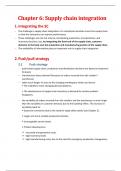
Chapter 6: Supply chain integration
1. Integrating the SC
− The challenge in supply chain integration is to coordinate activities across the supply chain
so that the enterprise can improve performance
− These challenges are met not only by coordinating production, transportation, and
inventory decisions, but, by integrating the front end of the supply chain, customer
demand, to the back end, the production and manufacturing portion of the supply chain
− The availability of information plays an important role in supply chain integration
2. Push/pull strategy
2.1 Push strategy
− push-based supply chain: production and distribution decisions are based on long-term
forecasts
− manufacturer bases demand forecasts on orders received from the retailer's
warehouses
− takes much longer to react to the changing marketplace which can lead to
• The inability to meet changing demand patterns.
• The obsolescence of supply chain inventory as demand for certain products
disappears.
− the variability of orders received from the retailers and the warehouses is much larger
than the variability in customer demand, due to the bullwhip effect. This increase in
variability leads to:
• Excessive inventories due to the need for large safety stocks (see Chapter 2).
• Larger and more variable production batches.
• Unacceptable service levels.
• Product obsolescence.
increased transportation costs,
high inventory levels
high manufacturing costs, due to the need for emergency production changeovers.
, 2.2 Pull strategy
− production and distribution are demand-driven
− the firm does not hold any inventory and only responds to specific orders.
− This is enabled by fast information flow mechanisms to transfer information about
customer demand (e.g., POS data) to the various supply chain participants
− Pull systems are intuitively attractive since they lead to
• A decrease in lead times achieved through the ability to better anticipate incoming
orders from the retailers.
• A decrease in inventory at the retailers since inventory levels at these facilities
increase with lead times
• A decrease in variability in the system and, in particular, variability faced by
manufacturers) due to lead-time reduction.
• Decreased inventory at the manufacturer due to the reduction in variability.
reduction in system inventory level
enhanced ability to manage resources
a reduction in system costs
− more difficult to take advantage of economies of scale in manufacturing and transportation
since systems are not planned far ahead in time
3. Identifying the appropriate SC strategy
− Generally speaking
• Low economies of scale call for a pull strategy
• High economies of scale call for a push strategy
• Low demand uncertainty call for a push strategy
1. Integrating the SC
− The challenge in supply chain integration is to coordinate activities across the supply chain
so that the enterprise can improve performance
− These challenges are met not only by coordinating production, transportation, and
inventory decisions, but, by integrating the front end of the supply chain, customer
demand, to the back end, the production and manufacturing portion of the supply chain
− The availability of information plays an important role in supply chain integration
2. Push/pull strategy
2.1 Push strategy
− push-based supply chain: production and distribution decisions are based on long-term
forecasts
− manufacturer bases demand forecasts on orders received from the retailer's
warehouses
− takes much longer to react to the changing marketplace which can lead to
• The inability to meet changing demand patterns.
• The obsolescence of supply chain inventory as demand for certain products
disappears.
− the variability of orders received from the retailers and the warehouses is much larger
than the variability in customer demand, due to the bullwhip effect. This increase in
variability leads to:
• Excessive inventories due to the need for large safety stocks (see Chapter 2).
• Larger and more variable production batches.
• Unacceptable service levels.
• Product obsolescence.
increased transportation costs,
high inventory levels
high manufacturing costs, due to the need for emergency production changeovers.
, 2.2 Pull strategy
− production and distribution are demand-driven
− the firm does not hold any inventory and only responds to specific orders.
− This is enabled by fast information flow mechanisms to transfer information about
customer demand (e.g., POS data) to the various supply chain participants
− Pull systems are intuitively attractive since they lead to
• A decrease in lead times achieved through the ability to better anticipate incoming
orders from the retailers.
• A decrease in inventory at the retailers since inventory levels at these facilities
increase with lead times
• A decrease in variability in the system and, in particular, variability faced by
manufacturers) due to lead-time reduction.
• Decreased inventory at the manufacturer due to the reduction in variability.
reduction in system inventory level
enhanced ability to manage resources
a reduction in system costs
− more difficult to take advantage of economies of scale in manufacturing and transportation
since systems are not planned far ahead in time
3. Identifying the appropriate SC strategy
− Generally speaking
• Low economies of scale call for a pull strategy
• High economies of scale call for a push strategy
• Low demand uncertainty call for a push strategy