Jurisprudence John Austin
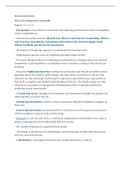
Classical Positivism
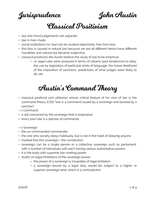
• law and moral judgements are separate
• law is man-made
• social institutions (i.e. law) can be studied objectively, free from bias
• this bias is caused in natural law because we are all different hence have different
moralities and natural law became subjective
• classical positivists like Austin believe the study of law to be empirical
• i.e. legal rules were analyzed in terms of citizens’ past tendencies to obey,
the use by legislators of particular kinds of language, the future likelihood
of the imposition of sanctions, predictions of what judges were likely to
do, etc.
Austin’s Command Theory
• classical positivist and utilitarian whose critical feature of his view of law is the
command theory (CSS) “law is a command issued by a sovereign and backed by a
sanction”
—> Command
• a will conceived by the sovereign that is imperative
• every law/rule is a species of commands
—> Sovereign
• the un-commanded commander
• the one who society obeys habitually, but is not in the habit of obeying anyone
• implied that this sovereign = the constitution
• sovereign can be a single person or a collective sovereign such as parliament,
with a number of individuals with each having various authoritative powers
• it is the body with supreme law-making power
• Austin on legal limitations of the sovereign power:
• the power of a sovereign is incapable of legal limitation
• a sovereign bound by a legal duty would be subject to a higher or
superior sovereign land, which is a contradiction
KMB 1 of 4
Classical Positivism
• law and moral judgements are separate
• law is man-made
• social institutions (i.e. law) can be studied objectively, free from bias
• this bias is caused in natural law because we are all different hence have different
moralities and natural law became subjective
• classical positivists like Austin believe the study of law to be empirical
• i.e. legal rules were analyzed in terms of citizens’ past tendencies to obey,
the use by legislators of particular kinds of language, the future likelihood
of the imposition of sanctions, predictions of what judges were likely to
do, etc.
Austin’s Command Theory
• classical positivist and utilitarian whose critical feature of his view of law is the
command theory (CSS) “law is a command issued by a sovereign and backed by a
sanction”
—> Command
• a will conceived by the sovereign that is imperative
• every law/rule is a species of commands
—> Sovereign
• the un-commanded commander
• the one who society obeys habitually, but is not in the habit of obeying anyone
• implied that this sovereign = the constitution
• sovereign can be a single person or a collective sovereign such as parliament,
with a number of individuals with each having various authoritative powers
• it is the body with supreme law-making power
• Austin on legal limitations of the sovereign power:
• the power of a sovereign is incapable of legal limitation
• a sovereign bound by a legal duty would be subject to a higher or
superior sovereign land, which is a contradiction
KMB 1 of 4