Health Assessment Review Questions, Week 6, Exam 2 (2022/2023) (Verified Solutions)
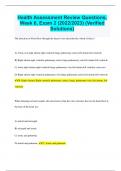
Health Assessment Review Questions, Week 6, Exam 2 (2022/2023) (Verified Solutions) The direction of blood flow through the heart is best described by which of these? A) Vena cava right atrium right ventricle lungs pulmonary artery left atrium left ventricle B) Right atrium right ventricle pulmonary artery lungs pulmonary vein left atrium left ventricle C) Aorta right atrium right ventricle lungs pulmonary vein left atrium left ventricle vena cava D) Right atrium right ventricle pulmonary vein lungs pulmonary artery left atrium left ventricle B. Right Atrium, Right ventricle pulmonary, artery, lungs, pulmonary vein, left atrium, left ventricle When listening to heart sounds, the nurse knows that the valve closures that can be heard best at the base of the heart are: A) mitral and tricuspid. B) tricuspid and aortic. C) aortic and pulmonic. D) mitral and pulmonic. C. Aortic and pulmonic Which of these statements describes the closure of the valves in a normal cardiac cycle? A) The aortic valve closes slightly before the tricuspid valve. B) The pulmonic valve closes slightly before the aortic valve. C) The tricuspid valve closes slightly later than the mitral valve. D) Both the tricuspid and pulmonic valves close at the same time. C. The tricuspid valve closes slightly later than the mitral valve Tip: S1 is louder than S2 at the apex (Tricuspid and mitral valve.) S2 is louder than S1 at the base (Aortic valve and pulmonic valve.) Sounds are equal at Erb's point When you are assessing your patient's heart sounds, you notice a murmur. You listen with the bell and would describe the murmur as moderately loud and easy to hear. Which grade would you chart? A. Grade i B. Grade v C. Grade iii D. Grade vi C. Grade iii How should the nurse document mild, slight pitting edema on the ankles of a heart failure patient? A. 1+ B. 2+ C. 3+ D. 4+ A. 1+ The nurse is presenting a class on risk factors for cardiovascular disease. Which of these are considered modifiable risk factors for MI? Select all that apply. A: Ethnicity B: Abnormal lipids C: Smoking D: Gender E: Hypertension F: Diabetes G: Family history B: abnormal lipids C. smoking E. Hypertension F. Diabetes Which of the following is an appropriate position to have the patient assume when auscultating for extra heart sounds or murmurs? A: Roll toward the left side B: Roll toward the right side C: Trendelenburg position D: Prone position A. Roll toward the left side Which statement is true regarding the arterial system? A: Arteries are large-diameter vessels. B: The arterial system is a high-pressure system. C: The walls of arteries are thinner than those of the veins. D: Arteries can greatly expand to accommodate a large blood volume increase. B. The arterial system is a high-pressure system. When assessing a patient the nurse is unable to palpate the left dorsalis pedis pulse. What should the nurse do first? A) Document the finding. B) Use the doppler to assess the pulse C) Call the physician and tell them the patient has no pulse D) Start assessing the next patient B. Use the doppler to assess the pulse A 67-year-old patient states that he recently began to have pain in his left calf when climbing the 10 stairs to his apartment. This pain is relieved by sitting for approximately 2 minutes; then he is able to resume his activities. The nurse interprets that this patient is most likely experiencing: A: Intermittent Claudication. B: Sore muscles. C: Muscle cramps. D: Venous insufficiency. A. Intermittent Claudication The nurse is preparing to perform a modified Allen test. Which is an appropriate reason for this test? A. To measure the rate of lymphatic drainage B. To evaluate the adequacy of capillary patency before venous blood draws C. To evaluate the adequacy of collateral circulation before cannulating the radial artery D. To evaluate the venous refill rate that occurs after the ulnar and radial arteries are temporarily occluded C. To evaluate the adequacy of collateral circulation before cannulating the radial artery (modified allen test) In assessing the carotid arteries of an older patient with cardiovascular disease, the nurse would: A) palpate the artery in the upper one third of the neck. B)listen with the bell of the stethoscope to assess for bruits. C) palpate both arteries simultaneously to compare amplitude. D) instruct patient to take slow deep breaths during auscultation. b. Listen with the bell of the stethoscope to assess for bruits When auscultating over a patient's femoral arteries, the nurse notices the presence of a bruit on the left side. The nurse knows that bruits: A: Are often associated with venous disease. B: Occur in the presence of lymphadenopathy. C: In the femoral arteries are caused by hypermetabolic states. D: Occur with turbulent blood flow, indicating partial occlusion. B. Occur with turbulent blood flow, indicating partial occulusion
Written for
- Institution
- Health Assessment
- Module
- Health Assessment
Document information
- Uploaded on
- September 10, 2023
- Number of pages
- 7
- Written in
- 2023/2024
- Type
- Exam (elaborations)
- Contains
- Questions & answers
Subjects
-
health assessment review questions week 6 exam 2

Also available in package deal