The World’s Legal Systems – Lecture 7
Hindu Law
Why is the study of Asian legal systems necessary?
So far, we studied common law and civil law and we studied what kind of methodologies are there in
civil law and in common law. We also studied what the legal institutions are. The exposure to these
Asian legal systems is required, because the legal institutions, the legal reasoning and the legal
methodologies in each of these Asian legal systems is different. There can be many kinds of
explanations to explain Western law. You have different schools of thought. You have legal positivism
(which talks about law by the state) and you have natural law (which approaches men as having reason
and also having certain things that are in common across cultures). This is not sufficient to understand
Asian legal systems. You have also social-legal jurisprudence which tries to understand why for
instance an Asian state does not function in the same way and why there are so many kinds of legal
systems in the Asian context. So there are three kinds of concepts that often categorize the study of
Asian law, which the author goes into. And he tries to say or he tries to dispel the kinds of normal ways
in which people approach law. One is the idea of statism (the idea that law is made by the state and
the state is very important in the context of all possible laws in Asia). For instance if you take an
individual country like India or China, people think that the state has complete control over law and
that there are no other law-making bodies and that there are no other sources of law, other than the
state. There is also this idea of what one calls legal centralism. Legal centralism means that there is
one uniform law. We often think about law being uniform and we do not think of multiple legal systems
coexisting in the same country. We also think, for instance of the fact that law is codified in the form
of codes. This is particularly the case in continental Europa. We also understand law in the context of
common law. That is some kind of unified law or unified set of beliefs of people which are expressed
within law. Common law is also about that. The other aspect which the teacher would like to focus on,
is to try to understand the notion of customary law a little differently from what one is used to. This
conception of customary law in common law sees it as being static and being practised for a long time,
but in the context of the Asian legal traditions custom is generally something like lived practice. It’s
something that one does every day. There is also the other kind of focus when one looks at Asian legal
tradition, for instance the focus on state traditions. One is Hindu law, one is Islamic law and the other
one is Chinese law. There is often this vision that all these traditions are categorized by religion and
that there is a lot of importance given to religion, but that is really not the case. Even in the case of the
Islam where you have one particular text like the Koran for instance, the legalised divine law is often
interpreted really differently from the Koran, because humans have to actually interpret it. So there
are often also questions as to whether religion can be law and whether religion can be a source of law.
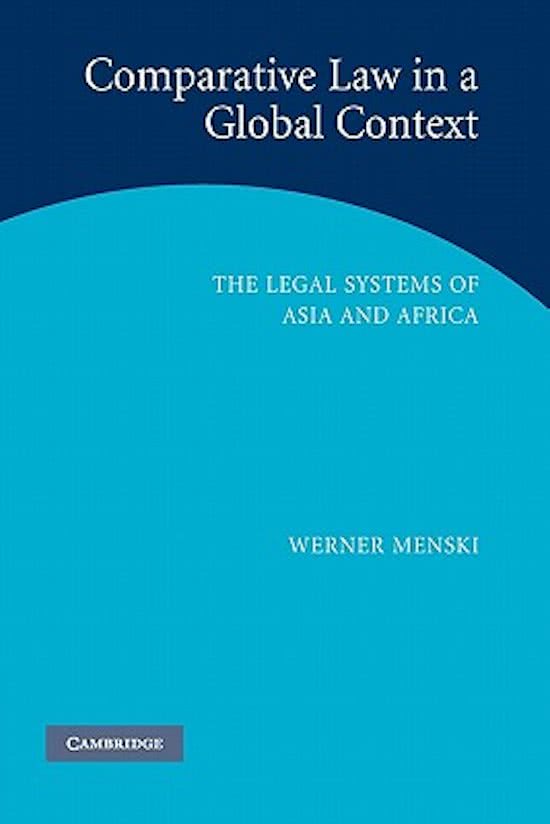
What the author urges us to think about, is that the way that we define law is in multiple ways. We
cannot count upon and agree on a definition of law. Religion is simply not the same as law. Law
anywhere in the world is just not based on religion ethics and morality.
The teacher will just briefly go into what we are actually studying today. There are some basic
questions that she will address and which she will also go into. She will give a brief introduction as to
what is Hindu law. One has to understand it very differently. It’s a tradition of around 6000 years. It
has a very different structure from what we understand in the European context. For instance, it is
generally understood that European law, civil law especially, has its foundations in Roman law and
Hindu Law
Why is the study of Asian legal systems necessary?
So far, we studied common law and civil law and we studied what kind of methodologies are there in
civil law and in common law. We also studied what the legal institutions are. The exposure to these
Asian legal systems is required, because the legal institutions, the legal reasoning and the legal
methodologies in each of these Asian legal systems is different. There can be many kinds of
explanations to explain Western law. You have different schools of thought. You have legal positivism
(which talks about law by the state) and you have natural law (which approaches men as having reason
and also having certain things that are in common across cultures). This is not sufficient to understand
Asian legal systems. You have also social-legal jurisprudence which tries to understand why for
instance an Asian state does not function in the same way and why there are so many kinds of legal
systems in the Asian context. So there are three kinds of concepts that often categorize the study of
Asian law, which the author goes into. And he tries to say or he tries to dispel the kinds of normal ways
in which people approach law. One is the idea of statism (the idea that law is made by the state and
the state is very important in the context of all possible laws in Asia). For instance if you take an
individual country like India or China, people think that the state has complete control over law and
that there are no other law-making bodies and that there are no other sources of law, other than the
state. There is also this idea of what one calls legal centralism. Legal centralism means that there is
one uniform law. We often think about law being uniform and we do not think of multiple legal systems
coexisting in the same country. We also think, for instance of the fact that law is codified in the form
of codes. This is particularly the case in continental Europa. We also understand law in the context of
common law. That is some kind of unified law or unified set of beliefs of people which are expressed
within law. Common law is also about that. The other aspect which the teacher would like to focus on,
is to try to understand the notion of customary law a little differently from what one is used to. This
conception of customary law in common law sees it as being static and being practised for a long time,
but in the context of the Asian legal traditions custom is generally something like lived practice. It’s
something that one does every day. There is also the other kind of focus when one looks at Asian legal
tradition, for instance the focus on state traditions. One is Hindu law, one is Islamic law and the other
one is Chinese law. There is often this vision that all these traditions are categorized by religion and
that there is a lot of importance given to religion, but that is really not the case. Even in the case of the
Islam where you have one particular text like the Koran for instance, the legalised divine law is often
interpreted really differently from the Koran, because humans have to actually interpret it. So there
are often also questions as to whether religion can be law and whether religion can be a source of law.
What the author urges us to think about, is that the way that we define law is in multiple ways. We
cannot count upon and agree on a definition of law. Religion is simply not the same as law. Law
anywhere in the world is just not based on religion ethics and morality.
The teacher will just briefly go into what we are actually studying today. There are some basic
questions that she will address and which she will also go into. She will give a brief introduction as to
what is Hindu law. One has to understand it very differently. It’s a tradition of around 6000 years. It
has a very different structure from what we understand in the European context. For instance, it is
generally understood that European law, civil law especially, has its foundations in Roman law and