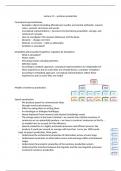
Lecture 13 – sentence production
Conceptual representations;
- Examples; objects (including affordances) number and mental arithmetic, musical
notes, syntactic structures and words.
- Conceptual representations = structures formed during acquisition, storage, and
retrieval of concepts.
- How to investigate? We measure Behaviour and the Brain.
- Dynamic – change over time
- Abstract vs concrete – table vs philosophy
- Symbolic or simulated?
Embodied and Grounded Cognition: Cognition by Simulation;
- What is simulated?
- Motor states
- Perceptual states including attention
- Affective states
- According to symbolic approach, conceptual representations are independent of
these experiences and (as such) they are amodal (hence, computer metaphor)
- According to embodied approach, conceptual representations reflect these
experiences and (as such) they are modal
Models of sentence production;
Speech production;
- We produce speech to communicate ideas
through words and sentences…
- Either by saying them or writing them
- In monologue or dialogue/multilogue
- About displaced (from memory) and situated (unfolding) events
- The storage space in the brain is limited > we cannot store infinite inventory of
sentences we can potentially produce > we have to construct sentences on the fly –
so models have to account for this efficiency
- Speech production is a highly automated processes and efficient process: We
produce 3 words per second on average with less than 1 error per 1000 words
Logic of speech production, Main goals:
- Understand the architectural properties of information access at each stage
- Understand constraints on information access and exchange within and between
stages
- Understand chronometric properties of the sentence production system
- Understand the interface between the linguistic and the non-linguistic processes
involved in sentence production
, Sentence production models are rarely simple;
- Parallel model by Chang (2002)
Models have certain thing in common;
- 1) Stages = from idea to articulation
- 2) Conceptualization (Event) = Speaker formulates a pre-
linguistic message to be described.
- 3) Formulation (Lemma and assembly) = Convert Event information into words and
their grammatical properties and arrange these words in a syntactic plan (syntactic
structure + word order)
- 4) Articulation = Plan and execute motor program fort overt articulation
Stages of sentence production: From idea to articulation
- Can produce sentence which mean the same but in
different syntactic arrangements.
- The choice of what you say reflects perceptual properties.
Terminology;
- E.g., “Spiderman is giving Sandman an apple”
Thematic roles (event):
- Agent – the “doer” Spiderman
- Patient – the entity the agent is acting upon Sandman
- Theme – similar to patient. Theme undergoes action but usually does not change
state Apple
Grammatical roles (syntax):
- Subject – constituent that “governs” the sentence by means of a verb. Doesn’t have
to be Agent
- Object – constituent subordinate to Subject. Both Sandman and apple are objects
Issues with sentence production;
- Difficult to “reverse-engineer” (or model) how we progress from idea to sentence
- Difficult to distinguish linguistic (selecting words and sentences) from non-linguistic
(attention, memory) processes
- Efficiency: Any model needs to account for it
- Mapping problem = Is mapping from event information to sentence arbitrary or
based on rules that link what you see to what you say? Correspondence between the
event and the sentence
- Stage partitioning problem = Are individual production stages independent of each
other? Interaction between production stages
- Planning scope problem = How much of the sentence do the speakers pre-plan?
Incrementality
Conceptual representations;
- Examples; objects (including affordances) number and mental arithmetic, musical
notes, syntactic structures and words.
- Conceptual representations = structures formed during acquisition, storage, and
retrieval of concepts.
- How to investigate? We measure Behaviour and the Brain.
- Dynamic – change over time
- Abstract vs concrete – table vs philosophy
- Symbolic or simulated?
Embodied and Grounded Cognition: Cognition by Simulation;
- What is simulated?
- Motor states
- Perceptual states including attention
- Affective states
- According to symbolic approach, conceptual representations are independent of
these experiences and (as such) they are amodal (hence, computer metaphor)
- According to embodied approach, conceptual representations reflect these
experiences and (as such) they are modal
Models of sentence production;
Speech production;
- We produce speech to communicate ideas
through words and sentences…
- Either by saying them or writing them
- In monologue or dialogue/multilogue
- About displaced (from memory) and situated (unfolding) events
- The storage space in the brain is limited > we cannot store infinite inventory of
sentences we can potentially produce > we have to construct sentences on the fly –
so models have to account for this efficiency
- Speech production is a highly automated processes and efficient process: We
produce 3 words per second on average with less than 1 error per 1000 words
Logic of speech production, Main goals:
- Understand the architectural properties of information access at each stage
- Understand constraints on information access and exchange within and between
stages
- Understand chronometric properties of the sentence production system
- Understand the interface between the linguistic and the non-linguistic processes
involved in sentence production
, Sentence production models are rarely simple;
- Parallel model by Chang (2002)
Models have certain thing in common;
- 1) Stages = from idea to articulation
- 2) Conceptualization (Event) = Speaker formulates a pre-
linguistic message to be described.
- 3) Formulation (Lemma and assembly) = Convert Event information into words and
their grammatical properties and arrange these words in a syntactic plan (syntactic
structure + word order)
- 4) Articulation = Plan and execute motor program fort overt articulation
Stages of sentence production: From idea to articulation
- Can produce sentence which mean the same but in
different syntactic arrangements.
- The choice of what you say reflects perceptual properties.
Terminology;
- E.g., “Spiderman is giving Sandman an apple”
Thematic roles (event):
- Agent – the “doer” Spiderman
- Patient – the entity the agent is acting upon Sandman
- Theme – similar to patient. Theme undergoes action but usually does not change
state Apple
Grammatical roles (syntax):
- Subject – constituent that “governs” the sentence by means of a verb. Doesn’t have
to be Agent
- Object – constituent subordinate to Subject. Both Sandman and apple are objects
Issues with sentence production;
- Difficult to “reverse-engineer” (or model) how we progress from idea to sentence
- Difficult to distinguish linguistic (selecting words and sentences) from non-linguistic
(attention, memory) processes
- Efficiency: Any model needs to account for it
- Mapping problem = Is mapping from event information to sentence arbitrary or
based on rules that link what you see to what you say? Correspondence between the
event and the sentence
- Stage partitioning problem = Are individual production stages independent of each
other? Interaction between production stages
- Planning scope problem = How much of the sentence do the speakers pre-plan?
Incrementality