Plasma membrane and transport 18/11/19
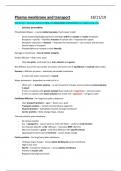
Membrane = boundary between intra and extracellular environment and neighbouring cells
- Selective permeability
Phospholipid bilayer – creates stable boundary, fluid mosaic model
- Some proteins/lipids/glycoproteins and lipids within or outside or inside membrane
- Receptors = specific – identifies function of certain cells – important for signals
- Receptors expression = dynamic – important for homeostasis – can increase and decrease
- Several types of receptors
- Phospholipids and receptors move laterally
Damage to membrane = loss of cellular integrity
Simple diffusion = down conc. grad
- Only non-polar, small polar (e.g. H2O, ethanol) and gasses
Net diffusion occurs for any number of solutes until some sort of equilibrium = reached (ideal state)
Osmosis = diffusion of water – selectively permeable membrane
- In most cells water movement = inward
Water movement = dependent on what cell is in
- Often cell = in isotonic solution – no net movement of water across membrane [ions/solutes]
is equal
- If cell is in solution with greater [solute] than inside cell = hypertonic – cell loses water
- If cell is in solution with lower [solute] than inside cell = hypotonic – cell gains water
Facilitated diffusion = for large/very polar substances
- Uses transport proteins – again – down conc. grad
- Transport proteins – contain transmembrane segments
- Channel proteins – hydrophilic channels through membrane
- Carrier proteins – Bind, change shape, release
Channel proteins span membrane
- No stimuli needed
- E.g. = aquaporins – causes water to enter cell faster – useful in renal function
- Ion channels allow K+ an Na+ diffusion – maintains RMP (-80 mV)
- Most ion channels = gated – only allow diffusion with specific stimuli
- Ligand gated may be due to hormone – causes shape change
Carrier proteins – for large/very polar substances
- Undergo shape change – moves solute-binding site across membrane
- High to low conc.
- GLUT1 = transporter of glucose – across plasma membrane
- Present in muscle cells
- Regulates blood glucose levels
Membrane = boundary between intra and extracellular environment and neighbouring cells
- Selective permeability
Phospholipid bilayer – creates stable boundary, fluid mosaic model
- Some proteins/lipids/glycoproteins and lipids within or outside or inside membrane
- Receptors = specific – identifies function of certain cells – important for signals
- Receptors expression = dynamic – important for homeostasis – can increase and decrease
- Several types of receptors
- Phospholipids and receptors move laterally
Damage to membrane = loss of cellular integrity
Simple diffusion = down conc. grad
- Only non-polar, small polar (e.g. H2O, ethanol) and gasses
Net diffusion occurs for any number of solutes until some sort of equilibrium = reached (ideal state)
Osmosis = diffusion of water – selectively permeable membrane
- In most cells water movement = inward
Water movement = dependent on what cell is in
- Often cell = in isotonic solution – no net movement of water across membrane [ions/solutes]
is equal
- If cell is in solution with greater [solute] than inside cell = hypertonic – cell loses water
- If cell is in solution with lower [solute] than inside cell = hypotonic – cell gains water
Facilitated diffusion = for large/very polar substances
- Uses transport proteins – again – down conc. grad
- Transport proteins – contain transmembrane segments
- Channel proteins – hydrophilic channels through membrane
- Carrier proteins – Bind, change shape, release
Channel proteins span membrane
- No stimuli needed
- E.g. = aquaporins – causes water to enter cell faster – useful in renal function
- Ion channels allow K+ an Na+ diffusion – maintains RMP (-80 mV)
- Most ion channels = gated – only allow diffusion with specific stimuli
- Ligand gated may be due to hormone – causes shape change
Carrier proteins – for large/very polar substances
- Undergo shape change – moves solute-binding site across membrane
- High to low conc.
- GLUT1 = transporter of glucose – across plasma membrane
- Present in muscle cells
- Regulates blood glucose levels