Topic 14: Stellar Evolution
Specification
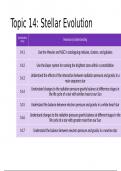
Point Necessary Understanding
14.1 Use the Messier and NGC in cataloguing nebulae, clusters, and galaxies
14.2 Use the Bayer system for naming the brightest stars within a constellation
Understand the effects of the interaction between radiation pressure and gravity in a
14.3
main sequence star
Understand changes to the radiation pressure-gravity balance at difference stages in
14.4 the life cycle of a star with similar mass to our Sun
14.5 Understand the balance between electron pressure and gravity in a white dwarf star
Understand changes to the radiation pressure-gravity balance at different stages in the
14.6
life cycle of a star with greater mass than our Sun
14.7 Understand the balance between neutron pressure and gravity in a neutron star
, Use the Messier and NGC in cataloguing nebulae, clusters, and
14.1
galaxies
The French astronomer Charles Messier was a c
hunter that kept discovering objects he thoug
initially were comets but turned out to not be co
upon further inspection.
Messier catalogued around 110 of those previo
supposed comets which remain somewhat usef
modern day astronomy, albeit limited as all t
observations were done only in France.
Within the Messier catalogue, all 110 entries ha
M prefix (e.g., M1 is the Crab Nebula in Tauru
The New General Catalogue of Nebula an
Clusters of Stars (NGC) are a list of galaxies,
clusters, and emission nebulae and absorptio
nebulae catalogued by number.
Objects are prefixed with ‘NGC’ (e.g., the
Nebula is NGC 1952).
[1]
, 14.1
Provide the name for the following nebula based on the Messier
catalogue:
Specification
Point Necessary Understanding
14.1 Use the Messier and NGC in cataloguing nebulae, clusters, and galaxies
14.2 Use the Bayer system for naming the brightest stars within a constellation
Understand the effects of the interaction between radiation pressure and gravity in a
14.3
main sequence star
Understand changes to the radiation pressure-gravity balance at difference stages in
14.4 the life cycle of a star with similar mass to our Sun
14.5 Understand the balance between electron pressure and gravity in a white dwarf star
Understand changes to the radiation pressure-gravity balance at different stages in the
14.6
life cycle of a star with greater mass than our Sun
14.7 Understand the balance between neutron pressure and gravity in a neutron star
, Use the Messier and NGC in cataloguing nebulae, clusters, and
14.1
galaxies
The French astronomer Charles Messier was a c
hunter that kept discovering objects he thoug
initially were comets but turned out to not be co
upon further inspection.
Messier catalogued around 110 of those previo
supposed comets which remain somewhat usef
modern day astronomy, albeit limited as all t
observations were done only in France.
Within the Messier catalogue, all 110 entries ha
M prefix (e.g., M1 is the Crab Nebula in Tauru
The New General Catalogue of Nebula an
Clusters of Stars (NGC) are a list of galaxies,
clusters, and emission nebulae and absorptio
nebulae catalogued by number.
Objects are prefixed with ‘NGC’ (e.g., the
Nebula is NGC 1952).
[1]
, 14.1
Provide the name for the following nebula based on the Messier
catalogue: