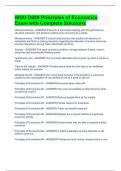
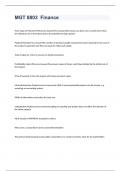
WGU D089 Principles of Economics Exam with Complete Solutions
Macroeconomics - ANSWER-A branch of economics dealing with the performance, structure, behavior, and decision-making of an economy as a whole Microeconomics - ANSWER-A branch of economics that studies the behavior of individuals and firms in making decisions regarding the allocation of scarce resources and the interactions among these individuals and firms Scarcity - ANSWER-The basic economic problem; the gap between limited, scarce , resources and theoretically limitless wants Opportunity cost - ANSWER-The next best alternative that is given up when a choice is made Think at the margin - ANSWER-Thinking about what the next step or an additional action means for a person Marginal benefit - ANSWER-The incremental increase in the benefit to a consumer caused by the consumption of one additional unit of a good or service Principles of Economics #1 - ANSWER-Everyone faces trade-offs Principles of Economics #2 - ANSWER-The cost of something is determined by what you give up to get it Principles of Economics #3 - ANSWER-Rational people think at the margin Principles of Economics #4 - ANSWER-People respond to incentives Principles of Economics #5 - ANSWER-Trade can benefit everyone Principles of Economics #6 - ANSWER-Markets are a sound method of organizing economic activity Principles of Economics #7 - ANSWER-Governments may be able to improve market outcomes Principles of Economics #8 - ANSWER-A nation's standard of living depends on it's ability to produce. Principles of Economics #9 - ANSWER-Printing too much money causes prices to rise Principles of Economics #10 - ANSWER-There is a short-run trade-off between inflation and unemployment Economic systems - ANSWER-A system of the production, resource allocation, and distribution of goods and services within a society or a given geographic area Traditional Economy - ANSWER-An economic system that relies on customs, history, and time-honored beliefs. Tradition guides economic decisions such as production and distribution Command Economy - ANSWER-An economic system in which production, investment, prices, and incomes are determined centrally by a government Market Economy - ANSWER-An economic system in which the decisions regarding investments, production, and distribution are guided by the price signals created by the forces of supply and demand Mixed Economy - ANSWER-An economic system in which both private enterprise and a degree of state monopoly (Usually in public services, defense, infrastructure, and basic industries) co-exist Five key characteristics of a Traditional Economy - ANSWER-1. It is centered around families or tribes. 2. It exists in a hunter-gatherer and nomadic society. 3. Trade is heavily dependent on bartering rather than money. 4. It only produces what is needed, and a surplus is very rare. 5. It eventually changes from purely trade to the use of some type of currency. Advantages to a Traditional Economy - ANSWER-There is little competition or friction among members of the society. People's roles and contributions are well understood. It can be more sustainable than a technology-based economy. Disadvantages to a Traditional Economy - ANSWER-It is exposed to environmental changes and weather patterns. It is vulnerable to market of command economies, which consume and deplete the resources or traditional economies. Five key characteristics of a Command Economy - ANSWER-1. All economic activity is planned and controlled by a centralized government power. 2. The government decides how to use and distribute the nation's natural, capital, and labor resources. 3. A nation's central power controls the priorities for how goods and services will be produced and distributed.
Written for
- Institution
- WGU D089
- Module
- WGU D089
Document information
- Uploaded on
- August 31, 2023
- Number of pages
- 38
- Written in
- 2023/2024
- Type
- Exam (elaborations)
- Contains
- Questions & answers
Subjects
-
wgu d089
-
wgu d089 principles of economics exam

Also available in package deal