

Unit 13: Applications of Inorganic Chemistry
A: Investigate acid-base equilibria in order and to understand buffer action to optimise acid-base
titration procedures.
Assignment title: Acid or base?
Aim: To optimise acid-base titration techniques, research acid-base equilibria in order to comprehend
buffer action. This assignment will include Determining the acid dissociation constant (Ka) for a weak
acid, Investigating buffer solution, Determining Ph curves for acid-alkalis titrations and Report of
different titration techniques.
Determining the acid dissociation constant (Ka) for a weak acid: Aim: This experiment aims to
precisely show a Ph measurement of a half-neutralized ethanoic acid solution and to get a value for K a
from this.
Introduction: First, you will precisely calculate the amount of sodium hydroxide solution needed to
neutralise 25 cm3 of 1 M ethanoic acid. Then, in order to estimate Ka, you will precisely measure the pH
of the resultant solution after neutralising exactly half of a fresh sample of 25 cm 3 ethanoic acid with
sodium hydroxide.
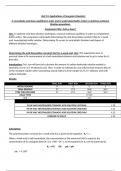
Results:
TRIAL RUN FIRST RUN SECOND RUN THIRD RUN
INITIAL READING 0 0 0 0
FINAL READING 27 27.4 26.8 26.9
TITRE (VILUME USED) 27 27.4 26.8 26.9
MEAN TITRE 27.025
V/2 13.5
PH OF HALF NEUTRALISED ETHANOIC ACID SOLUTION (1ST RUN) 4.28
PH OF HALF NEUTRALISED ETHANOIC ACID SOLUTION (2ND RUN) 4.24
PH OF HALF NEUTRALISED ETHANOIC ACID SOLUTION (3RD RUN) 4.25
AVERAGE PH VALUE 4.26
Calculation:
The acid dissociation constant for a weak acid (Ka) is given by the equation : Ka = ¿ ¿
When a weak acid is half-neutralised, the concentration of the weak acid (HA) is equal to the
concentration of its conjugate base (A-) (i.e. (HA) = (A-) ), so the equation for Ka can be expressed as
Ka = (H+) OR pKa = pH
pKa = 4.2567
, At the half-neutralisation point
This expression can be rearranged to give : Ka = 10-pH
Average pH value of ethanoic acid from my results = 4.2567
Placing this value in the equation = Ka = 10 -4.2567
= Ka = 0.000055 = 5.5 × 10⁻⁵ mol/L
Comparing Ka value for my solution of ethanoic acid against a referenced source for Ka for ethanoic
acid:
According to University of Washington (Link for website: https://depts.washington.edu/eooptic/links/acidstrength.html ) the
Ka for ethanoic acid is 1.8 × 10⁻⁵. Comparing this to the value of Ka value for my solution of ethanoic acid
there is a difference of 0.000037 or 3.7 × 10⁻⁵ and a percentage difference of 69.09%. This means that
impurities are present in the sample or this difference could also be due to experimental errors that
occurred within your experiment.
Investigating buffer solution
Aim: To develop buffer solutions with a certain PH and to research the role that buffer solutions play in
PH maintenance.
Buffer Solution: A weak acid and its conjugate base, or a weak base and its conjugate acid, are
combined to form the water-based solution known as a buffer solution. They withstand being diluted or
having modest amounts of acid or alkali added to them without changing their pH. When a tiny amount
of a strong acid or strong base is added, the pH of buffer solutions barely changes. They are
consequently employed to maintain a consistent pH level. When a little quantity of acid or base is
diluted or added, the buffer solution undergoes very slight variations in its hydrogen ion concentration
(pH). The activity of enzymes and the capacity of the blood to transport oxygen require certain hydrogen
ion concentrations, and buffer solutions are employed in fermentation, food preservation, medicine
administration, electroplating, and printing (pH). pH may be maintained in buffer solutions, which are
mixtures of a weak acid and its conjugate base or a weak base and its conjugate acid. Acidic and
alkaline buffers are the two main groups into which buffer solutions are commonly categorised. Acidic
Buffers are employed to keep surroundings acidic, as their name indicates. A weak acid and its salt are
combined with a strong base to create an acid buffer, which has an acidic pH. Alkaline buffers are
employed to keep things in their fundamental forms. A weak base and its salt are combined with a
strong acid to create basic buffer, which has an acidic pH.
Making buffer solution: 25 cm3 of 1M ethanoic acid solution was measured and poured into a beaker.
Subsequently, 25 cm3 of 1M sodium ethanoate solution was added to the same beaker which made 50
cm3of buffer solution. pH of the buffer solution was measured using a pH meter and then recorded. Then
, the buffer solution was divided into 4 different beakers. In 1 of the 4 beakers 1 cm 3 of hydrochloric acid
(strong acid) was added, in the 2nd beaker 2 cm3 of hydrochloric acid was added, in the 3rd beaker 1 cm3
of sodium hydroxide (strong base) was added and in the 4th beaker 2 cm3 of sodium hydroxide was
added. The pH of all these was recorded.
Results: pH of buffer solution = 4.45
Volume acid/base added pH Change in pH
3
1 cm of hydrochloric acid added to 4.4 4.4 - 4.45 = - 0.05
buffer solution
2 cm3 of hydrochloric acid added to 4.35 4.35 - 4.45 = - 0.1
buffer solution
1 cm3 of sodium hydroxide added to 4.5 4.5 – 4.45 = + 0.05
buffer solution
2 cm3 of sodium hydroxide added to 4.55 4.55 – 4.45 = + 0.1
buffer solution
Henderson Hassel Balch equation = pH = -log Kₐ + log([A⁻]/[HA])
Here we will calculate the theoretical pH of the buffer solution using Henderson Hassel Balch
equation:
Sodium Ethanoate = n = c/v Ethanoic Acid = n = c/v
Sodium Ethanoate = n = 1 x 25/1000 Ethanoic Acid = n = 1 x 25/1000
Sodium Ethanoate = n = 0.025 mol Ethanoic Acid = n = 0.025 mol
= pH = - log (1.8 x 10⁻⁵) + log (0.025/0.025)
= pH = 4.74
Percentage error = 4.74 – 4.45 = 0.29
Percentage error = 0..45 = 0.065
Percentage error = 0.065 x 100 = 6.5 %
Here we will calculate the theoretical pH of the buffer solution when acid is added using Henderson
Hassel Balch equation:
Add HCL → 1cm3 → mol dm3
A: Investigate acid-base equilibria in order and to understand buffer action to optimise acid-base
titration procedures.
Assignment title: Acid or base?
Aim: To optimise acid-base titration techniques, research acid-base equilibria in order to comprehend
buffer action. This assignment will include Determining the acid dissociation constant (Ka) for a weak
acid, Investigating buffer solution, Determining Ph curves for acid-alkalis titrations and Report of
different titration techniques.
Determining the acid dissociation constant (Ka) for a weak acid: Aim: This experiment aims to
precisely show a Ph measurement of a half-neutralized ethanoic acid solution and to get a value for K a
from this.
Introduction: First, you will precisely calculate the amount of sodium hydroxide solution needed to
neutralise 25 cm3 of 1 M ethanoic acid. Then, in order to estimate Ka, you will precisely measure the pH
of the resultant solution after neutralising exactly half of a fresh sample of 25 cm 3 ethanoic acid with
sodium hydroxide.
Results:
TRIAL RUN FIRST RUN SECOND RUN THIRD RUN
INITIAL READING 0 0 0 0
FINAL READING 27 27.4 26.8 26.9
TITRE (VILUME USED) 27 27.4 26.8 26.9
MEAN TITRE 27.025
V/2 13.5
PH OF HALF NEUTRALISED ETHANOIC ACID SOLUTION (1ST RUN) 4.28
PH OF HALF NEUTRALISED ETHANOIC ACID SOLUTION (2ND RUN) 4.24
PH OF HALF NEUTRALISED ETHANOIC ACID SOLUTION (3RD RUN) 4.25
AVERAGE PH VALUE 4.26
Calculation:
The acid dissociation constant for a weak acid (Ka) is given by the equation : Ka = ¿ ¿
When a weak acid is half-neutralised, the concentration of the weak acid (HA) is equal to the
concentration of its conjugate base (A-) (i.e. (HA) = (A-) ), so the equation for Ka can be expressed as
Ka = (H+) OR pKa = pH
pKa = 4.2567
, At the half-neutralisation point
This expression can be rearranged to give : Ka = 10-pH
Average pH value of ethanoic acid from my results = 4.2567
Placing this value in the equation = Ka = 10 -4.2567
= Ka = 0.000055 = 5.5 × 10⁻⁵ mol/L
Comparing Ka value for my solution of ethanoic acid against a referenced source for Ka for ethanoic
acid:
According to University of Washington (Link for website: https://depts.washington.edu/eooptic/links/acidstrength.html ) the
Ka for ethanoic acid is 1.8 × 10⁻⁵. Comparing this to the value of Ka value for my solution of ethanoic acid
there is a difference of 0.000037 or 3.7 × 10⁻⁵ and a percentage difference of 69.09%. This means that
impurities are present in the sample or this difference could also be due to experimental errors that
occurred within your experiment.
Investigating buffer solution
Aim: To develop buffer solutions with a certain PH and to research the role that buffer solutions play in
PH maintenance.
Buffer Solution: A weak acid and its conjugate base, or a weak base and its conjugate acid, are
combined to form the water-based solution known as a buffer solution. They withstand being diluted or
having modest amounts of acid or alkali added to them without changing their pH. When a tiny amount
of a strong acid or strong base is added, the pH of buffer solutions barely changes. They are
consequently employed to maintain a consistent pH level. When a little quantity of acid or base is
diluted or added, the buffer solution undergoes very slight variations in its hydrogen ion concentration
(pH). The activity of enzymes and the capacity of the blood to transport oxygen require certain hydrogen
ion concentrations, and buffer solutions are employed in fermentation, food preservation, medicine
administration, electroplating, and printing (pH). pH may be maintained in buffer solutions, which are
mixtures of a weak acid and its conjugate base or a weak base and its conjugate acid. Acidic and
alkaline buffers are the two main groups into which buffer solutions are commonly categorised. Acidic
Buffers are employed to keep surroundings acidic, as their name indicates. A weak acid and its salt are
combined with a strong base to create an acid buffer, which has an acidic pH. Alkaline buffers are
employed to keep things in their fundamental forms. A weak base and its salt are combined with a
strong acid to create basic buffer, which has an acidic pH.
Making buffer solution: 25 cm3 of 1M ethanoic acid solution was measured and poured into a beaker.
Subsequently, 25 cm3 of 1M sodium ethanoate solution was added to the same beaker which made 50
cm3of buffer solution. pH of the buffer solution was measured using a pH meter and then recorded. Then
, the buffer solution was divided into 4 different beakers. In 1 of the 4 beakers 1 cm 3 of hydrochloric acid
(strong acid) was added, in the 2nd beaker 2 cm3 of hydrochloric acid was added, in the 3rd beaker 1 cm3
of sodium hydroxide (strong base) was added and in the 4th beaker 2 cm3 of sodium hydroxide was
added. The pH of all these was recorded.
Results: pH of buffer solution = 4.45
Volume acid/base added pH Change in pH
3
1 cm of hydrochloric acid added to 4.4 4.4 - 4.45 = - 0.05
buffer solution
2 cm3 of hydrochloric acid added to 4.35 4.35 - 4.45 = - 0.1
buffer solution
1 cm3 of sodium hydroxide added to 4.5 4.5 – 4.45 = + 0.05
buffer solution
2 cm3 of sodium hydroxide added to 4.55 4.55 – 4.45 = + 0.1
buffer solution
Henderson Hassel Balch equation = pH = -log Kₐ + log([A⁻]/[HA])
Here we will calculate the theoretical pH of the buffer solution using Henderson Hassel Balch
equation:
Sodium Ethanoate = n = c/v Ethanoic Acid = n = c/v
Sodium Ethanoate = n = 1 x 25/1000 Ethanoic Acid = n = 1 x 25/1000
Sodium Ethanoate = n = 0.025 mol Ethanoic Acid = n = 0.025 mol
= pH = - log (1.8 x 10⁻⁵) + log (0.025/0.025)
= pH = 4.74
Percentage error = 4.74 – 4.45 = 0.29
Percentage error = 0..45 = 0.065
Percentage error = 0.065 x 100 = 6.5 %
Here we will calculate the theoretical pH of the buffer solution when acid is added using Henderson
Hassel Balch equation:
Add HCL → 1cm3 → mol dm3




