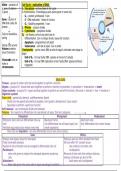
Allele – variation of Cell Cycle – replication of DNA.
a gene. (2 alleles = 1. Interphase – active phase of cell cycle.
1 gene) 6 chromosomes, 3 homologous pairs (same gene in same loci).
- G1 – protein synthesised. ↑size
Gene – section of - S – DNA replicated. ↑mass of nucleus
DNA that codes for - G2 – Doubling organelles. ↑size
protein 2. Mitosis – nucleus divides
3. Cytokinesis – cytoplasm divides
Coils to resemble a G0 – cell leaves cycle at any point due to;
spring - Differentiation. Can no longer divide, leaves for function.
- Apoptosis – programmed cell death
Spring coils around - Senescence – cell rest & repair. Can re-enter.
histone proteins Checkpoints – cyclins check DNA at end of stage & stimulate next stage to
(now Chromatin) begin
- End of G1 – for any faulty DNA. (passes & moves to S phase)
Chromatin coils to - End of G2 – for any DNA replication errors/ faulty DNA. (passes &mitosis
make a triggered)
chromosome
Stem Cells
Tissues – groups of similar cells that work together to perform a function
Organs – groups of 2+ tissues that work together to perform a function (myocardium + epicardium + endocardium = heart)
Organ systems – groups of 2+ organs working together to perform an overall life function. (Pancreas + stomach + liver + intestines =
Digestive system)
Stem cells – genetically identical, undifferentiated, diploid
- Divide into new genetically identical daughter cells (growth, development, tissue repair)
- Specialise to perform a particular function
Self-renewal – can continuously divide and replicate.
Potency – the capacity to differentiate into specialised cell types. Discrete categories.
Totipotent Pluripotent Multipotent
Embryonic stem cells can differentiate into any Blastocyst forms. Adult stem cells
cells Can differentiate into all tissue types (not Only differentiate into certain tissues.
Fertilised egg produced by meiosis (very few) whole organisms)
- Most cells are Unipotent – can only differentiate into its own cell by mitosis.
Uses Ethics
Produce new organs/ tissue for transplant Embryos used are often donated from those
Treat irreversible diseases left over after IVF. Consent issues
Injected at site of disorder and encouraged to differentiate into cell - Use umbilical cord stem cells
Parkinson’s (multipotent)
- stem cells grown to replace the damaged dopamine producing Removal of stem cells from embryo destroys
cells. embryo & Embryos are start of life
Alzheimer’s - Adult stem cells (multipotent)
- Stem cells grown into nerve cells to repair neurological condition
, During Interphase – chromosomes uncoil & DNA replicates to sister chromosomes held by centromere.
Chromosomes – only visible under microscope in mitosis (DNA has replicated and chromosomes seen as sister chromatids)
Sister chromatid - DNA is replicated, 2 genetically identical DNA held by centromere.
Homologous chromosomes – One maternal & one paternal chromosome pair up that are different alleles of the same gene.
Mitosis – process of replicating & dividing the genome
Meiosis (Sexual) - Asexual reproduction, growth, repair, replacement
(Meiosis 1 – PMAT in mitosis +) – separation of homologous pairs - Increase chance of mutations (incorrect base pair affects primary
1. Prophase | structure of protein = secondary structure = tertiary structure)
- Homologous chromosomes pair up and non-sister chromosomes 1. Prophase
cross over forming a bivalent. Point of cross is chiasmata. - Chromatins supercoil and are now visible
2. Metaphase | - Nucleolus disappears and nuclear membrane disintegrates
- Homologous pairs of chromosomes line up on equator - Centrioles migrate to opposite poles
- Independent assortment – line up along equator and each - Spindle fibres form from centrioles
orientates independently. Chromosomes move randomly to 2. Metaphase
separate poles in anaphase - Spindle fibres attach to centromere and move chromosomes to
3. Anaphase | line up across equator.
- Random segregation as homologous chromosomes are pulled to 3. Anaphase
poles - Spindle fibres contract (subunits removed)
- Alleles are exchanged between non-sister chromosomes (variation) - Centromere & chromatids are separated to opposite poles
4. Telophase | 4. Telophase
- Start of cytokinesis to form 2 diploid cells - Nuclear membrane & nucleolus reform
- No homologous pairs. - Chromosomes relax & uncoil (non-visible)
(Meiosis 2 – PMAT in mitosis to each cell) – separation of sister - Spindle fibres break down
chromatids - Cytokinesis begins
1. Prophase || – sister chromatids Cytokinesis – cytoplasm divides to form 2 genetically identical
2. Metaphase ||- Independent assortment of chromosomes daughter cells
3. Anaphase || – random segregation of chromosomes Animal cells Plant cells
4. Telophase ||
1. Cleavage furrow forms 1. cell wall prevents cleavage furrow
- Cytokinesis results in 4 haploid gametes.
in centre of cell 2. Vesicles collect on equator & fuse
- Genetically different (crossing & independent assortment)
2. Actin & Myosin pull 3. Grows to form middle lamella
Sexual Reproduction
cytoskeleton inwards until 4. Cellulose builds each side to form 2
- Random fertilisation is fusing of 2 random haploid cells to form
CSM fuses cell walls.
diploid cell. ↑genetic variation
Centrioles No centrioles
Mitosis Meiosis Become rounded before No shape changes
Prophase Sister Homologous Spindles disappear before Some spindle remains during
chromatid chromosomes form cytokinesis
s bivalent Asexual Reproduction
Metaphase Independent - Single-celled organisms
assortment - Rely on horizontal gene transfer of plasmids for variation.
Anaphase Chromatid Homologous
s pulled to chromosomes pulled to
opposite opposite ends of poles
a gene. (2 alleles = 1. Interphase – active phase of cell cycle.
1 gene) 6 chromosomes, 3 homologous pairs (same gene in same loci).
- G1 – protein synthesised. ↑size
Gene – section of - S – DNA replicated. ↑mass of nucleus
DNA that codes for - G2 – Doubling organelles. ↑size
protein 2. Mitosis – nucleus divides
3. Cytokinesis – cytoplasm divides
Coils to resemble a G0 – cell leaves cycle at any point due to;
spring - Differentiation. Can no longer divide, leaves for function.
- Apoptosis – programmed cell death
Spring coils around - Senescence – cell rest & repair. Can re-enter.
histone proteins Checkpoints – cyclins check DNA at end of stage & stimulate next stage to
(now Chromatin) begin
- End of G1 – for any faulty DNA. (passes & moves to S phase)
Chromatin coils to - End of G2 – for any DNA replication errors/ faulty DNA. (passes &mitosis
make a triggered)
chromosome
Stem Cells
Tissues – groups of similar cells that work together to perform a function
Organs – groups of 2+ tissues that work together to perform a function (myocardium + epicardium + endocardium = heart)
Organ systems – groups of 2+ organs working together to perform an overall life function. (Pancreas + stomach + liver + intestines =
Digestive system)
Stem cells – genetically identical, undifferentiated, diploid
- Divide into new genetically identical daughter cells (growth, development, tissue repair)
- Specialise to perform a particular function
Self-renewal – can continuously divide and replicate.
Potency – the capacity to differentiate into specialised cell types. Discrete categories.
Totipotent Pluripotent Multipotent
Embryonic stem cells can differentiate into any Blastocyst forms. Adult stem cells
cells Can differentiate into all tissue types (not Only differentiate into certain tissues.
Fertilised egg produced by meiosis (very few) whole organisms)
- Most cells are Unipotent – can only differentiate into its own cell by mitosis.
Uses Ethics
Produce new organs/ tissue for transplant Embryos used are often donated from those
Treat irreversible diseases left over after IVF. Consent issues
Injected at site of disorder and encouraged to differentiate into cell - Use umbilical cord stem cells
Parkinson’s (multipotent)
- stem cells grown to replace the damaged dopamine producing Removal of stem cells from embryo destroys
cells. embryo & Embryos are start of life
Alzheimer’s - Adult stem cells (multipotent)
- Stem cells grown into nerve cells to repair neurological condition
, During Interphase – chromosomes uncoil & DNA replicates to sister chromosomes held by centromere.
Chromosomes – only visible under microscope in mitosis (DNA has replicated and chromosomes seen as sister chromatids)
Sister chromatid - DNA is replicated, 2 genetically identical DNA held by centromere.
Homologous chromosomes – One maternal & one paternal chromosome pair up that are different alleles of the same gene.
Mitosis – process of replicating & dividing the genome
Meiosis (Sexual) - Asexual reproduction, growth, repair, replacement
(Meiosis 1 – PMAT in mitosis +) – separation of homologous pairs - Increase chance of mutations (incorrect base pair affects primary
1. Prophase | structure of protein = secondary structure = tertiary structure)
- Homologous chromosomes pair up and non-sister chromosomes 1. Prophase
cross over forming a bivalent. Point of cross is chiasmata. - Chromatins supercoil and are now visible
2. Metaphase | - Nucleolus disappears and nuclear membrane disintegrates
- Homologous pairs of chromosomes line up on equator - Centrioles migrate to opposite poles
- Independent assortment – line up along equator and each - Spindle fibres form from centrioles
orientates independently. Chromosomes move randomly to 2. Metaphase
separate poles in anaphase - Spindle fibres attach to centromere and move chromosomes to
3. Anaphase | line up across equator.
- Random segregation as homologous chromosomes are pulled to 3. Anaphase
poles - Spindle fibres contract (subunits removed)
- Alleles are exchanged between non-sister chromosomes (variation) - Centromere & chromatids are separated to opposite poles
4. Telophase | 4. Telophase
- Start of cytokinesis to form 2 diploid cells - Nuclear membrane & nucleolus reform
- No homologous pairs. - Chromosomes relax & uncoil (non-visible)
(Meiosis 2 – PMAT in mitosis to each cell) – separation of sister - Spindle fibres break down
chromatids - Cytokinesis begins
1. Prophase || – sister chromatids Cytokinesis – cytoplasm divides to form 2 genetically identical
2. Metaphase ||- Independent assortment of chromosomes daughter cells
3. Anaphase || – random segregation of chromosomes Animal cells Plant cells
4. Telophase ||
1. Cleavage furrow forms 1. cell wall prevents cleavage furrow
- Cytokinesis results in 4 haploid gametes.
in centre of cell 2. Vesicles collect on equator & fuse
- Genetically different (crossing & independent assortment)
2. Actin & Myosin pull 3. Grows to form middle lamella
Sexual Reproduction
cytoskeleton inwards until 4. Cellulose builds each side to form 2
- Random fertilisation is fusing of 2 random haploid cells to form
CSM fuses cell walls.
diploid cell. ↑genetic variation
Centrioles No centrioles
Mitosis Meiosis Become rounded before No shape changes
Prophase Sister Homologous Spindles disappear before Some spindle remains during
chromatid chromosomes form cytokinesis
s bivalent Asexual Reproduction
Metaphase Independent - Single-celled organisms
assortment - Rely on horizontal gene transfer of plasmids for variation.
Anaphase Chromatid Homologous
s pulled to chromosomes pulled to
opposite opposite ends of poles