

100% satisfaction guarantee Immediately available after payment Both online and in PDF No strings attached 4.2 TrustPilot
logo-home
Exam (elaborations)

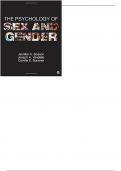
The Psychology Of Sex And Gender 1st Edition by Jennifer Katherine - Test Bank

Rating
-
Sold
-
Pages
451
Grade
A
Uploaded on
29-08-2023
Written in
2022/2023

Chapter 3: The Nature and Nurture of Sex and Gender Test Bank Multiple Choice 1. As early as 1993, Biologist Ann Fausto-Sterling argued what about biological sex? A. that at least five or more biological sexes should be recognized B. that the cultural tendency to view sex as binary is largely correct C. that there are actually three biological sexes D. that the concept of biological sex is meaningless Ans: A Learning Objective: 3-3: Analyze the biological and sociocultural factors that shape sex assignment and gender identity. Cognitive Domain: Knowledge Answer Location: The Nature and Nurture of Sex and Gender Difficulty Level: Easy 2. Each method of sex verification testing in athletics has shortcomings because ______. A. biological sex is irrelevant to athletics B. there are actually three distinct sexes C. sex falls along a continuum from consistently female to consistently male D. there are no reliable hormonal differences between males and females Ans: C Learning Objective: 3-3: Analyze the biological and sociocultural factors that shape sex assignment and gender identity. Cognitive Domain: Comprehension Answer Location: The Nature and Nurture of Sex and Gender Difficulty Level: Medium 3. A gene-by-environment interaction occurs when ______. A. a genetic tendency emerges only under certain environmental circumstances B. environmental factors influence personality regardless of genetic makeup C. genetic predispositions emerge across different environments D. environments pressure the selection of specific genes and traits Ans: A Learning Objective: 3-1: Explain how nature and nurture interactively contribute to the development of sex and gender. Cognitive Domain: Knowledge Answer Location: Gene-by-Environment Interactions Difficulty Level: Easy 4. Which of the following is the best example of a passive gene-by-environment interaction? A. a genetically aggressive person choosing to consume violent media B. a child with an active temperament who elicits rough-and-tumble play from his peers C. genetically athletic parents who begin athletic training for their children at an early age D. strengthened neural connections due to early experiences of aggressive play Ans: C Learning Objective: 3-1: Explain how nature and nurture interactively contribute to the development of sex and gender. Cognitive Domain: Comprehension Answer Location: Gene-by-Environment Interactions Difficulty Level: Medium 5. Which of the following is the best example of nurture (environmental factors) influencing nature (biological differences)? A. naturally artistic parents exposing their children to the arts at an early age B. the finding that girls who experience higher family stress tend to have an earlier age of menstruation C. the relationship between violent media exposure in childhood and aggression in adulthood D. a genetically shy person deliberately choosing quieter environments Ans: B Learning Objective: 3-1: Explain how nature and nurture interactively contribute to the development of sex and gender. Cognitive Domain: Comprehension Answer Location: Gene-by-Environment Interactions Difficulty Level: Medium 6. The findings from Caspi and colleagues’ (2003) longitudinal study on the environmental and genetic roots of depression best support which of the following interpretations? A. Certain genetic predispositions make depression inevitable. B. Genetic vulnerabilities and stressful environments combine to influence the prevalence of depression. C. People suffering from depression most likely had frequent, highly stressful experiences early in life. D. Depression spreads throughout social environments via emotional contagion. Ans: B Learning Objective: 3-2: Explain how chromosomes, genes, and hormones shape sex differentiation in both typical and atypical (intersex) cases. Cognitive Domain: Comprehension Answer Location: Gene-by-Environment Interactions Difficulty Level: Medium 7. The study of biological mechanisms that guide whether or not certain genes get expressed or activated is called ______. A. epigenetics B. metagenetics C. eugenics D. genetics Ans: A Learning Objective: 3-2: Explain how chromosomes, genes, and hormones shape sex differentiation in both typical and atypical (intersex) cases. Cognitive Domain: Knowledge Answer Location: Epigenetics Difficulty Level: Easy 8. The complex series of processes that unfolds as embryos transition into an individual with male, female, or intersex genitalia is called ______. A. sex selection B. sex differentiation C. gender assignment D. genderization Ans: B Learning Objective: 3-2: Explain how chromosomes, genes, and hormones shape sex differentiation in both typical and atypical (intersex) cases. Cognitive Domain: Knowledge Answer Location: How Do Nature and Nurture Shape Sex Differentiation? Difficulty Level: Easy 9. Which of the following best describes what determines a person’s biological sex? A. their external genitalia B. the specific combination of sex chromosomes (e.g., XX and XY) C. a combination of chromosomes, genes, hormones, and internal and external sex organs D. the combination of sex chromosomes and the external genitalia they produce Ans: C Learning Objective: 3-2: Explain how chromosomes, genes, and hormones shape sex differentiation in both typical and atypical (intersex) cases. Cognitive Domain: Knowledge Answer Location: Typical Sex Differentiation Difficulty Level: Easy 10. What type of chromosome contains genes that code for attributes such as eye color, hair color, and height? A. allosome B. autosome C. unisome D. sex chromosomes Ans: B Learning Objective: 3-2: Explain how chromosomes, genes, and hormones shape sex differentiation in both typical and atypical (intersex) cases. Cognitive Domain: Knowledge Answer Location: Typical Sex Differentiation Difficulty Level: Easy 11. Which of the following is TRUE of chromosomes in the human body? A. Every somatic cell contains 26 unpaired of chromosomes. B. All but one chromosome or chromosome pair are non-sex chromosomes. C. Reproductive cells contain paired chromosomes. D. Sperm cells provide a Y chromosome during fertilization. Ans: B Learning Objective: 3-2: Explain how chromosomes, genes, and hormones shape sex differentiation in both typical and atypical (intersex) cases. Cognitive Domain: Knowledge Answer Location: Typical Sex Differentiation Difficulty Level: Easy 12. At the genetic level alone, female and male are defined by ______. A. the presence of androgen B. the presence of estrogen C. the presence or absence of an X chromosome D. the presence or absence of a Y chromosome Ans: D Learning Objective: 3-2: Explain how chromosomes, genes, and hormones shape sex differentiation in both typical and atypical (intersex) cases. Cognitive Domain: Knowledge Answer Location: Typical Sex Differentiation Difficulty Level: Easy 13. The ______ is(are) the sex organ(s) responsible for producing sex cells and hormones. A. gonads B. genitalia C. genital ridge D. genital tubercle Ans: A Learning Objective: 3-2: Explain how chromosomes, genes, and hormones shape sex differentiation in both typical and atypical (intersex) cases. Cognitive Domain: Knowledge Answer Location: Typical Sex Differentiation Difficulty Level: Easy 14. The gonads of female and male embryos begin to differ by sex in the ______ of development. A. third month B. second trimester C. first week D. sixth week Ans: D Learning Objective: 3-2: Explain how chromosomes, genes, and hormones shape sex differentiation in both typical and atypical (intersex) cases. Cognitive Domain: Knowledge Answer Location: Typical Sex Differentiation Difficulty Level: Easy 15. Which of the following is FALSE regarding the role of hormones in sex differentiation? A. The genital ridge develops into female internal genitalia in the absence of androgens. B. Gonads begin producing hormones by about the eighth week of gestation. C. In genetic females, the ovaries produce many hormones prenatally. D. Androgens initiate the biological masculinization in male genitalia. Ans: C Learning Objective: 3-2: Explain how chromosomes, genes, and hormones shape sex differentiation in both typical and atypical (intersex) cases. Cognitive Domain: Comprehension Answer Location: Typical Sex Differentiation Difficulty Level: Medium 16. Which of the following best describes sex differences in the production of testosterone? A. Testosterone is the male hormone while estrogen and progesterone are the female hormones. B. Both sexes produce testosterone, but males produce much more during certain phases of development. C. Sex differences in testosterone are a common misconception. Both sexes produce equal amounts of testosterone. D. At certain phases of development, males produce more testosterone, but in other phases, females produce far more. Ans: B Learning Objective: 3-2: Explain how chromosomes, genes, and hormones shape sex differentiation in both typical and atypical (intersex) cases. Cognitive Domain: Comprehension Answer Location: Typical Sex Differentiation Difficulty Level: Medium 17. Which of the following is NOT one of the four deviations of the typical XX or XY chromosomal pattern that have been widely studied? A. Turner’s syndrome (i.e., a single X chromosome) B. Triple X syndrome (i.e., three X chromosomes) C. Klinefelter syndrome (i.e., an XXY chromosomal pattern) D. Wagner’s syndrome (i.e., a single Y chromosome) Ans: D Learning Objective: 3-2: Explain how chromosomes, genes, and hormones shape sex differentiation in both typical and atypical (intersex) cases. Cognitive Domain: Knowledge Answer Location: Intersex Conditions Difficulty Level: Easy 18. Based on both atypical and typical chromosomal patterns, what relationship appears to exist between chromosomal patterns and gender identity? A. The presence of a Y chromosome strongly predicts a male gender identity. B. The presence of an X chromosome strongly predicts a female gender identity. C. The presence of a third chromosome predicts male gender identity. D. People with atypical chromosomal patterns tend to identify as female. Ans: A Learning Objective: 3-2: Explain how chromosomes, genes, and hormones shape sex differentiation in both typical and atypical (intersex) cases. Cognitive Domain: Comprehension Answer Location: Intersex Conditions Difficulty Level: Medium 19. Which of the following is NOT true of genetic females with congenital adrenal hyperplasia (CAH)? A. They often undergo feminization surgery of their genitalia in infancy. B. Most ultimately identify as male. C. They play with male typical toys more than their sisters without CAH. D. They show decreased satisfaction with their sex assignment. Ans: B Learning Objective: 3-2: Explain how chromosomes, genes, and hormones shape sex differentiation in both typical and atypical (intersex) cases. Cognitive Domain: Comprehension Answer Location: Intersex Conditions Difficulty Level: Medium 20. People with conditions that make the cells of the body less responsive to androgens tend to ______. A. only affect the gender identity of females B. appear female at birth and develop a female gender identity C. develop gender identities inconsistent with their genetic sex if female D. be born with enlarged genitalia Ans: B Learning Objective: 3-2: Explain how chromosomes, genes, and hormones shape sex differentiation in both typical and atypical (intersex) cases. Cognitive Domain: Comprehension Answer Location: Intersex Conditions Difficulty Level: Medium 21. Which of the following is TRUE of the relationship between culture and the experiences of intersex individuals? A. Intersex individuals are at increased risk of violence in any culture. B. Western countries tend to be more inclusive of intersex individuals. C. All cultures tend to respond to intersexuality in the same manner. D. Social and legal exclusion of intersex individuals is unrelated to violence towards them. Ans: A Learning Objective: 3-2: Explain how chromosomes, genes, and hormones shape sex differentiation in both typical and atypical (intersex) cases. Cognitive Domain: Comprehension Answer Location: Intersex Conditions Difficulty Level: Medium 22. ______ refers to the binary sex that doctors and parents perceive as the best option for newborn infants whose genitalia appear atypical. A. Optimal sex B. Target sex C. Biological sex D. Socialized sex Ans: A Learning Objective: 3-3: Analyze the biological and sociocultural factors that shape sex assignment and gender identity. Cognitive Domain: Knowledge Answer Location: Optimal Sex Difficulty Level: Easy 23. John Money’s optimal sex policy at John Hopkins University reflected his belief that ______. A. gender identity is primarily driven by genetic sex B. gender identity doesn’t begin forming until adolescence C. social factors can override any role that biology plays in gender identity D. physical appearance may not be consistent with assigned sex Ans: C Learning Objective: 3-3: Analyze the biological and sociocultural factors that shape sex assignment and gender identity. Cognitive Domain: Comprehension Answer Location: Optimal Sex Difficulty Level: Medium 24. Dr. Johnson rejects optimal sex policies on ethical grounds. Which of the following recommendations is Dr. Johnson most likely to make to parents who give birth to an intersex child? A. consider surgery to ensure physical appearance is consistent with assigned sex B. offer treatments to ensure typical hormone levels for the child C. recommend postponing any treatments until the child becomes old enough to contribute to the decision D. advise parents to select the sex and raise their child as that sex Ans: C Learning Objective: 3-3: Analyze the biological and sociocultural factors that shape sex assignment and gender identity. Cognitive Domain: Application Answer Location: Optimal Sex Difficulty Level: Hard 25. Which of the following best describes the case story of David Reimer, a genetic boy raised a girl? A. Reimer’s story is a perfect example of John Money’s views on gender identity. B. Reimer’s story indicates that gender identity cannot be entirely shaped by socialization. C. Reimer experienced no psychological trauma from being raised as a girl. D. Reimer’s story is inconsistent with larger studies of intersex individuals. Ans: B Learning Objective: 3-3: Analyze the biological and sociocultural factors that shape sex assignment and gender identity. Cognitive Domain: Comprehension Answer Location: Gender Identity Difficulty Level: Medium 26. The Meyer-Bahlburg (2005) study of genetic males who were raised as female found that ______. A. .6% experienced symptoms of gender dysphoria B. they were 37 times more likely to be transgender than the U.S. population as a whole C. most failed to develop the female gender identity they were socialized to adopt D. chromosomes and hormones are a more dominant influence upon gender identity than socialization Ans: B Learning Objective: 3-3: Analyze the biological and sociocultural factors that shape sex assignment and gender identity. Cognitive Domain: Knowledge Answer Location: Gender Identity Difficulty Level: Easy 27. Which best describes the implications of the Meyer-Bahlburg (2005) study (examining genetic males raised as females) for the nature versus nurture debate as it relates to the development of gender identity? A. Biological variables are a stronger influence than socialization. B. Chromosomes and hormones rarely override the influence of socialization and rearing. C. It is not possible to distinguish between biological (nature) and social (nurture) variables when studying gender identity development. D. Nurture variables (e.g., rearing) have strong effects upon gender identity, but they can be overridden by nature variables (e.g., chromosomes and hormones). Ans: D Learning Objective: 3-3: Analyze the biological and sociocultural factors that shape sex assignment and gender identity. Cognitive Domain: Analysis Answer Location: Gender Identity Difficulty Level: Medium 28. A(n) ______ is a statistic that specifies the proportion of total population variance in a given trait that is due to genetic differences among the people in the population. a genetic effect size B. inherited ratio C. epigenetic variance D. heritability estimate Ans: D Learning Objective: 3-3: Analyze the biological and sociocultural factors that shape sex assignment and gender identity. Cognitive Domain: Knowledge Answer Location: Gender Identity Difficulty Level: Easy 29. What does it mean if the heritability estimate of conscientiousness in a population is .27? A. Out of 100 people, approximately 27 will have inherited traits for high conscientiousness B. Twenty-seven percent of an individual’s conscientiousness traits are explained by his or her genes. C. Genes explain 27% of the population variance in conscientiousness D. Twenty-seven percent of the population will have conscientiousness traits explained entirely by their genes. Ans: C Learning Objective: 3-3: Analyze the biological and sociocultural factors that shape sex assignment and gender identity. Cognitive Domain: Comprehension Answer Location: Gender Identity Difficulty Level: Medium 30. Heritability estimates are calculated by ______. A. comparing the similarity of monozygotic and dizygotic twins B. correlating the presence of specific genes with traits in a population C. manipulating the social environment in which dizygotic twins are raised D. administering hormones to one twin in a monozygotic pair Ans: A Learning Objective: 3-3: Analyze the biological and sociocultural factors that shape sex assignment and gender identity. Cognitive Domain: Comprehension Answer Location: Gender Identity Difficulty Level: Medium 31. Studies providing heritability estimates for gender identity suggest that ______. A. biological factors primarily contribute to gender identity status B. social factors primarily contribute to gender identity status C. the heritability of gender identity is similar to the heritability of major personality traits D. socialization determines gender identity but only in the presence of specific chromosomal and hormonal patterns Ans: C Learning Objective: 3-3: Analyze the biological and sociocultural factors that shape sex assignment and gender identity. Cognitive Domain: Comprehension Answer Location: Gender Identity Difficulty Level: Medium 32. Which of the following is TRUE of studies examining the heritability of masculine and feminine traits? A. For men, approximately 20–48% of their masculine traits is explained by genes. B. Feminine traits are more heritable than masculine traits. C. They find no genetic influences on sex-typed preferences for toys among children. D. Around 52–80% of the population variance in feminine and masculine traits is explained by social and environmental factors. Ans: D Learning Objective: 3-3: Analyze the biological and sociocultural factors that shape sex assignment and gender identity. Cognitive Domain: Knowledge Answer Location: Gender Identity Difficulty Level: Easy 33. In a review of longitudinal studies, White, Hughto and Reisner (2016) found what effects of hormone treatments among Transwomen and Transmen? A. Transmen showed significant declines in their physical health. B. Both Transmen and Transwomen showed significant decreases in anxiety and depression. C. Transwomen showed increased rates of depression while Transmen showed decreased rates. D. Hormone treatments had no effects on mental health. Ans: B Learning Objective: 3-3: Analyze the biological and sociocultural factors that shape sex assignment and gender identity. Cognitive Domain: Knowledge Answer Location: Gender Confirmation Procedures Difficulty Level: Easy 34. Gender confirmation procedures refer to ______. A. a set of procedures (e.g., surgery) designed to align one’s physical body with gender identity B. psychological treatment designed to change one’s gender identity to be consistent with biological sex C. feminization or masculinization procedures given to intersex infants at birth D. the process of determining and assigning gender to newborns Ans: A Learning Objective: 3-3: Analyze the biological and sociocultural factors that shape sex assignment and gender identity. Cognitive Domain: Knowledge Answer Location: Gender Confirmation Procedures Difficulty Level: Easy 35. Which of the following is NOT true of sex differences in brain size? A. Male brains are on average 11% larger in volume than female. B. Women tend to have larger frontal pole cortexes (responsible for planning and decision making). C. Men tend to have large left hippocampuses (responsible for memory, learning, and emotion). D. Women’s left hemispheres are slightly larger when body size is taken into account. Ans: D Learning Objective: 3-4: Evaluate evidence for sex differences in the brain and the prevalence of neurosexism. Cognitive Domain: Knowledge Answer Location: Sex Differences in the Brain Difficulty Level: Easy 36. MRI allows researchers to look at brain ______ and fMRI allows them to examine brain ______. A. activity; function B. activity; hormones C. hormones; function D. structures; activity Ans: D Learning Objective: 3-4: Evaluate evidence for sex differences in the brain and the prevalence of neurosexism. Cognitive Domain: Knowledge Answer Location: Sex Differences in the Brain Difficulty Level: Easy 37. What is meant by neural plasticity? A. the various stages of neural development from birth to early adulthood B. the vulnerability of specific brain structures to hormonal imbalances C. the brain’s ability to generate new neurons in adulthood D. the brain’s ability to reorganize physically in response to environmental factors Ans: D Learning Objective: 3-4: Evaluate evidence for sex differences in the brain and the prevalence of neurosexism. Cognitive Domain: Knowledge Answer Location: Sex Differences in the Brain Difficulty Level: Easy 38. Ruigrok et al., (2014) found that, compared to women, men tend to show greater volume in the left amygdala (a part of the limbic system involved in processing and expressing emotions, especially fear). What can be concluded from this finding? A. Sex differences in fear expression are more driven by nature than nurture. B. That men tend to have better memories of highly emotional experiences. C. Men will generally feel more afraid than women. D. This finding alone is not indicative of any meaningful sex differences in emotional experiences. Ans: D Learning Objective: 3-4: Evaluate evidence for sex differences in the brain and the prevalence of neurosexism. Cognitive Domain: Application Answer Location: Equating the Brain with “Nature” Difficulty Level: Hard 39. In her 2009 book--Pink Brain, Blue Brain--Lise Eliot puts forth what interpretation of observed sex differences in the brain? A. Gender stereotypes create different life experiences for boys and girls which exaggerate structural differences in the brain. B. The presence of sex differences in brain structures is evidence of a stronger role of nature over nurture. C. Sex differences in brain structures are primarily influenced by the presence or absence of androgens during gestation. D. That when looked at on the whole, sex differences in brain structures are too small to research meaningfully. Ans: A Learning Objective: 3-4: Evaluate evidence for sex differences in the brain and the prevalence of neurosexism. Cognitive Domain: Knowledge Answer Location: Equating the Brain with “Nature” Difficulty Level: Easy 40. When Cordelia Fine introduced the concept of neurosexism in her 2010 book, Delusions of Gender, what did she mean by it? A. People tend to interpret neuroscience research in ways that reinforce gender stereotypes. B. The field of neuroscience is unwelcoming to female colleagues. C. The bulk of sex differences in brain structures actually give women a slight cognitive edge. D. Studying sex differences in neuroanatomy is inherently damaging to women’s progress. Ans: A Learning Objective: 3-4: Evaluate evidence for sex differences in the brain and the prevalence of neurosexism. Cognitive Domain: Knowledge Answer Location: Neuroscience or Neurosexism Difficulty Level: Easy 41. According to evolutionary psychology in what contexts should sex differences emerge? A. in domains in which women and men historically faced different adaptive problems B. for behaviors that are rewarded differently for men and women by cultures C. in traits that only helped males or females attract as many mates as possible D. for capacities that helped detect predators and immediate threats in the environment Ans: A Learning Objective: 3-5: Examine the roles of nature and nurture in theories of the origins of sex differences. Cognitive Domain: Comprehension Answer Location: Evolutionary Psychology Difficulty Level: Medium 42. Throughout evolutionary history women have faced unique challenges when it comes to ______ while men have faced the challenge of ______. A. foraging; hunting B. paternity uncertainty; commitment to children C. bearing children; paternity uncertainty D. spatial reasoning; linguistics Ans: C Learning Objective: 3-5: Examine the roles of nature and nurture in theories of the origins of sex differences. Cognitive Domain: Knowledge Answer Location: Evolutionary Psychology Difficulty Level: Easy 43. Which of the following traits is the best example of a trait that would give an organism a competitive edge with respect to intrasexual selection A. the ornate, colorful plumage of peacocks B. the head-butting horns of bighorn sheep C. the manes of lions D. the elaborate songs and whistles of birds Ans: B Learning Objective: 3-5: Examine the roles of nature and nurture in theories of the origins of sex differences. Cognitive Domain: Application Answer Location: Evolutionary Psychology Difficulty Level: Hard 44. For what reason does evolutionary psychology argue women are more selective than men when choosing mates? A. Women have low expectations for their enjoyment of sexual intimacy. B. Women have to invest more in producing offspring. C. Women can never be completely sure who the father of their child is. D. Women’s roles in human societies tend to be less risky and allow for them to take their time in selecting mates. Ans: B Learning Objective: 3-5: Examine the roles of nature and nurture in theories of the origins of sex differences. Cognitive Domain: Comprehension Answer location: Evolutionary Psychology Difficulty Level: Medium 45. Relative to women, men tend to prefer mates who are ______, while women tend to value ______ more than men. A. high status; sense of humor B. educated; physical attractiveness C. young; sexual fidelity D. physically attractive; access to resources Ans: D Learning Objective: 3-5: Examine the roles of nature and nurture in theories of the origins of sex differences. Cognitive Domain: Knowledge Answer Location: Evolutionary Psychology Difficulty Level: Easy 46. According to evolutionary psychology which quality should both sexes be equally likely to rate as essential in a mate? A. assertiveness B. kindness C. attractiveness D. social status Ans: B Learning Objective: 3-5: Examine the roles of nature and nurture in theories of the origins of sex differences. Cognitive Domain: Comprehension Answer Location: Evolutionary Psychology Difficulty Level: Medium 47. Evolutionary psychology faces a challenge to its scientific merit because ______. A. the theory of natural selection has undergone recent revisions as our understanding of genetics has advanced B. it does not contribute any meaningful hypotheses regarding same-sex relationships C. its predictions can be speculative and difficult to test empirically D. there is evidence of increased bias in the field of evolutionary psychology Ans: C Learning Objective: 3-5: Examine the roles of nature and nurture in theories of the origins of sex differences. Cognitive Domain: Comprehension Answer Location: Evolutionary Psychology Difficulty Level: Medium 48. According to biosocial constructionist theory, the key to understanding sex differences and similarities between men and women is ______. A. the division of labor in society B. to examine the different problems men and women faced in ancient cultures C. how early childhood experiences affect the prevalence of different hormones during development D. to examine how men and women respond to social hierarchies in modern society Ans: A Learning Objective: 3-5: Examine the roles of nature and nurture in theories of the origins of sex differences. Cognitive Domain: Comprehension Answer Location: Biosocial Constructionist Theory Difficulty Level: Medium 49. What outcome does biosocial constructionist theory predict decreases in physically demanding jobs and increases in cognitively oriented jobs to have upon sex differences? A. It should reinforce gender stereotypes as women and men are free to pursue their preferences. B. Women should see increases in their intellectual abilities relative to men. C. Men should become more competitive as the job market is more saturated. D. Expectations for women to stay in child rearing and nurturing social roles should decrease. Ans: D Learning Objective: 3-5: Examine the roles of nature and nurture in theories of the origins of sex differences. Cognitive Domain: Application Answer Location: Biosocial Constructionist Theory Difficulty Level: Hard 50. Which of the following best describes a key difference in the predictions made by evolutionary psychology and biosocial constructionist theory? A. Biosocial constructionist theory argues that changes in cultural gender stereotypes can occur more rapidly than evolutionary psychology predicts. B. Biosocial constructionist theory posits that sex differences are affected by both biology and culture whereas evolutionary psychology does not. C. Evolutionary psychology predicts sex differences in the volume of brain structures but this is inconsistent with biosocial constructionist theory. D. Evolutionary psychology predicts sex differences in assertiveness and risk-taking while biosocial constructionist theory argues there are no differences in psychological variables. Ans: A Learning Objective: 3-5: Examine the roles of nature and nurture in theories of the origins of sex differences. Cognitive Domain: Analysis Answer Location: Biosocial Constructionist Theory Difficulty Level: Medium True/False 1. Epigenetics research demonstrates that a mother’s diet, sleep patterns, or stress levels during pregnancy may affect gene expression in her offspring Ans: T Learning Objective: 3-1: Explain how nature and nurture interactively contribute to the development of sex and gender. Cognitive Domain: Comprehension Answer Location: Epigenetics Difficulty Level: Medium 2. The story of David Reimer, a genetic boy raised as a girl, is consistent with John Money’s assumption that nurture overrides nature in determining individuals’ gender identity. Ans: F Learning Objective: 3-3: Analyze the biological and sociocultural factors that shape sex assignment and gender identity. Cognitive Domain: Comprehension Answer Location: Gender Identity Difficulty Level: Medium 3. There is little cultural variability in the treatment and acceptance of intersex and transgender individuals. Ans: F Learning Objective: 3-2: Explain how chromosomes, genes, and hormones shape sex differentiation in both typical and atypical (intersex) cases. Cognitive Domain: Knowledge Answer Location: The Nature and Nurture of Sex and Gender Difficulty Level: Easy 4. Most scientists today agree that nurture rather than nature is the primary factor influencing sex and gender. Ans: F Learning Objective: 3-1: Explain how nature and nurture interactively contribute to the development of sex and gender. Cognitive Domain: Comprehension Answer Location: Nature Versus Nurture or Nature and Nurture? Difficulty Level: Medium 5. By looking at either external genitalia or sex chromosomes scientists can accurately determine a person’s sex. Ans: F Learning Objective: 3-3: Analyze the biological and sociocultural factors that shape sex assignment and gender identity. Cognitive Domain: Knowledge Answer Location: Typical Sex Differentiation Difficulty Level: Easy 6. Throughout most of childhood boys and girls do not differ much in their hormone levels. Ans: T Learning Objective: 3-2: Explain how chromosomes, genes, and hormones shape sex differentiation in both typical and atypical (intersex) cases. Cognitive Domain: Knowledge Answer Location: Typical Sex Differentiation Difficulty Level: Easy 7. Genetic males with complete androgen insensitivity typically develop a female gender identity. Ans: T Learning Objective: 3-2: Explain how chromosomes, genes, and hormones shape sex differentiation in both typical and atypical (intersex) cases. Cognitive Domain: Knowledge Answer Location: Intersex Conditions Difficulty Level: Easy 8. Gender identity is roughly as heritable as personality in general. Ans: T Learning Objective: 3-3: Analyze the biological and sociocultural factors that shape sex assignment and gender identity. Cognitive Domain: Knowledge Answer Location: Gender Identity Difficulty Level: Easy 9. White, Hughto, and Reisner’s (2016) longitudinal study of transgender people seeking gender confirmation procedures found that initiating hormone treatments increased anxiety and depression symptoms. Ans: F Learning Objective: 3-3: Analyze the biological and sociocultural factors that shape sex assignment and gender identity. Cognitive Domain: Knowledge Answer Location: Gender Confirmation Procedures Difficulty Level: Easy 10. The sizes of a brain structures are reliable predictors of meaningful behavioral and psychological sex differences. Ans: F Learning Objective: 3-4: Evaluate evidence for sex differences in the brain and the prevalence of neurosexism. Cognitive Domain: Knowledge Answer Location: Sex Differences in the Brain Difficulty Level: Easy 11. Sex differences in brain structures are indicative of innate, biological differences between female and male individuals. Ans: F Learning Objective: 3-4: Evaluate evidence for sex differences in the brain and the prevalence of neurosexism. Cognitive Domain: Comprehension Answer Location: Equating the Brain with “Nature” Difficulty Level: Medium 12. According to evolutionary psychology, a primary reproductive problem men have adapted to is paternity uncertainty. Ans: T Learning Objective: 3-5: Examine the roles of nature and nurture in theories of the origins of sex differences. Cognitive Domain: Knowledge Answer Location: Evolutionary Psychology Difficulty Level: Easy 13. Eagly and Wood (1999) find that cultures with high gender equality exhibit smaller sex differences in mating preferences based on earning potential. Ans: T Learning Objective: 3-5: Examine the roles of nature and nurture in theories of the origins of sex differences. Cognitive Domain: Knowledge Answer Location: Evolutionary Psychology Difficulty Level: Easy 14. According to biosocial constructionist theory, sex differences in traits related to warmth and assertiveness emerge from how societies divide labor. Ans: T Learning Objective: 3-5: Examine the roles of nature and nurture in theories of the origins of sex differences. Cognitive Domain: Knowledge Answer Location: Biosocial Constructionist Theory Difficulty Level: Easy 15. Biosocial constructionist theory argues that sex differences in psychological factors such as personality traits, mating preferences, and jealousy are not genetically heritable. Ans: T Learning Objective: 3-5: Examine the roles of nature and nurture in theories of the origins of sex differences. Cognitive Domain: Knowledge Answer Location: Biosocial Constructionist Theory Difficulty Level: Easy Short Answer 1. What is meant by a gene-by-environment interaction? Ans: A gene-by-environment interaction occurs when a tendency emerges only under certain environmental circumstances, or when an environment shapes traits or behavior only for individuals with a particular genetic makeup. Learning Objective: 3-1: Explain how nature and nurture interactively contribute to the development of sex and gender. Cognitive Domain: Knowledge Answer Location: Gene-by-Environment Interactions Difficulty Level: Easy 2. Briefly describe how epigenetics explains why identical twins, who are genetic copies of each other, nonetheless different in subtle ways? Ans: Epigenetic marks are molecular structures that activate or deactivate genes. As the environments of identical twins diverge epigenetic markers may activate different genes in their cells. Learning Objective: 3-1: Explain how nature and nurture interactively contribute to the development of sex and gender. Cognitive Domain: Comprehension Answer Location: Epigenetics Difficulty Level: Medium 3. What is the difference between autosomes and allosomes? Ans: Autosomes are non-sex chromosomes that contain genes that code for attributes such as eye color, hair color, and height. Allosomes are sex chromosomes which contain genes that code for sex. Learning Objective: 3-2: Explain how chromosomes, genes, and hormones shape sex differentiation in both typical and atypical (intersex) cases. Cognitive Domain: Knowledge Answer Location: Typical Sex Differentiation Difficulty Level: Easy 4. During what periods of development are there NO sex differences in the presence of testosterone? Ans: From about the 24th week of gestation until puberty, except for a 6-month period immediately after birth in which boys’ testosterone levels surge briefly. Learning Objective: 3-2: Explain how chromosomes, genes, and hormones shape sex differentiation in both typical and atypical (intersex) cases. Cognitive Domain: Knowledge Answer Location: Typical Sex Differentiation Difficulty Level: Easy 5. Briefly describe Congenital Adrenal Hyperplasia (CAH). How is the gender identity of genetic females with CAH similar to or different from non-CAH females? Ans: CAH is a condition in which the body over manufactures androgens. Genetic females with CAH typically identified as female but they show less satisfaction with their sex assignment and more mail typical gender identity than non-CAH females. Learning Objective: 3-2: Explain how chromosomes, genes, and hormones shape sex differentiation in both typical and atypical (intersex) cases. Cognitive Domain: Knowledge Answer Location: Intersex Conditions Difficulty Level: Easy 6. Juan is reading an academic article claiming that the heritability of intelligence is approximately 63%. He interprets this as meaning that in explaining the average person’s intelligence, roughly 63% of that persons intelligence is inherited or caused by their genes. It is Juan’s interpretation correct? Why or why not? Ans: No, heritability estimates indicate the percentage of population variance on a trait that is explained by genes, not an individual’s score on that trait. Learning Objective: 3-3: Analyze the biological and sociocultural factors that shape sex assignment and gender identity. Cognitive Domain: Application Answer Location: Gender Identity Difficulty Level: Hard 7. Describe a few qualities human males evolved to give them an upper hand in intersexual selection and explain why they are examples of intersexual selection specifically. Ans: Examples include qualities such as physical size, greater strength, and competitive and aggressive tendencies because these qualities helped men to win competitions for mating opportunities against other men. Learning Objective: 3-5: Examine the roles of nature and nurture in theories of the origins of sex differences. Cognitive Domain: Comprehension Answer Location: Evolutionary Psychology Difficulty Level: Medium Essay 1. Consider both John Money’s optimal sex policy and the case story of David Reimer. Are the assumptions of John Money’s policy consistent or inconsistent with David Reimer’s experience? What do each imply about the role of nature and nurture in determining individuals’ gender identity? Provide an example of how John Money’s might recommend parents respond to the birth of an intersex child. Lastly, indicate whether or not David Reimer’s story might suggest recommendations different from John Money’s optimal sex policy. Ans: John Money assumed that nurture is stronger than nature in determining individuals gender identity. He claimed that a child born with visually atypical genitals could be raised successfully as either female or male, contingent upon strong and consistent socialization pressure from parents and the surrounding environment. David Reimer was a genetic boy raised as a girl following a botched circumcision that accidentally removed most of his penis. However, David never felt like a girl growing up and later adopted a male gender identity. David’s experience suggests that nature can sometimes override nurture in determining gender identity, thus it is inconsistent with John Money’s optimal sex policy. John Money would recommend parents of intersex children to decide either to raise their child as a male or female from birth. David’s experience suggests that determining gender identity is more complex than socialization alone can explain, and that it may be best to wait until the child is old enough to contribute to decisions about their sex assignment. Learning Objective: 3-3: Analyze the biological and sociocultural factors that shape sex assignment and gender identity. Cognitive Domain: Analysis Answer Location: Optimal Sex Difficulty Level: Medium 2. Does the existence of sex differences in brain structure necessitate a stronger role of nature than nurture in causing these differences? Explain why or why not. Discuss both neural plasticity and the insights of neuroscientist Lise Eliot’s book, Pink Brain, Blue Brain, in your answer. Ans: According to Lise Eliot gender stereotypes have the power to enlarge what our only small sex differences in infants brain structures of birth and great sex differences in brain structures that were not present at birth. This suggests that the different experiences of boys and girls may contribute to observed differences in brain structure. Thus the brain’s plasticity renders it modifiable by the different expectations and patterns of reward cultures impart upon boys and girls from a young age. Learning Objective: 3-4: Evaluate evidence for sex differences in the brain and the prevalence of neurosexism. Cognitive Domain: Analysis Answer Location: Equating the Brain with “Nature” Difficulty Level: Medium 3. Explain both evolutionary psychology’s and biosocial constructionist theory’s accounts of the role of nature and nurture in sex differences. Discuss where their predictions about sex differences diverge. Ans: Evolutionary theorists tend to view the human brain as a fossil that represents adaptations to conditions that occurred tens of thousands of years ago, which means that recent changes in occupational or social roles should not change our fundamental psychology much. They propose that sex differences in tendencies such as mating preferences, competitiveness, sexual jealousy, and nurturance are genetically coded at the species level and therefore unlikely to change over the short term. Biosocial constructionist theorists assume that sex differences in psychological factors such as personality traits, mating preferences, and jealousy are not genetically heritable. From this view, sex differences in psychological variables are determined by how labor is divided in society, which is partly determined by biological sex differences in physical strength and size. Therefore they would predict that changes in social roles can create rapid changes in the psychology of men and women, resulting in changes in cultural gender stereotypes. Learning Objective: 3-5: Examine the roles of nature and nurture in theories of the origins of sex differences. Cognitive Domain: Analysis Answer Location: Biosocial Constructionist Theory Difficulty Level: Medium abnormal psychology test bank, ap psychology test bank, developmental psychology test bank, social psychology test bank pdf, abnormal psychology test bank pdf, myers ap psychology test bank pdf, developmental psychology test bank pdf, openstax psychology test bank chapter 1, openstax psychology test bank, introduction to psychology test bank, abnormal child psychology test bank, ap psychology unit 7 test bank, ap psychology unit 4 test bank, ap psychology unit 6 test bank, ap psychology unit 5 test bank, psychology themes and variations test bank, psychology themes and variations test bank pdf, biological psychology test bank, the psychology of criminal and violent behaviour test bank, research methods in psychology beth morling test bank, behavioral finance psychology decision-making and markets test bank, kalat biological psychology test bank, test bank answers, are test banks worth it, psychology question bank pdf class 12, what are test bank questions, psychological test example, psychological test topics, types of interest test in psychology, psychological test companies, cognitive psychology test bank, cognitive psychology test bank pdf, clinical psychology test bank, cengage psychology test bank, abnormal child psychology 7th edition test bank, social psychology 8th Canadian edition test bank, abnormal psychology 6th Canadian edition test bank free, psychology themes and variations 6th Canadian edition test bank, derby psychology test bank, psychology test bank pdf download, what is a test in psychology, what is a good test in psychology, what are some psychological tests, experimental psychology test bank, educational psychology test bank pdf, educational psychology test bank, psychology themes and variations 6th edition test bank, essentials of understanding psychology 14th edition test bank, psychology themes and variations 5th edition test bank, psychology frontiers and applications 7th edition test bank, psychology test bank free, test bank for abnormal psychology, test bank questions for psychology, what is a psychological test in psychology, test bank for psychology, myers psychology for AP test bank, are test banks cheating, health psychology test bank, cultural psychology Heine test bank, test bank answer key, psychology question bank IB, example of an interest test in psychology, what is an interest test in psychology, industrial psychology test bank pdf, introduction to psychology test bank pdf, industrial-organizational psychology test bank, abnormal psychology an integrative approach test bank, industrial psychology Aamodt test bank, psychological assessment test example, psychology test bank pdf, test bank psychology, psych test bank, myers social psychology test bank, most accurate psychology test, what is the MMPI test in psychology, openstax psychology 2e test bank, openstax psychology test bank chapter 3, openstax psychology test bank chapter 6, industrial/organizational psychology test bank pdf, psychology test-bank (PTB) committee, psychology question bank pdf, abnormal psychology test bank questions pdf, AP psychology unit 5 test bank quizlet, psychological test example questions, psychological test instructions, test bank psychology themes and variations, AP psychology unit 9 test bank, AP psychology unit 10 test bank, AP psychology unit 3 test bank, AP psychology unit 11 test bank, AP psychology unit 8 test bank, what is a valid test in psychology, what questions are on a psychological test, z test psychology, psychology question bank class 12 HSC, psychology 1000 test bank, test bank psychology 101, AP psychology unit 1 test bank, what is psychology chapter 1 test. Chapter 1: Introducing Sex and Gender Test Bank Multiple Choice 1. The study of gender psychology first gained traction ______. A. in 1879 when William Wundt founded the first psychology lab B. during the Women’s suffrage movement of the early 1900s C. in response to large numbers of women entering the workforce during World War II D. during the second wave of the women’s movement in the 1970s Ans: D Learning Objective: 1-3: Evaluate the meaning and relevance of feminisms, gender movements, and systems of power, privilege, and inequality. Cognitive Domain: Knowledge Answer Location: Introducing Sex and Gender Difficulty Level: Easy 2. Rhoda Unger (1979) argued for using “sex” to refer to the ______ aspects of being female or male while “gender” should be used when discussing the ______ aspects. A. culturally constructed; biological B. hormonal; culturally constructed C. biological; culturally constructed D. anatomical; hormonal Ans: C Learning Objective: 1-1: Explain central terminology in the study of sex and gender. Cognitive Domain: Knowledge Answer Location: Sex and Gender Difficulty Level: Easy 3. To address the ambiguity of biological and social causes of sex differences, Alice Eagly (2013) suggests using “sex” to refer to ______ and “gender” to ______. A. groups of people; the meanings given to different sex categories B. culturally constructed differences; biological differences C. biological categories; social meaning given to those categories D. a chosen social identity; a category given to you at birth Ans: A Learning Objective: 1-1: Explain central terminology in the study of sex and gender. Cognitive Domain: Knowledge Answer Location: Sex and Gender Difficulty Level: Easy 4. Using “sex” to refer to biological differences between men and women and “gender” to refer to the culturally constructed differences is problematic for which of the following reasons? A. Biology has too small of an influence to warrant its own term. B. It overemphasizes the role of socialization and cultural forces. C. It is difficult to pinpoint the precise influence of biology and culture in sex differences. D. The terms sex and gender fail to account for issues related to intersectionality. Ans: C Learning Objective: 1-1: Explain central terminology in the study of sex and gender. Cognitive Domain: Comprehension Answer Location: Sex and Gender Difficulty Level: Medium 5. Researchers have found that testosterone ______. A. is stable and generally insensitive to social events B. increases during competition but only for men C. decreases when women perform masculine behaviors D. decreases when men perform feminine behaviors Ans: D Learning Objective: 1-2: Evaluate how culture, gender identity, and sexual orientation shape the experience and expression of sex and gender. Cognitive Domain: Knowledge Answer Location: Sex and Gender Difficulty Level: Easy 6. Research shows that differences in physical aggression between men and women are ______. A. due to hormonal differences, such as higher levels of testosterone in men B. primarily caused by differences in brain structure arising from the presence of androgen during fetal development C. caused by men being socialized to be risky and to direct negative emotion outward D. most likely caused by some mixture of biological and social factors Ans: D Learning Objective: 1-2: Evaluate how culture, gender identity, and sexual orientation shape the experience and expression of sex and gender. Cognitive Domain: Comprehension Answer Location: Sex and Gender Difficulty Level: Medium 7. Which of the following do sex binaries NOT accomplish? A. communicating the variety in the biological components of sex B. simplifying social interactions C. organizing labor divisions D. maintaining order in social institutions Ans: A Learning Objective: 1-2: Evaluate how culture, gender identity, and sexual orientation shape the experience and expression of sex and gender. Cognitive Domain: Application Answer Location: The Sex and Gender Binaries Difficulty Level: Hard 8. Around what percent of infants are born with some form of intersexuality? A. 2% B. 5% C. 10% D. 20% Ans: A Learning Objective: 1-2: Evaluate how culture, gender identity, and sexual orientation shape the experience and expression of sex and gender. Cognitive Domain: Knowledge Answer Location: The Sex and Gender Binaries Difficulty Level: Easy 9. Intersexuality refers to instances where ______. A. gender identity transcends multiple sex categories B. people feel sexual attraction to others regardless of their gender identity C. biological components of sex do not fit the typical male/female pattern D. there is a mismatch between anatomical and psychological gender Ans: C Learning Objective: 1-1: Explain central terminology in the study of sex and gender. Cognitive Domain: Knowledge Answer location: The Sex and Gender Binaries Difficulty Level: Easy 10. Strict sex and gender binaries are ______. A. observed in all cultures across the world B. oversimplified categorical structures people impose on society C. reflections of the simple biological facts of sex D. necessary to maintain social order Ans: B Learning Objective: 1-2: Evaluate how culture, gender identity, and sexual orientation shape the experience and expression of sex and gender. Cognitive Domain: Knowledge Answer Location: Our (Interdisciplinary) Psychological Approach Difficulty Level: Easy 11. For transgender individuals there exists ______ A. no sense of belonging to any category of sex B. a mismatch between the sex they are assigned at birth and their psychological gender C. a match between the sex they are assigned birth and gender to which they feel they belong D. a sense of belonging to both categories of sex Ans: B Learning Objective: 1-1: Explain central terminology in the study of sex and gender. Cognitive Domain: Knowledge Answer Location: Gender Identity Difficulty Level: Easy 12. Categories such as heterosexual, gay, and lesbian refer to ______ whereas categories such as cisgender, transgender, and genderqueer refer to ______. A. sex; gender B. biological identities; cultural identities C. sexual orientation; gender identities D. group identities; individual identities Ans: C Learning Objective: 1-1: Explain central terminology in the study of sex and gender. Cognitive Domain: Knowledge Answer Location: Gender Identity Difficulty Level: Easy 13. People who do not feel a sense of belonging to any category of sex are referred to as ______. A. cisgender B. transgender C. agender D. pangender Ans: C Learning Objective: 1-1: Explain central terminology in the study of sex and gender. Cognitive Domain: Knowledge Answer Location: Gender Identity Difficulty Level: Easy 14. ______ refers to an individuals’ psychological experience of their gender. A. Sex B. Gender identity C. Sexual identity D. Gender orientation Ans: B Learning Objective: 1-1: Explain central terminology in the study of sex and gender. Cognitive Domain: Knowledge Answer Location: Gender Identity Difficulty Level: Easy 15. Which of the following is most characteristic of a person who is gender fluid? A. shifting among female, male, and third gender identities B. unusual fluctuations in hormones associated with masculine and feminine behavior C. changes in which gender they feel sexually attracted to D. never having any clear gender identity at any given time Ans: A Learning Objective: 1-1: Explain central terminology in the study of sex and gender. Cognitive Domain: Comprehension Answer Location: Gender Identity Difficulty Level: Medium 16. Which of the following is TRUE according to Janet Spence’s Multifactorial Theory of Gender Identity? A. The variety of roles, traits, and attitudes that shape gender identity are independent/uncorrelated. B. There are a narrow set of different ways gender attributes group together. C. Most people struggle to develop a basic sense of belongingness to their biological sex. D. It is common to discount gender typical traits and emphasize gender atypical traits. Ans: A Learning Objective: 1-3: Evaluate the meaning and relevance of feminisms, gender movements, and systems of power, privilege, and inequality. Cognitive Domain: Comprehension Answer Location: Gender Identity Difficulty Level: Medium 17. Which of the following BEST represents an intersectional perspective? A. studying how women are affected by sexism B. examining power differences between ethnic groups C. comparing oppression across multiple minority groups D. researching how Black women face multiple forms of discrimination Ans: D Learning Objective: 1-3: Evaluate the meaning and relevance of feminisms, gender movements, and systems of power, privilege, and inequality. Cognitive Domain: Application Answer Location: Intersectionality Difficulty Level: Hard 18. Sociologist Patricia Collins (2000) argues that a matrix represents the best way to think about the social organization of intersecting identities. Which of the following most accurately describes what she means by this? A. Every individual occupies multiple social groups with various levels of privilege and oppression. B. Individuals can be sorted into dichotomous groups of low and high status. C. Multiple types of experiences can be organized under a single identity. D. Different identities are salient at different times, affecting the influence of group stereotypes. Ans: A Learning Objective: 1-3: Evaluate the meaning and relevance of feminisms, gender movements, and systems of power, privilege, and inequality. Cognitive Domain: Comprehension Answer Location: Intersectionality Difficulty Level: Medium 19. Which of the following terms refers to possessing high levels of both masculine and feminine traits? A. genderqueer B. genderfluid C. pansexual D. androgynous Ans: D Learning Objective: 1-1: Explain central terminology in the study of sex and gender. Cognitive Domain: Knowledge Answer Location: Masculinity and Femininity Difficulty Level: Easy 20. Some social understandings of sex and gender show a great deal of cultural variability, such as ______. A. the tendency to view women as more warm, moral, and appearance oriented B. the acceptance of patriarchal versus matriarchal societies C. stereotypes of men as more physically aggressive D. the acceptability of third sex/gender options Ans: D Learning Objective: 1-2: Evaluate how culture, gender identity, and sexual orientation shape the experience and expression of sex and gender. Cognitive Domain: Knowledge Answer Location: Complexity and Change Difficulty Level: Easy 21. Which of the following is TRUE of the history of acceptance of nonbinary categories of sex and gender in Western cultures? A. New York City issued the first intersex birth certificate in the United States in 2016. B. In Western cultures, people who are born intersex are typically assigned to a third gender category. C. Australia remains the only developed nation to recognize a third gender option. D. Western cultures have historically been more open to nonbinary gender options than non-Western cultures. Ans: A Learning Objective: 1-2: Evaluate how culture, gender identity, and sexual orientation shape the experience and expression of sex and gender. Cognitive Domain: Knowledge Answer Location: Complexity and Change Difficulty Level: Easy 22. Sex and gender are ______ or mental frameworks through which people process their social worlds. A. schemas B. scripts C. stereotypes D. prejudices Ans: A Learning Objective: 1-1: Explain central terminology in the study of sex and gender. Cognitive Domain: Knowledge Answer Location: Complexity and Change Difficulty Level: Easy 23. Which of the following have researchers studying gender and culture NOT found? A. People associate books more with men and film more with women. B. Across culture certain foods, such as red meat, are considered more masculine. C. The number 1 is considered more masculine than the number 2. D. People in the United States tend to associate blue with boys. Ans: A Learning Objective: 1-2: Evaluate how culture, gender identity, and sexual orientation shape the experience and expression of sex and gender. Cognitive Domain: Knowledge Answer Location: Ubiquity and Invisibility Difficulty Level: Easy 24. Which group would be least likely to recognize the influence of sex and gender in daily life? A. cisgender men B. Black women C. people who are genderqueer D. transgender men Ans: A Learning Objective: 1-2: Evaluate how culture, gender identity, and sexual orientation shape the experience and expression of sex and gender. Cognitive Domain: Application Answer Location: Ubiquity and Invisibility Difficulty Level: Hard 25. Group based privilege refers to ______. A. group status earned legitimately B. social efforts to increase opportunities for marginalized groups C. advantage that stems from favorable personality traits D. automatic, unearned advantage that accompanies certain groups Ans: D Learning Objective: 1-3: Evaluate the meaning and relevance of feminisms, gender movements, and systems of power, privilege, and inequality. Cognitive Domain: Knowledge Answer Location: Ubiquity and Invisibility Difficulty Level: Easy 26. Which of the following fits with sociologist Judith Lorber’s (1994) suggestions for combating dominant gender norms? A. campaigns to ask female actors more substantive questions rather than focusing on looks and sexuality B. efforts to increase diversity in science and technology fields C. spending less time interviewing male athletes D. attempts to rebrand feminism in order to avoid negative stereotypes Ans: A Learning Objective: 1-2: Evaluate how culture, gender identity, and sexual orientation shape the experience and expression of sex and gender. Cognitive Domain: Application Answer Location: Ubiquity and Invisibility Difficulty Level: Hard 27. One research study by Case et al. (2014) found that exposing participants to videotaped discussions of male and heterosexual privilege had what effect? A. prompted men to become more defensive and less open to notions of male privilege B. caused women and sexual minorities to become even more aware of group based privilege but had no effect upon men C. unconsciously made men less likely to employ automatic stereotypes D. reduced sexist attitudes and increases motivation to avoid prejudice Ans: D Learning Objective: 1-3: Evaluate the meaning and relevance of feminisms, gender movements, and systems of power, privilege, and inequality. Cognitive Domain: Knowledge Answer Location: Ubiquity and Invisibility Difficulty Level: Easy 28. James Wilkie and Galen Bodenhausen (2012) discovered a tendency to perceive the number 1 as more masculine than the 2. Which best describes their interpretation of this finding? A. The number 1 is more phallic. B. The number 1 represents a solitary, autonomous entity. C. The number 1 is associated with finishing in first place. D. The curvatures in the number 2 prompt perceptions of femininity. Ans: B Learning Objective: 1-2: Evaluate how culture, gender identity, and sexual orientation shape the experience and expression of sex and gender. Cognitive Domain: Comprehension Answer Location: Ubiquity and Invisibility Difficulty Level: Medium 29. Which is FALSE regarding the role sex and gender have played in historically shaping societies? A. In most human societies, men as a group rule and control how it operates. B. There is evidence of several matriarchal societies in human history. C. Many societies trace family history through the mothers’ rather than the fathers’ line. D. There are many societies that are both matrilineal and patriarchal. Ans: B Learning Objective: 1-3: Evaluate the meaning and relevance of feminisms, gender movements, and systems of power, privilege, and inequality. Cognitive Domain: Knowledge Answer Location: Structure of Power and Inequality Difficulty Level: Easy 30. According to Social Dominance Theory, group-based social hierarchies emerge from ______. A. fair and legitimate systems of social reward B. certain groups being more fit to survive in their environment C. personalities of specific groups inherently desiring more status D. systems of discrimination that operate on the individual, interpersonal, and institutional level Ans: D Learning Objective: 1-3: Evaluate the meaning and relevance of

Show more Read less


Whoops! We can’t load your doc right now. Try again or contact support.

Document information

Uploaded on
August 29, 2023
Number of pages
451
Written in
2022/2023
Type
Exam (elaborations)
Contains
Questions & answers

Subjects

Content preview

, Instructor Resource

Bosson, The Psychology of Sex and Gender 1e

SAGE Publishing, 2018

Chapter 1: Introducing Sex and Gender


Test Bank


Multiple Choice


1. The study of gender psychology first gained traction ______.


A. in 1879 when William Wundt founded the first psychology lab


B. during the Women’s suffrage movement of the early 1900s


C. in response to large numbers of women entering the workforce during World War II


D. during the second wave of the women’s movement in the 1970s


Ans: D


Learning Objective: 1-3: Evaluate the meaning and relevance of feminisms, gender movements, and systems of power, privilege, and inequality.


Cognitive Domain: Knowledge


Answer Location: Introducing Sex and Gender


Difficulty Level: Easy


2. Rhoda Unger (1979) argued for using “sex” to refer to the ______ aspects of being female or male while “gender” should be used when discussing

the ______ aspects.


A. culturally constructed; biological


B. hormonal; culturally constructed


C. biological; culturally constructed


D. anatomical; hormonal


Ans: C


Learning Objective: 1-1: Explain central terminology in the study of sex and gender.


Cognitive Domain: Knowledge

, Instructor Resource

Bosson, The Psychology of Sex and Gender 1e

SAGE Publishing, 2018

Answer Location: Sex and Gender


Difficulty Level: Easy


3. To address the ambiguity of biological and social causes of sex differences, Alice Eagly (2013) suggests using “sex” to refer to ______ and “gender”

to ______.


A. groups of people; the meanings given to different sex categories


B. culturally constructed differences; biological differences


C. biological categories; social meaning given to those categories


D. a chosen social identity; a category given to you at birth


Ans: A


Learning Objective: 1-1: Explain central terminology in the study of sex and gender.


Cognitive Domain: Knowledge


Answer Location: Sex and Gender


Difficulty Level: Easy


4. Using “sex” to refer to biological differences between men and women and “gender” to refer to the culturally constructed differences is problematic for

which of the following reasons?


A. Biology has too small of an influence to warrant its own term.


B. It overemphasizes the role of socialization and cultural forces.


C. It is difficult to pinpoint the precise influence of biology and culture in sex differences.


D. The terms sex and gender fail to account for issues related to intersectionality.


Ans: C


Learning Objective: 1-1: Explain central terminology in the study of sex and gender.


Cognitive Domain: Comprehension


Answer Location: Sex and Gender

, Instructor Resource

Bosson, The Psychology of Sex and Gender 1e

SAGE Publishing, 2018

Difficulty Level: Medium


5. Researchers have found that testosterone ______.


A. is stable and generally insensitive to social events


B. increases during competition but only for men


C. decreases when women perform masculine behaviors


D. decreases when men perform feminine behaviors


Ans: D


Learning Objective: 1-2: Evaluate how culture, gender identity, and sexual orientation shape the experience and expression of sex and gender.


Cognitive Domain: Knowledge


Answer Location: Sex and Gender


Difficulty Level: Easy


6. Research shows that differences in physical aggression between men and women are ______.


A. due to hormonal differences, such as higher levels of testosterone in men


B. primarily caused by differences in brain structure arising from the presence of androgen during fetal development


C. caused by men being socialized to be risky and to direct negative emotion outward


D. most likely caused by some mixture of biological and social factors


Ans: D


Learning Objective: 1-2: Evaluate how culture, gender identity, and sexual orientation shape the experience and expression of sex and gender.


Cognitive Domain: Comprehension


Answer Location: Sex and Gender


Difficulty Level: Medium


7. Which of the following do sex binaries NOT accomplish?

Get to know the seller

Seller avatar
Reputation scores are based on the amount of documents a seller has sold for a fee and the reviews they have received for those documents. There are three levels: Bronze, Silver and Gold. The better the reputation, the more your can rely on the quality of the sellers work.
ExamsExpert (self)
View profile
Follow You need to be logged in order to follow users or courses
Sold
613
Member since
2 year
Number of followers
313
Documents
2838
Last sold
1 day ago
ExamsExpert

We as a team provide best and Latest Test Banks that helps students to get A Grade we have vast range of test banks you can order us any test bank that you need

4.5

85 reviews

5
58
4
15
3
9
2
1
1
2

Recently viewed by you

Why students choose Stuvia

Created by fellow students, verified by reviews

Quality you can trust: written by students who passed their exams and reviewed by others who've used these revision notes.

Didn't get what you expected? Choose another document

No problem! You can straightaway pick a different document that better suits what you're after.

Pay as you like, start learning straight away

No subscription, no commitments. Pay the way you're used to via credit card and download your PDF document instantly.

Student with book image

“Bought, downloaded, and smashed it. It really can be that simple.”

Alisha Student

Frequently asked questions
