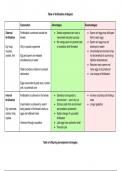
Table of fertilisation strategies:
Explanation: Advantages: Disadvantages:
External Fertilisation is achieved outside the ● Sessile organisms can have a ● Sperm and eggs may drift apart
fertilisation female maximised reductive success (fail to reach egg)
● No energy spent on parental care ● Sperm and eggs may be
Eg: frogs, Only in aquatic organisms or protective shell formation destroyed or eaten
muscles, ● Uncontrolled environment (may
oysters, fish Egg and sperm are released not be beneficial to survival eg:
simultaneously in water high/low temperatures)
● Requires many sperm and
Water provides a medium to prevent many eggs to be produced
desiccation ● Low change of fertilisation
Eggs surrounded by jelly layer, contain
yolk, no parental care
Internal Fertilisation is achieved in the female ● Gametes not exposed to ● Involves courtship and finding a
fertilisation environment ∴ won’t dry out mate
Insemination is achieved by sperm ● Embryos safe from environment ● Longer gestation
Eg: mammals, being placed in the female's body so and predators (protected)
sharks, birds, eggs are fertilised inside ● Higher change of successful
reptiles fertilisation
Achieved through copulation ● Laid eggs have protective shell
● Parental care
Table of offspring development strategies:
, Explanation Advantages Disadvantages
Ovipary Egg laying organism Aquatic organisms: Aquatic organisms:
● Nourished by egg yolk ● Susceptible to predators
Eg: birds, Embryos develop in the egg outside ● Many eggs with small yolks ● No parental care
platypus, the parent
echidna, Land animals: (amniotic egg) Land organisms:
reptiles, Fertilised internally or externally ● Nourished by egg yolk (larger) ● Susceptible to predators
insects, ● Protective shell to prevent
frogs, fish desiccation
● Parental care
Ovovipary Kept inside then hatched internally ● Younger born fully developed ∴ can
(soft shell) escape predators and get their own
Eg:some food
sharks, Kept at a constant ideal temperature in ● Protected by mother while
garter the mother developing
snakes Mother provides gaseous exchange
Internal fertilisation
Vivipary Egg cells have no shell ● Regulated incubation temperature
● Protected by mother at embryo
Eg: Embryo develops in female and is stage
placental nourished by female (live-born young)
mammals,
some Internal fertilisation
sharks
Explanation: Advantages: Disadvantages:
External Fertilisation is achieved outside the ● Sessile organisms can have a ● Sperm and eggs may drift apart
fertilisation female maximised reductive success (fail to reach egg)
● No energy spent on parental care ● Sperm and eggs may be
Eg: frogs, Only in aquatic organisms or protective shell formation destroyed or eaten
muscles, ● Uncontrolled environment (may
oysters, fish Egg and sperm are released not be beneficial to survival eg:
simultaneously in water high/low temperatures)
● Requires many sperm and
Water provides a medium to prevent many eggs to be produced
desiccation ● Low change of fertilisation
Eggs surrounded by jelly layer, contain
yolk, no parental care
Internal Fertilisation is achieved in the female ● Gametes not exposed to ● Involves courtship and finding a
fertilisation environment ∴ won’t dry out mate
Insemination is achieved by sperm ● Embryos safe from environment ● Longer gestation
Eg: mammals, being placed in the female's body so and predators (protected)
sharks, birds, eggs are fertilised inside ● Higher change of successful
reptiles fertilisation
Achieved through copulation ● Laid eggs have protective shell
● Parental care
Table of offspring development strategies:
, Explanation Advantages Disadvantages
Ovipary Egg laying organism Aquatic organisms: Aquatic organisms:
● Nourished by egg yolk ● Susceptible to predators
Eg: birds, Embryos develop in the egg outside ● Many eggs with small yolks ● No parental care
platypus, the parent
echidna, Land animals: (amniotic egg) Land organisms:
reptiles, Fertilised internally or externally ● Nourished by egg yolk (larger) ● Susceptible to predators
insects, ● Protective shell to prevent
frogs, fish desiccation
● Parental care
Ovovipary Kept inside then hatched internally ● Younger born fully developed ∴ can
(soft shell) escape predators and get their own
Eg:some food
sharks, Kept at a constant ideal temperature in ● Protected by mother while
garter the mother developing
snakes Mother provides gaseous exchange
Internal fertilisation
Vivipary Egg cells have no shell ● Regulated incubation temperature
● Protected by mother at embryo
Eg: Embryo develops in female and is stage
placental nourished by female (live-born young)
mammals,
some Internal fertilisation
sharks