4. Other Dementias
1. Vascular (multi-infarct) dementia
o Second most common cause of dementia in UK and Europe; commonest
cause in some parts of Asia (e.g., 50% in Japan).
o Loss of cognitive functioning due to disruption of blood supply to the brain, e.g., a series of small
‘strokes’ (= disruption to the supply of blood to the brain caused by:
- blocked artery (e.g., a blood clot: thrombosis) or
- bleed into the brain from a burst artery (haemorrhage)
o Blocked arteries are the most common cause of vascular dementia.
o Strokes deprive the brain of oxygen and nutrients. Cells die, leading to areas of cell
loss (‘lesions’ or ‘infarcts’).
o Each small stroke causes a further deterioration.
o Many patients have a history of hypertension (high blood pressure).
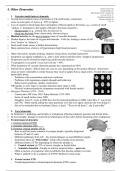
Arrows show small lesions in the brain of a
patient with multi-infarct dementia
o Other risk factors include smoking, diabetes, being obese, and high cholesterol.
o Symptoms can appear suddenly (e.g., after a mini stroke) and then show “stepped” progression.
o Progression can be slowed by improving cardiovascular function
o Yet prognosis is not good: 5-year survival rate < 40%
o What proportion of vascular dementia patients have hypertension? 80%
o Patients have ‘patchy’ deficits that vary case to case, depending on the area(s) affected. Some brain
areas are more vulnerable to stroke because they receive supply from a single artery. Frontal lobes seem
particularly prone:
- Problems with concentration and acute confusion
- Problems with organising complex thought and behaviour
- Behavioural symptoms: apathy, restlessness
NB Apathy at early stage in vascular dementia (later stage in AD)
- Physical weakness/paralysis (symptoms associated with frontal stroke)
o Margaret Thatcher (1923 - 2013)
- Conservative MP from 1959. Prime Minister 1979-1990.
- Series of small strokes since 2002.
- Daughter, Carol T, wrote in 2008 how she first noticed problems in 2000, when Mrs. T. was in her
mid 70s: “Mum started asking the same questions over and over again, unaware she was doing so”.
- Has to be reminded that her husband, Denis, is dead: “’Were we all there?’, she’d ask softly”
2. Focal dementias
o In Alzheimer’s, pathology and atrophy is widespread, affecting temporal, parietal, and frontal lobes.
o In focal atrophy, damage is restricted to limited parts of the cortex before becoming more widespread.
o Frontotemporal dementia
1. Frontal-variant (fvFTD)
2. Semantic dementia (SD)
3. Posterior cortical atrophy (PCA)
- Rare overall but more common in younger people; typically diagnosed
between 45 and 65 years.
- Different pathology from AD – No amyloid plaques or neurofibrillary tangles.
- Sometimes there are “Pick bodies” inside cells (clumps of tau protein).
- Different forms of FTD, depending on where the atrophy is:
Frontal variant (in 70% of cases): atrophy in frontal lobes
Semantic dementia: Atrophy in anterior temporal lobes – quiet rare
- Often a mixture of symptoms; start out different but become similar over time
- What is unlikely to be a symptom in fvFTD? Reduced visual acuity
1. Frontal variant FTD
- Frontal degeneration in frontotemporal dementia (FTD) causes:
1. Vascular (multi-infarct) dementia
o Second most common cause of dementia in UK and Europe; commonest
cause in some parts of Asia (e.g., 50% in Japan).
o Loss of cognitive functioning due to disruption of blood supply to the brain, e.g., a series of small
‘strokes’ (= disruption to the supply of blood to the brain caused by:
- blocked artery (e.g., a blood clot: thrombosis) or
- bleed into the brain from a burst artery (haemorrhage)
o Blocked arteries are the most common cause of vascular dementia.
o Strokes deprive the brain of oxygen and nutrients. Cells die, leading to areas of cell
loss (‘lesions’ or ‘infarcts’).
o Each small stroke causes a further deterioration.
o Many patients have a history of hypertension (high blood pressure).
Arrows show small lesions in the brain of a
patient with multi-infarct dementia
o Other risk factors include smoking, diabetes, being obese, and high cholesterol.
o Symptoms can appear suddenly (e.g., after a mini stroke) and then show “stepped” progression.
o Progression can be slowed by improving cardiovascular function
o Yet prognosis is not good: 5-year survival rate < 40%
o What proportion of vascular dementia patients have hypertension? 80%
o Patients have ‘patchy’ deficits that vary case to case, depending on the area(s) affected. Some brain
areas are more vulnerable to stroke because they receive supply from a single artery. Frontal lobes seem
particularly prone:
- Problems with concentration and acute confusion
- Problems with organising complex thought and behaviour
- Behavioural symptoms: apathy, restlessness
NB Apathy at early stage in vascular dementia (later stage in AD)
- Physical weakness/paralysis (symptoms associated with frontal stroke)
o Margaret Thatcher (1923 - 2013)
- Conservative MP from 1959. Prime Minister 1979-1990.
- Series of small strokes since 2002.
- Daughter, Carol T, wrote in 2008 how she first noticed problems in 2000, when Mrs. T. was in her
mid 70s: “Mum started asking the same questions over and over again, unaware she was doing so”.
- Has to be reminded that her husband, Denis, is dead: “’Were we all there?’, she’d ask softly”
2. Focal dementias
o In Alzheimer’s, pathology and atrophy is widespread, affecting temporal, parietal, and frontal lobes.
o In focal atrophy, damage is restricted to limited parts of the cortex before becoming more widespread.
o Frontotemporal dementia
1. Frontal-variant (fvFTD)
2. Semantic dementia (SD)
3. Posterior cortical atrophy (PCA)
- Rare overall but more common in younger people; typically diagnosed
between 45 and 65 years.
- Different pathology from AD – No amyloid plaques or neurofibrillary tangles.
- Sometimes there are “Pick bodies” inside cells (clumps of tau protein).
- Different forms of FTD, depending on where the atrophy is:
Frontal variant (in 70% of cases): atrophy in frontal lobes
Semantic dementia: Atrophy in anterior temporal lobes – quiet rare
- Often a mixture of symptoms; start out different but become similar over time
- What is unlikely to be a symptom in fvFTD? Reduced visual acuity
1. Frontal variant FTD
- Frontal degeneration in frontotemporal dementia (FTD) causes: