4. Analysis and Interpretation of Neuroimaging Data
1. Designing fMRI Experiments
o Problems when Designing fMRI Experiments
We can only have a snapshot of brain activations roughly every 2s, and more critically, the signal is
delayed by seconds, with respect to neural activations
Successive scans are not independent from each other, as the signal itself is very sluggish and blurs
across multiple scans
We have to adjust our experiments to make this less problematic!
o fMRI Block Designs
Solution 1: Discard any temporal information and present stimuli in blocks
BOLD signals will build up over the block to form a sustained response
For example, present a couple of animals for a couple of seconds (typically between 10 and 20s), and
then a couple of objects
Advantages: High detection power due to strong signals
Disadvantages: No temporal information, no separation between stimulus exemplars, no trial sorting
according to other responses (e.g., correct versus wrong responses), expectation effects within a
block
o fMRI Event-Related Designs
Solution 2: Randomise trial sequences, but leave long and variable time periods between trials
Event-related designs allows for separating responses to individual trials
For example, present animals and objects intermixed, appearing roughly every 4 seconds
To optimally separate activations we either need to be further apart in time, or we need to jitter
(temporally randomise) the onsets of stimuli
For interpreting temporally overlapping activations, we can assume that BOLD signals are
(approximately) linearly additive, and just stack up when they overlap
Advantages: Responses to individual trials can be recovered, post-hoc sorting of trials is possible,
minimizes expectation effects
Disadvantages: Weaker detection power due to fewer repetitions and potentially overlapping
responses
2. fMRI Data Analysis Basics
o Key Steps in fMRI Data Analysis
Data Preprocessing
- Realignment: Align functional MRI scans to account for in-scanner motion
- Co-registration: Align functional MRI scans with structural MRI scan
- Normalization: Transform images into a standard space (e.g., using an
average template across many participants) to make them comparable
across participants
- Smoothing: Functional MRI images are noisy, with random fluctuations
across voxels, that are not reflecting genuine changes in neural
activation. To alleviate this problem, data are spatially smoothed to average out spurious, noisy
activations.
Modelling Neural Activations
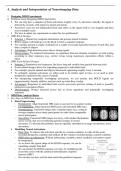
- Basic idea: To retrieve the activation specific to a certain condition, we take all the scans
recorded during this condition and subtract all the volumes recorded during a control condition.
- fMRI relies on subtraction: Without subtracting a suitable control condition, activations cannot
be interpreted!
- As we know the typical shape of the BOLD response, we can do
something smarter than that!
- We can predict the BOLD response over time, by multiplying the
event time series with the canonical hemodynamic response
function (HRF)
- We can then see how well the data match this predicted response
1. Designing fMRI Experiments
o Problems when Designing fMRI Experiments
We can only have a snapshot of brain activations roughly every 2s, and more critically, the signal is
delayed by seconds, with respect to neural activations
Successive scans are not independent from each other, as the signal itself is very sluggish and blurs
across multiple scans
We have to adjust our experiments to make this less problematic!
o fMRI Block Designs
Solution 1: Discard any temporal information and present stimuli in blocks
BOLD signals will build up over the block to form a sustained response
For example, present a couple of animals for a couple of seconds (typically between 10 and 20s), and
then a couple of objects
Advantages: High detection power due to strong signals
Disadvantages: No temporal information, no separation between stimulus exemplars, no trial sorting
according to other responses (e.g., correct versus wrong responses), expectation effects within a
block
o fMRI Event-Related Designs
Solution 2: Randomise trial sequences, but leave long and variable time periods between trials
Event-related designs allows for separating responses to individual trials
For example, present animals and objects intermixed, appearing roughly every 4 seconds
To optimally separate activations we either need to be further apart in time, or we need to jitter
(temporally randomise) the onsets of stimuli
For interpreting temporally overlapping activations, we can assume that BOLD signals are
(approximately) linearly additive, and just stack up when they overlap
Advantages: Responses to individual trials can be recovered, post-hoc sorting of trials is possible,
minimizes expectation effects
Disadvantages: Weaker detection power due to fewer repetitions and potentially overlapping
responses
2. fMRI Data Analysis Basics
o Key Steps in fMRI Data Analysis
Data Preprocessing
- Realignment: Align functional MRI scans to account for in-scanner motion
- Co-registration: Align functional MRI scans with structural MRI scan
- Normalization: Transform images into a standard space (e.g., using an
average template across many participants) to make them comparable
across participants
- Smoothing: Functional MRI images are noisy, with random fluctuations
across voxels, that are not reflecting genuine changes in neural
activation. To alleviate this problem, data are spatially smoothed to average out spurious, noisy
activations.
Modelling Neural Activations
- Basic idea: To retrieve the activation specific to a certain condition, we take all the scans
recorded during this condition and subtract all the volumes recorded during a control condition.
- fMRI relies on subtraction: Without subtracting a suitable control condition, activations cannot
be interpreted!
- As we know the typical shape of the BOLD response, we can do
something smarter than that!
- We can predict the BOLD response over time, by multiplying the
event time series with the canonical hemodynamic response
function (HRF)
- We can then see how well the data match this predicted response