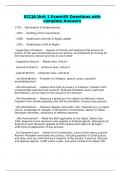
SCCJA Unit 1 Exam/65 Questions with
complete Answers
1776 - -Declaration of Independence
-1787 - -Drafting of the Constitution
-1788 - -Ratification with Bill of Rights added
-1791 - -Ratification of Bill of Rights
-Separation of Powers - -System of checks and balances that ensure no
branch of the government becomes too strong, accomplished by forcing all
the branches to interact and rely on each other.
-Legislative Branch - -Makes laws, Article I
-Executive Branch - -Enforces laws, Article II
-Judicial Branch - -Interprets laws, Article III
-1st Amendment - -Freedom of: Religion, speech, press, peaceful
assembly/protest
-4th Amendment - -Implies that right to privacy is inherent. Freedom from
unreasonable searches and seizures. Requires probable cause, particular
descriptions, and an oath for the issuance of a warrant.
-5th Amendment - -Requires a grand jury for capital or infamous crimes.
Freedom from double jeopardy and self-incrimination. Ensures due process.
-6th Amendment - -Ensures: Speedy and public trial, impartial jury in proper
venue, knowledge of charges, confrontation of witnesses, ability to obtain
favorable witnesses, assistance of defense attorney.
-14th Amendment - -Made the BoR applicable to the states. Before the
14th, Supreme Court decisions only applied to Federal agents, afterwards all
Supreme Court decisions applied to both Federal and state LE. Brought
uniformity to application of due process.
-US Supreme Court - -Article III of Constitution. Court of last resort. Judicial
Review. President nominates all justices, including position of Chief Justice,
and they must be confirmed by a majority of the senate. 9 justices. Receive
and dispose approx. 5,000 cases a year, and grant certiorari to about 150
, cases. Term begins the first Monday of October and ends in late June or early
July.
-Due process - -No law will be unreasonable, arbitrary, or capricious and the
means selected to enforce that law shall have a reasonable and substantial
relation to the object being sought to be achieved by that law or process.
FUNDAMENTAL FAIRNESS
-Civil Liability - -Responsibility that an officer must bear for damages or
injuries that the officer has caused another person to suffer
-Tort - -A civil wrong, other than a breach of contract, for which the court
will provide a remedy in the form of an action for damages
-Negligence - -Failure to do what a reasonable officer would be expected to
do under the circumstances. Established by determining: Was a duty owed?
Did the officer breach that duty? Did that failure cause the injury?
-Plaintiff - -Person who files or initiates a lawsuit
-Municipal Liability - -"Deep Pockets Liability" is shown when an agency has
a policy (pattern, or practice) that was the cause of the injury. "Policy" can
be written or unwritten
-Direct Liability - -Officer caused the injury or harm and is being sued as the
defendant
-Indirect Liability - -Allows the court to impose legal responsibility on a
superior officer or an agency not directly at fault for the injury. Liability is
founded on the relationship between the officer and the supervisor/agency.
Respondeat superior tort.
-Vicarious Liability - -Showing a link between the supervisor's conduct and
the officer's actions. Failure to train, failure to supervise, and failure to
discipline.
-Absolute Immunity - -Applies to judges and legislators, freeing them from
liability in performing their duties
-Sovereign Immunity - -Protects the state. SC Tort Claims Act made it so
that SC was open to limited liability.
-Qualified Immunity - -"Limited immunity", applies to LE so that they do not
need to have a crystal ball in order to predict the changes in law. Will not
qualify for immunity if: Violated a constitutional right, that right was clearly
complete Answers
1776 - -Declaration of Independence
-1787 - -Drafting of the Constitution
-1788 - -Ratification with Bill of Rights added
-1791 - -Ratification of Bill of Rights
-Separation of Powers - -System of checks and balances that ensure no
branch of the government becomes too strong, accomplished by forcing all
the branches to interact and rely on each other.
-Legislative Branch - -Makes laws, Article I
-Executive Branch - -Enforces laws, Article II
-Judicial Branch - -Interprets laws, Article III
-1st Amendment - -Freedom of: Religion, speech, press, peaceful
assembly/protest
-4th Amendment - -Implies that right to privacy is inherent. Freedom from
unreasonable searches and seizures. Requires probable cause, particular
descriptions, and an oath for the issuance of a warrant.
-5th Amendment - -Requires a grand jury for capital or infamous crimes.
Freedom from double jeopardy and self-incrimination. Ensures due process.
-6th Amendment - -Ensures: Speedy and public trial, impartial jury in proper
venue, knowledge of charges, confrontation of witnesses, ability to obtain
favorable witnesses, assistance of defense attorney.
-14th Amendment - -Made the BoR applicable to the states. Before the
14th, Supreme Court decisions only applied to Federal agents, afterwards all
Supreme Court decisions applied to both Federal and state LE. Brought
uniformity to application of due process.
-US Supreme Court - -Article III of Constitution. Court of last resort. Judicial
Review. President nominates all justices, including position of Chief Justice,
and they must be confirmed by a majority of the senate. 9 justices. Receive
and dispose approx. 5,000 cases a year, and grant certiorari to about 150
, cases. Term begins the first Monday of October and ends in late June or early
July.
-Due process - -No law will be unreasonable, arbitrary, or capricious and the
means selected to enforce that law shall have a reasonable and substantial
relation to the object being sought to be achieved by that law or process.
FUNDAMENTAL FAIRNESS
-Civil Liability - -Responsibility that an officer must bear for damages or
injuries that the officer has caused another person to suffer
-Tort - -A civil wrong, other than a breach of contract, for which the court
will provide a remedy in the form of an action for damages
-Negligence - -Failure to do what a reasonable officer would be expected to
do under the circumstances. Established by determining: Was a duty owed?
Did the officer breach that duty? Did that failure cause the injury?
-Plaintiff - -Person who files or initiates a lawsuit
-Municipal Liability - -"Deep Pockets Liability" is shown when an agency has
a policy (pattern, or practice) that was the cause of the injury. "Policy" can
be written or unwritten
-Direct Liability - -Officer caused the injury or harm and is being sued as the
defendant
-Indirect Liability - -Allows the court to impose legal responsibility on a
superior officer or an agency not directly at fault for the injury. Liability is
founded on the relationship between the officer and the supervisor/agency.
Respondeat superior tort.
-Vicarious Liability - -Showing a link between the supervisor's conduct and
the officer's actions. Failure to train, failure to supervise, and failure to
discipline.
-Absolute Immunity - -Applies to judges and legislators, freeing them from
liability in performing their duties
-Sovereign Immunity - -Protects the state. SC Tort Claims Act made it so
that SC was open to limited liability.
-Qualified Immunity - -"Limited immunity", applies to LE so that they do not
need to have a crystal ball in order to predict the changes in law. Will not
qualify for immunity if: Violated a constitutional right, that right was clearly