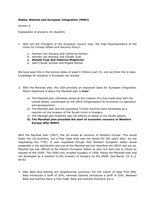
States, Markets and European Integration (SMEI)
Version A
Explanation of answers, for students
1. Who are the President of the European Council resp. the High Representative of the
Union for Foreign Affairs and Security Policy?
a. Herman Van Rompuy and Catherine Ashton.
b. Herman van Rompuy and Donald Tusk.
c. Donald Tusk and Federica Mogherini.
d. Jean-Claude Juncker and Angela Merkel.
We have seen this in the lecture slides of week 4 (History part II), and we think this is basic
knowledge for students in European law studies.
2. With the Marshall plan, the USA provided an important basis for European integration.
Which statement is about the Marshall plan is true?
a) The Marshall plan ultimately aimed at the creation of a free trade area with the
United States, coordinated by the OECD (Organisation for Economic Co-operation
and development).
b) The Marshall plan and the preceding Truman doctrine were developed as a
reaction on the invasion of the Soviet Union in Hungary.
c) The Marshall plan explicitly was not offered to states in the Soviet sphere.
d) The Marshall plan provided the start of economic recovery in Western
Europe after WWII.
With the Marshall plan (1947), the US aimed at recovery of Western Europe. This would
foster the US economy, but a free trade area was not aimed for (60 years later, we are
negotiating the TTIP). It was requested though that Western European states would
cooperate in the distribution and use of the Marshall aid and therefore the OECD was set up.
Marshall aid was offered to the Eastern European States as well, but they had to refuse on
request of the USSR. The USSR only invaded Hungary in 1956, hence the Marshall plan was
not developed as a reaction to the invasion of Hungary by the USSR. See Bache, Ch 5, p.
89-92
3. Alfa, Beta and Gamma are neighbouring countries. For the import of steel from Alfa,
Beta introduces a tariff of 20%, whereas Gamma introduces a tariff of 25%. Between
Beta and Gamma there is free trade. Beta and Gamma therefore are a:
Version A
Explanation of answers, for students
1. Who are the President of the European Council resp. the High Representative of the
Union for Foreign Affairs and Security Policy?
a. Herman Van Rompuy and Catherine Ashton.
b. Herman van Rompuy and Donald Tusk.
c. Donald Tusk and Federica Mogherini.
d. Jean-Claude Juncker and Angela Merkel.
We have seen this in the lecture slides of week 4 (History part II), and we think this is basic
knowledge for students in European law studies.
2. With the Marshall plan, the USA provided an important basis for European integration.
Which statement is about the Marshall plan is true?
a) The Marshall plan ultimately aimed at the creation of a free trade area with the
United States, coordinated by the OECD (Organisation for Economic Co-operation
and development).
b) The Marshall plan and the preceding Truman doctrine were developed as a
reaction on the invasion of the Soviet Union in Hungary.
c) The Marshall plan explicitly was not offered to states in the Soviet sphere.
d) The Marshall plan provided the start of economic recovery in Western
Europe after WWII.
With the Marshall plan (1947), the US aimed at recovery of Western Europe. This would
foster the US economy, but a free trade area was not aimed for (60 years later, we are
negotiating the TTIP). It was requested though that Western European states would
cooperate in the distribution and use of the Marshall aid and therefore the OECD was set up.
Marshall aid was offered to the Eastern European States as well, but they had to refuse on
request of the USSR. The USSR only invaded Hungary in 1956, hence the Marshall plan was
not developed as a reaction to the invasion of Hungary by the USSR. See Bache, Ch 5, p.
89-92
3. Alfa, Beta and Gamma are neighbouring countries. For the import of steel from Alfa,
Beta introduces a tariff of 20%, whereas Gamma introduces a tariff of 25%. Between
Beta and Gamma there is free trade. Beta and Gamma therefore are a: