

The Brain
Your brain is encased by the cranium, protecting it, and is also
protected by meninges (protective membranes). The brain is
part of the central nervous system. It’s made up of billions of
interconnected neurons and oversees all our complex
behaviours. Different parts of the brain coordinate different
things:
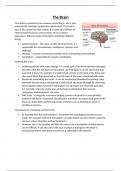
Cerebral Cortex – The outer wrinkly bit of the brain. It is
responsible for consciousness, intelligence, memory and
language.
Medulla – controls unconscious activities such as breathing and heartbeat.
Cerebellum – responsible for muscle coordination
Studying the brain:
Studying patients with brain damage – if a small part of the brain has been damaged,
the effect that this will have on the patient can help figure a lot out about that part
and what it does. For example, if a patient had a stroke at the back of the brain and
then went blind, that would tell us that the back of the brain is involved with vision.
Electrically stimulating the brain – it can be electrically stimulated by pushing a tiny
electrode into the tissue and passing a small zap of electricity through. By observing
what happens when the brain is stimulated, we can figure out what that part does.
For example, when the motor area of the brain is stimulated, then muscle
contraction and movement can occur.
MRI Scans – a magnetic resonance imaging scanner can produce a very detailed
picture of the brain’s structures. By using this, scientists can assess what parts of the
brain are active when performing certain activities such as listening to music or
recalling a memory.
Consequences of messing with the brain:
By knowing how the brain functions, treatments for neurological diseases can be
made. For example, electrical stimulation can help reduce muscle tremors caused by
nervous system disorders such as Parkinson’s.
However, due to its complex and delicate nature, the investigation of brain disease
can be difficult. It can also carry risks such as physical damage to the brain or
increased problems with brain functions (e.g. Difficulties with speech).
Your brain is encased by the cranium, protecting it, and is also
protected by meninges (protective membranes). The brain is
part of the central nervous system. It’s made up of billions of
interconnected neurons and oversees all our complex
behaviours. Different parts of the brain coordinate different
things:
Cerebral Cortex – The outer wrinkly bit of the brain. It is
responsible for consciousness, intelligence, memory and
language.
Medulla – controls unconscious activities such as breathing and heartbeat.
Cerebellum – responsible for muscle coordination
Studying the brain:
Studying patients with brain damage – if a small part of the brain has been damaged,
the effect that this will have on the patient can help figure a lot out about that part
and what it does. For example, if a patient had a stroke at the back of the brain and
then went blind, that would tell us that the back of the brain is involved with vision.
Electrically stimulating the brain – it can be electrically stimulated by pushing a tiny
electrode into the tissue and passing a small zap of electricity through. By observing
what happens when the brain is stimulated, we can figure out what that part does.
For example, when the motor area of the brain is stimulated, then muscle
contraction and movement can occur.
MRI Scans – a magnetic resonance imaging scanner can produce a very detailed
picture of the brain’s structures. By using this, scientists can assess what parts of the
brain are active when performing certain activities such as listening to music or
recalling a memory.
Consequences of messing with the brain:
By knowing how the brain functions, treatments for neurological diseases can be
made. For example, electrical stimulation can help reduce muscle tremors caused by
nervous system disorders such as Parkinson’s.
However, due to its complex and delicate nature, the investigation of brain disease
can be difficult. It can also carry risks such as physical damage to the brain or
increased problems with brain functions (e.g. Difficulties with speech).


