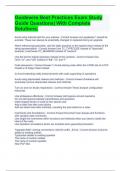
Guidewire Best Practices Exam Study Guide Questions| With Complete Solutions.
Avoid using internal path for your classes - Correct Answer-com.guidewire.* should be avoided. These can always be potentially changed or replaced during an upgrade.
When referencing typecodes, use the static property on the typelist class instead of the string representation - Correct Answer-Use TC_TYPECODE instead of "typecode", example: LossCause.TC_REAREND instead of "rearend"
Use the text for logical operators instead of the symbols - Correct Answer-Use "and","or", and "not" instead of "&&", "||", and "!"
Code placement - Correct Answer-1) Avoid placing code within the CODE tab of a PCF.
Create a UI helper class instead
2) Avoid extending entity enhancements with code supporting UI operations
Avoid using deprecated classes and methods - Correct Answer-Guidewire will eventually remove deprecated classes and methods.
Turn on and run Studio Inspections - Correct Answer-These analyze configuration resources
Use whitespace effectively - Correct Answer-Add spaces around operators
Do not add spaces between parentheses and operators
Indent logical blocks of code by two spaces only
Add a blank line after code blocks
Add two blank lines after methods, including the last method in a class
Comments and Annotations - Correct Answer-Document new classes and functions with Javadoc-style comments
Use single-line comments within functions and methods when you need to clarify the intent of the code
Use GoseDoc annotations which are included when generating GosuDoc
"Upgrade-Safe" naming conventions: Add the suffix _Ext to - Correct Answer-Columns added to existing entities Typecodes added to existing typelists The name of custom entities The name of custom typelists
New PCF files Script parameters
Package naming conventions - Correct Answer-Use the format customer.application.featurecategory.feature
Customer - company name abbreviation Application- InsuranceSuite application code (pc, bc, cc, suite)
Feature Category - major feature (delinquency, configuration, integration)
Feature - feature (rating, catastrophe, authentication)
Example: si.suite.integration.authentication
Class naming conventions - Correct Answer-Use UpperCamelCase
Do not add _Ext to classes within customer package spaces
Function naming conventions - Correct Answer-Use lowerCamelCase
Use a verb that describes that the function is doing i.e. verifyAddress
Do not add _Ext suffix to private functions or enhancements in customer package spaces
Variable naming conventions - Correct Answer-Member variable names use lowerCamelCase with a leading underscore i.e. _pluginCallbackHandler
Local variable names use lowerCamelCase short names that describe the purpose i.e. latestPolicyRevision
Display key naming conventions - Correct Answer-Add suffix _Ext too all new display keys
Do not modify automatically generated display keys
Logging is - Correct Answer-The process of recording application actions and state to a secondary interface
Logging is used for - Correct Answer-Application maintenance and troubleshooting
Creating statistics relating to application usage
Auditing by capturing significant events
Typical events to log are - Correct Answer-Success / Failure - a transaction or action has succeeded or failed
Recovery - a system went down or connection failed, retried, and recovered
Identification - any large functional areas such as integration, rating, reinsurance, and rules
Logging components - Logger - Correct Answer-has a category and level, sends content to an Appender
Logging components - Appender - Correct Answer-is an output destination (server console or rolling file) Logging components - Layout - Correct Answer-defines the format of the content sent to
an appender
Logging Level - Trace - Correct Answer-Description: Fine-grained informational events
When to use: Log method entry and exit
Logging Level - Debug - Correct Answer-Description: Detailed informational events
When to use: Log important steps and calculations for diagnosing problems
Logging Level - Info - Correct Answer-Description: Coarse-grained informational messages of progress
When to use: Log the occurrence or result of an important event
Logging Level - Warn - Correct Answer-Description: Indicate a potential problem
When to use: The user experience has not been affected
Logging Level - Error - Correct Answer-Description - Indicate definite problems
When to use: The user experience has been affected
There are 2 ways to initialize a logger in Gosu - Correct Answer-Integration: PLLoggerCategory.INTEGRATION
Plugin: PLLoggerCategory.PLUGIN
Use sub-level of existing logging category to maintain structure. Example: PLUGIN.MotorVehicleRecord
static var _motorVehiclePluginLogger = LoggerFactory.getLogger(PLLoggerCategory.PLUGIN."MotorVehicleRecord")
Logging Format should be - Correct Answer-a standard format to simplify analysis of large logs
Guarded Logging should be used - Correct Answer-To test log level before logging costly messages (those with expensive expressions)
Typically used with the DEBUG level
Format is - if (_logger.DebugEnabled) { <log statement content>}
Not required for parameterized expressions lacking expensive operations, as in:
var hello = "Hello"
var world = "world" _logger.debug("{}, {}!", hello, world)
Logging: Exception Messages - Correct Answer-Logged at the ERROR level when user interface is affected
Avoid using internal path for your classes - Correct Answer-com.guidewire.* should be avoided. These can always be potentially changed or replaced during an upgrade.
When referencing typecodes, use the static property on the typelist class instead of the string representation - Correct Answer-Use TC_TYPECODE instead of "typecode", example: LossCause.TC_REAREND instead of "rearend"
Use the text for logical operators instead of the symbols - Correct Answer-Use "and","or", and "not" instead of "&&", "||", and "!"
Code placement - Correct Answer-1) Avoid placing code within the CODE tab of a PCF.
Create a UI helper class instead
2) Avoid extending entity enhancements with code supporting UI operations
Avoid using deprecated classes and methods - Correct Answer-Guidewire will eventually remove deprecated classes and methods.
Turn on and run Studio Inspections - Correct Answer-These analyze configuration resources
Use whitespace effectively - Correct Answer-Add spaces around operators
Do not add spaces between parentheses and operators
Indent logical blocks of code by two spaces only
Add a blank line after code blocks
Add two blank lines after methods, including the last method in a class
Comments and Annotations - Correct Answer-Document new classes and functions with Javadoc-style comments
Use single-line comments within functions and methods when you need to clarify the intent of the code
Use GoseDoc annotations which are included when generating GosuDoc
"Upgrade-Safe" naming conventions: Add the suffix _Ext to - Correct Answer-Columns added to existing entities Typecodes added to existing typelists The name of custom entities The name of custom typelists
New PCF files Script parameters
Package naming conventions - Correct Answer-Use the format customer.application.featurecategory.feature
Customer - company name abbreviation Application- InsuranceSuite application code (pc, bc, cc, suite)
Feature Category - major feature (delinquency, configuration, integration)
Feature - feature (rating, catastrophe, authentication)
Example: si.suite.integration.authentication
Class naming conventions - Correct Answer-Use UpperCamelCase
Do not add _Ext to classes within customer package spaces
Function naming conventions - Correct Answer-Use lowerCamelCase
Use a verb that describes that the function is doing i.e. verifyAddress
Do not add _Ext suffix to private functions or enhancements in customer package spaces
Variable naming conventions - Correct Answer-Member variable names use lowerCamelCase with a leading underscore i.e. _pluginCallbackHandler
Local variable names use lowerCamelCase short names that describe the purpose i.e. latestPolicyRevision
Display key naming conventions - Correct Answer-Add suffix _Ext too all new display keys
Do not modify automatically generated display keys
Logging is - Correct Answer-The process of recording application actions and state to a secondary interface
Logging is used for - Correct Answer-Application maintenance and troubleshooting
Creating statistics relating to application usage
Auditing by capturing significant events
Typical events to log are - Correct Answer-Success / Failure - a transaction or action has succeeded or failed
Recovery - a system went down or connection failed, retried, and recovered
Identification - any large functional areas such as integration, rating, reinsurance, and rules
Logging components - Logger - Correct Answer-has a category and level, sends content to an Appender
Logging components - Appender - Correct Answer-is an output destination (server console or rolling file) Logging components - Layout - Correct Answer-defines the format of the content sent to
an appender
Logging Level - Trace - Correct Answer-Description: Fine-grained informational events
When to use: Log method entry and exit
Logging Level - Debug - Correct Answer-Description: Detailed informational events
When to use: Log important steps and calculations for diagnosing problems
Logging Level - Info - Correct Answer-Description: Coarse-grained informational messages of progress
When to use: Log the occurrence or result of an important event
Logging Level - Warn - Correct Answer-Description: Indicate a potential problem
When to use: The user experience has not been affected
Logging Level - Error - Correct Answer-Description - Indicate definite problems
When to use: The user experience has been affected
There are 2 ways to initialize a logger in Gosu - Correct Answer-Integration: PLLoggerCategory.INTEGRATION
Plugin: PLLoggerCategory.PLUGIN
Use sub-level of existing logging category to maintain structure. Example: PLUGIN.MotorVehicleRecord
static var _motorVehiclePluginLogger = LoggerFactory.getLogger(PLLoggerCategory.PLUGIN."MotorVehicleRecord")
Logging Format should be - Correct Answer-a standard format to simplify analysis of large logs
Guarded Logging should be used - Correct Answer-To test log level before logging costly messages (those with expensive expressions)
Typically used with the DEBUG level
Format is - if (_logger.DebugEnabled) { <log statement content>}
Not required for parameterized expressions lacking expensive operations, as in:
var hello = "Hello"
var world = "world" _logger.debug("{}, {}!", hello, world)
Logging: Exception Messages - Correct Answer-Logged at the ERROR level when user interface is affected