100% satisfaction guarantee Immediately available after payment Both online and in PDF No strings attached 4.2 TrustPilot
logo-home
Exam (elaborations)

TEST BANK ANATOMY AND PHYSIOLOGY OPENSTAX

Rating
4.7
(3)
Sold
1
Pages
186
Grade
A+
Uploaded on
13-08-2023
Written in
2023/2024

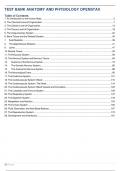
TEST BANK ANATOMY AND PHYSIOLOGY OPENSTAX Table of Contents 1. An Introduction to the Human Body ................................................................................................................. 2 2. The Chemical Level of Organization ................................................................................................................ 7 3. The Cellular Level of Organization ................................................................................................................. 13 4. The Tissue Level of Organization ................................................................................................................... 18 5. The Integumentary System ............................................................................................................................ 24 6. Bone Tissue and the Skeletal System ............................................................................................................ 30 7. Axial Skeleton ............................................................................................................................................. 36 8. The Appendicular Skeleton ......................................................................................................................... 41 9. Joints ......................................................................................................................................................... 47 10. Muscle Tissue ............................................................................................................................................. 53 11. The Muscular System .................................................................................................................................. 59 12. The Nervous System and Nervous Tissue ................................................................................................... 64 13. Anatomy of the Nervous System ............................................................................................................. 72 14. The Somatic Nervous System ................................................................................................................. 80 15. The Autonomic Nervous System ............................................................................................................. 88 16. The Neurological Exam................................................................................................................................ 95 17. The Endocrine System .............................................................................................................................. 101 18. The Cardiovascular System: Blood ............................................................................................................ 110 19. The Cardiovascular System: The Heart ...................................................................................................... 116 20. The Cardiovascular System: Blood Vessels and Circulation ....................................................................... 122 21. The Lymphatic and Immune System .......................................................................................................... 129 22. The Respiratory System ............................................................................................................................ 137 23. The Digestive System ................................................................................................................................ 144 24. Metabolism and Nutrition ........................................................................................................................... 154 25. The Urinary System ................................................................................................................................... 162 26. Fluid, Electrolyte, and Acid-Base Balance .................................................................................................. 167 27. The Reproductive System .......................................................................................................................... 173 28. Development and Inheritance .................................................................................................................... 181 1 | P a g e1. An Introduction to the Human Body 1. is the study of the larger structures of the body, those visible without the aid of magnification (A) Gross anatomy (B) Microscopic anatomy (C) Macroscopic anatomy (D) Physical anatomy Ans A Diff Easy Page 8 2. The word “anatomy” comes from a Greek root that means “ .... ’’ (A) To cut apart (B) To fix with (C) To view inside (D) To study exterior Ans A Diff Easy 3. Dissection is still used in …………. (A) Medical schools (B) Pathology labs (C) Anatomy courses (D) All of above Ans D Diff Easy 4. Microscopic anatomy includes …………. (A) Histology (B) Cytology (C) Both of above (D) None of above Ans C Diff Easy Page 8 Page 8 Page 8 5 .............. is the study of the structures that make up a discrete body system—that is, a group of structures that work together to perform a unique body function. (A) Regional anatomy (B) Systematic anatomy (C) Both of above (D) None of above Ans C Diff Easy Page 9 6. Human physiology is the scientific study of the .... of the structures of the body and the ways in which they work together to support the functions of life. (A) Chemistry 2 | P a g e(B) Physic (C) Both Above (D) None of Above Ans C Diff Medium Page 9 7. Homeostasis is the state of steady --- maintained by living things. (A) Internal Condition (B) External conditions (C) Both Above (D) None of Above Ans A Diff Easy Page 9 8. An organ is an anatomically distinct structure of the body composed of - tissue types. (A) One (B) Two (C) Two or more (D) None of above Ans C Diff Easy Page 11 9. In ----------- organisms, including humans, all cells, tissues, organs, and organ systems of the body work together to maintain the life and health of the organism. (A) Unicellular (B) Bicellular (C) Multicellular (D) None of above Ans C Diff Easy Page 14 10. The different organ systems each have different functions and therefore -- roles to perform in physiology. (A) Unique (B) Different (C) Both Above (D) None of Above Ans C Diff Easy Page14 11. A human body consists of trillions of cells organized in a way that maintains distinct ……….. . (A) Internal compartments (B) External compartments (C) Both of above (D) None of above Ans A Diff Medium Page 14 3 | P a g e12. The organism level is the ....... level of organization (A) Lowest (B) Highest (C) Medium (D) Extreme Ans A Diff Medium Page 14 13. Which of the following mechanism is involved in releasing energy? (A) Catabolism (B) Anabolism (C) Both of above (D) None of above Ans C Diff Medium Page 14 14. Every cell in your body makes use of a chemical compound, adenosine triphosphate (ATP), to ………. . (A) Store energy (B) Release energy (C) Both of above (D) None of above Ans C Diff Medium Page 15 15............ is the ability of an organism to adjust to changes in its internal and external environments (A) Responsiveness (B) Movement (C) Locomotion (D) All of above Ans A Diff Hard Page 15 16. Anatomic structures and physiological processes allow runners to coordinate the action of muscle groups and sweat in response to rising internal ……….. . (A) Body temperature (B) Blood pressure (C) Hormone level (D) All of above Ans A Diff Hard Page 16 17 ....... is all of the changes the body goes through in life. (A) Development (B) Growth (C) Reproduction 4 | P a g e(D) All of above Ans A Diff Medium 18. Development includes the process of ………. . (A) Differentiation (B) Growth (C) Repair (D) All of above Ans D Diff Medium Page 16 Page 16 19. Humans have been adapting to life on Earth for at least the past …………. . (A) years (B) years (C) years (D) years Ans B Diff Hard Page 17 20. Atmospheric air is only about ....... percent oxygen, but that oxygen is a key component of the chemical reactions that keep the body alive, including the reactions that produce ATP (A) 20 (B) 30 (C) 40 (D) 60 An s A Diff Medium Page 17 21. Controlled hypothermia often is used, for example, during open-heart surgery because it the metabolic needs of the brain, heart, and other organs, reducing the risk of damage to them. (A) Decreases (B) Increases (C) Remains constant (D) None of above Ans A Diff Medium Page 18 22. In the emergency department, the physician induces coma and lowers the patient’s body temperature to approximately 91 degrees. This condition, which is maintained for 24 hours . the patient’s metabolic rate (A) Slows (B) Enhances (C) Neutralizes (D) None of above Ans A 5 | P a g e Diff Easy Page 1823. The pressure of the nitrogen gas in your blood would be much . than the pressure of nitrogen in the space surrounding your body (A) Higher (B) Lower (C) Equal (D) None of above Ans A Diff Medium Page 19 24. Decompression sickness (DCS) is a condition in which gases dissolved in the blood or in other body tissues are no longer dissolved following a reduction in pressure on the body. This condition affects ………. (A) Underwater divers (B) Pilots (C) Mountaineers (D) All of above Ans D Diff Medium Page 20 25. The most common symptom of DCS is ………….. . (A) Pain in the joints (B) Headache (C) Vision disturbances (D) All of above Ans D Diff Medium Page 20 26. The brain triggers the thyroid gland in the endocrine system to release thyroid hormone, which ……… metabolic activity and heat production in cells throughout the body. (A) Increases (B) Decreases (C) Remains constant (D) None of above Ans A Diff Hard Page 21 27. Childbirth and the body’s response to blood loss are two examples of ........ Loops that are normal but are activated only when needed. (A) Positive feedback (B) Negative feedback (C) Both of above (D) None of above Ans A Diff Medium 6 | P a g e Page 2228........... position describes a position in a limb that is nearer to the point of attachment or the trunk of the body (A) Proximal (B) Distal (C) Medial (D) Lateral Ans A Diff Hard Page 25 29. A plane is .............. surface that passes through the body. (A) Two dimensional (B) Three dimensional (C) Imaginary two dimensional (D) Imaginary three dimensional Ans C Diff Hard 30. The .......... is the largest cavity in the body (A) Abdominopelvic cavity (B) Thoracic cavity (C) Cranial cavity (D) Spinal cavity Ans A P age 25 Diff Hard Page 27 2. The Chemical Level of Organization 1. Human chemistry includes …….. . (A) Organic molecules (B) Elements (C) Biochemical (D) All of above Ans D Diff Easy Page 42 2. In glucose, there are always six carbon and six oxygen units for every (A) Three (B) Six (C) Twelve (D) Eighteen Ans C hydrogen units. Diff Medium Page 43 3. The percentage of potassium in human body is …………. (A) 0.2 7 | P a g e(B) 0.3 (C) 0.4 (D) 0.5 Ans C Diff Medium Page 43 4. Uranium (U), is referred to as a heavy metal and it contains .. neutrons (A) 238 (B) 92 (C) 146 (D) 240 Ans C Diff Medium 5. The number of protons and neutrons …………. (A) May be equal for some elements (B) Are equal for all elements (C) Both of above (D) None of above Ans A Diff Medium Page 44 Page 45 6. An isotope is one of the different forms of an element, distinguished from one another by different numbers of …………. . (A) Electrons (B) Protons (C) Neutrons (D) All of above Ans C Diff Easy Page 46 7. Excessive exposure to radioactive isotopes can cause ………….. . (A) Damage of human cells (B) Birth defects (C) Cancer (D) All of above Ans D Diff Hard Page 46 8. If you take a look at the periodic table of the elements, you will notice that hydrogen and helium are placed alone on either sides of the top row; they are the only elements that have ……….. . (A) One electron shells (B) Two electron shells (C) Three electron shells (D) Four electron shells 8 | P a g eAns A Diff Medium Page 47 9. The most common example of ........ in the natural world occurs between molecules of water (A) Ionic bonding (B) Covalent bonding (C) Hydrogen bonding (D) All of above Ans C Diff Hard Page 53 10............... is the energy of position, or the energy matter possesses because of the positioning or structure of its components. (A) Kinetic energy (B) Chemical energy (C) Potential energy (D) None of above Ans C Diff Easy Page 54 11. The full spectrum of .......... is referred to as the electromagnetic spectrum. (A) Radiant energy (B) Electrical energy (C) Mechanical energy (D) None of above Ans A Diff Medium Page 55 12. An exchange reaction is a chemical reaction in which both synthesis and decomposition occur, chemical bonds are both formed and broken, and chemical energy is ……….. . (A) Absorbed (B) Stored (C) Released (D) All of above Ans D Diff Hard Page 56 13. The most important catalysts in the human body are ……….. . (A) Enzymes (B) Proteins (C) Lipids (D) Carbohydrates Ans A Diff Easy Page 57 14. An inorganic compound is a substance that does not contain …………. (A) Carbon (B) Hydrogen 9 | P a g e(C) Both of above (D) None of the above Ans C Diff Medium Page 58 15. In the bloodstream of humans, glucose concentration is usually measured in milligram (mg) per deciliter (dL), and in a healthy adult averages about ……… (A) 10 mg/dL (B) 100 mg/d (C) 1000 mg/dL (D) None of above Ans B Diff Hard Page 59 16. A buffer is a solution of a …………………. (A) Weak acid and its conjugate base (B) Strong acid and its conjugate base (C) Weak base and its conjugate acid (D) Strong base and its conjugate acid Ans A Diff Hard 16. Which of the following can cause respiratory alkalosis? (A) Lung disease (B) Aspirin overdose (C) Shock (D) All of above Ans D Diff Medium Page 63 Page 64 17. Which of the following functional groups is involved in dehydration synthesis and hydrolysis reactions? (A) Carboxylic group (B) Hydroxyl group (C) Methyl group (D) Phosphate group Ans B Diff Hard Page 65 18. A triglyceride is one of the most common dietary ..... , and the type found most abundantly in body tissues (A) Lipid groups (B) Carbohydrate groups (C) Carbohydrate groups (D) All of above Ans A 10 | P a g e Diff Medium Page 6919............ are compounds in which the hydrophobic triglycerides are packaged in protein envelopes for transport in body fluids. (A) Glycolipids (B) Fatty acids (C) Lipoproteins (D) All of above Ans C Diff Hard Page 70 20. One reason that the omega-3 fatty acids found in fish are beneficial is that they stimulate the production of certain .. that help regulate aspects of blood pressure and inflammation, and thereby reduce the risk for heart disease (A) Prostaglandins (B) Sterols (C) Phospholipids (D) All of above Ans A Diff Hard Page 71 21. Proteins include the keratin in the epidermis of skin that protects ……………. (A) Collagen (B) Underlying tissues (C) Both of above (D) None of above Ans C Diff Medium Page 72 22. If a particular essential amino acid is not available in sufficient quantities in the amino acid pool, however, synthesis of proteins containing it can ………… . (A) Slow (B) Cease (C) Increase (D) A and B Ans D Diff hard Page 73 23. In protein shapes, the most common secondary structure is a spiral called ………. (A) An alpha-helix (B) Beta-pelated sheet (C) Both of above (D) None of above Ans C Diff Hard Page 74 24. A nucleotide is one of a class of organic compounds composed of …………. (A) One or more phosphate groups 11 | P a g e(B) A pentose sugar (C) A nitrogen containing base (D) All of above Ans D Diff Medium Page 76 25. A ........... is a nitrogen-containing molecule with a double ring structure, which accommodates several nitrogen atoms. (A) Purine (B) Pyrimidine (C) Both of above (D) None of above Ans A Diff Easy Page 76 26. Humans have almost ...... genes in their DNA, locked up in the 46 chromosomes inside the nucleus of each cell (except red blood cells which lose their nuclei during development). (A) 10000 (B) 12000 (C) 20000 (D) 22000 Ans D Diff Medium 27. The nucleotide adenosine triphosphate (ATP), is composed of ……….. . (A) Ribose sugar (B) An adenine base (C) Three phosphate groups (D) All of above Ans D Diff Hard 28. ATP is classified as a ………………. (A) High energy compound (B) Low energy compound (C) Medium energy compound (D) None of above Ans A Page 77 Page 77 Diff Medium Page 77 29. Which of the following bases is found in RNA only? (A) Cytosine (B) Thymine (C) Uracil (D) All of above Ans C Diff Hard 12 | P a g e Page 7630. Any given enzyme catalyzes ……………. . (A) One type of reaction (B) Two types of reactions (C) Three types of reactions (D) Multiple type reactions Ans A Diff Medium 3. The Cellular Level of Organization 1. Primary responsibility of each cell is to contribute to ………. . (A) Homeostasis (B) Reproduction (C) Sustainability (D) Protection Ans A Diff Easy Page 88 Page 75 2. An amphipathic molecule is one that contains ……….. . (A) Hydrophilic region (B) Hydrophobic region (C) Both of above (D) None of above Ans C Diff Easy Page 88 3. The phospholipid bilayer consists of two adjacent sheets of phospholipids, arranged ………. (A) Tail to tail (B) Head to tail (C) Head to head (D) Head to tail Ans A Diff Easy Page 89 4is the movement of substances across the membrane without the expenditure of cellular energy. (A) Passive transport (B) Active transport (C) Both of above (D) None of above Ans A 13 | P a g e Diff Easy Page 915is the movement of particles from an area of higher concentration to an area of lower concentration (A) Active transport (B) Passive transport (C) Diffusion (D) Concentration gradient Ans C Diff Medium Page 91 6. Facilitated diffusion of substances crossing the cell (plasma) membrane takes place with the help of ……………. . (A) Channel proteins (B) Carrier proteins (C) Both of above (D) None of above Ans C Diff Medium Page 92 7 .............. brings fluid containing dissolved substances into a cell through membrane vesicles. (A) Endocytosis (B) Phagocytosis (C) Pinocytosis (D) All of above Ans C Diff Medium Page 95 8. Cells of the stomach and pancreas produce and secrete digestive enzymes through ……….. . (A) Endocytosis (B) Exocytosis (C) Both of above (D) None of above Ans B Diff Medium Page 95 9. Cystic fibrosis (CF) is a genetic disease well known for its damage to the …….. . (A) Lungs (B) Liver (C) Pancreas (D) All of above Ans D Diff Medium Page 95 10. Which of the following is organelle of the endomembrane system? (A) Endoplasmic reticulum 14 | P a g e(B) Golgi apparatus (C) Vesicles (D) All of above Ans D Diff Hard Page 98 11. One of the main functions of the smooth endoplasmic reticulum is in the synthesis of ……….. . (A) Lipids (B) Proteins (C) Carbohydrates (D) All of above Ans A Diff Medium Page 99 12. Which of the following organelles is the “energy transformer” of the cell. (A) Cell membrane (B) Mitochondria (C) Nucleus (D) Endoplasmic reticulum Ans B Diff Hard 13. Peroxisomes perform a function of ………………. (A) Lipid metabolism (B) Chemical detoxification (C) Both of above (D) None of above Ans C Diff Medium Page 101 Page 102 14. Due to their ………………………………., ROS can set off chain reactions where they remove electrons from other molecules, which then become oxidized and reactive, and do the same to other molecules, causing a chain reaction (A) Characteristic paired electrons (B) Characteristics unpaired electrons (C) Characteristic free radicals (D) All of above Ans A Diff Hard Page 101 15. Which of the following versions of free radical theory is more widely accepted? (A) Aging process itself is a result of oxidative damage (B) Oxidative damage causes age related diseases (C) Both of above 15 | P a g e(D) None of above Ans B Diff Hard 16. The cytoskeleton consists of …………. . (A) Microtubules (B) Microfilaments (C) Intermediate filaments (D) All of above Ans D Page 103 Diff Medium Page 104 17. The ........ is a region of the nucleus that is responsible for manufacturing the RNA necessary for construction of ribosomes. (A) Nucleolus (B) Nuclear envelop (C) Nuclei (D) None of above Ans A Diff Medium Page 105 18. In the step of ........ Of DNA replication, each strand becomes a template along which a new complementary strand is built. (A) Initiation (B) Elongation (C) Termination (D) All of above Ans B Diff Hard Page 109 19. One of the most important classes of proteins is ..... , which help speed up necessary biochemical reactions that take place inside the cell (A) Enzymes (B) Lipoproteins (C) Lysozyme (D) Oligosaccharides Ans A Diff Medium 20. Gene expression begins with the process called …………. (A) Transcription Page 110 (B) Initiation (C) Elongation 16 | P a g e(D) Termination Ans A Diff Hard Page 111 21 is a type of RNA that, together with proteins, composes the structure of the ribosome (A) rRNA (B) mRNA (C) tRNA (D) all of above Ans A Diff Medium 22 is the period of the cell cycle during which the cell is not dividing (A) Interphase (B) Mitosis (C) Cytokinesis (D) None of above Ans A Diff Medium Page 116 23. A ......... is a point in the cell cycle at which the cycle can be signaled to move forward or stopped (A) Checkpoint (B) Cyclin (C) Cyclindependent kinase (D) None of above Ans A Diff Medium Page 119 24. The process of cellular differentiation leads cells to assume their final …………. . (A) Morphology (B) Physiology (C) Both of above (D) None of above Ans C Diff Easy Page 121 Page 113 25. A pluripotent stem cell is one that has the potential to differentiate into any type of human tissue but cannot support the full development of an organism (A) Pluripotent (B) Oligopotent (C) Unipotent (D) None of above Ans A Diff Hard 26. Breakdown of cells by their own enzymatic action is called ………. . 17 | P a g e P age 121(A) Autolysis (B) Cell cycle (C) Anticodon (D) Autophagy Ans A Diff Medium Page 126 27.......... is one of the coding regions of an mRNA molecule that remain after splicing (A) Codon (B) Exon (C) Anticodon (D) Chromatin Ans B Diff Hard P age 127 28. G2 phase is the ...... phase of the cell cycle, after the DNA synthesis phase (A) First (B) Second (C) Third (D) Fourth Ans C Diff Medium Page 127 29 is the fluid in the small spaces between cells not contained within blood vessels (A) Interstitial fluid (B) Intracellular fluid (C) Intron (D) None of above Ans A Diff Hard Page 128 30 is the diffusion of water molecules down their concentration gradient across a selectively permeable membrane. (A) Osmosis (B) Mitosis (C) Pinocytosis (D) Phagocytosis Ans A 4. The Tissue Level of Organization 1. The body contains at least ..... distinct cell types 18 | P a g e Diff Medium Page 129(A) 100 (B) 200 (C) 300 (D) 400 Ans B Diff Medium Page 135 2 ............, refers to the sheets of cells that cover exterior surfaces of the body, lines internal cavities and passageways, and forms certain glands (A) Epithelial tissues (B) Connective tissues (C) Nervous tissues (D) All of above Ans A Diff Hard Page 136 3. Synovial membranes surround the joints of the ………. (A) Shoulder (B) Elbow (C) Knee (D) All of above Ans D Diff Medium Page 139 4. Epithelial tissues provide the body’s first line of protection from ...... wear and tear (A) Physical (B) Chemical (C) Biological (D) All of above Ans D Diff Medium Page 141 5. Epithelial tissues are classified according to the ……….. . (A) Shape of the cells (B) Number of the cells (C) Both of above (D) None of above Ans C Diff Easy 6. Squamous cell nuclei tend to be …………. . (A) Flat (B) Horizontal (C) Elliptical 19 | P a g e Page 143(D) All of above Ans D Diff Hard Page 143 7 ............. is a type of epithelium that appears to be stratified but instead consists of a single layer of irregularly shaped and differently sized columnar cells (A) Pseudo stratified epithelium (B) Simple columnar epithelium (C) Goblet cells epithelium (D) None of above Ans A Diff Medium Page 144 8. Which of the following is examples of endocrine glands? (A) Anterior pituitary (B) Thymus (C) Adrenal cortex (D) All of above Ans D Diff Hard Page 147 9. Breast milk is an example of ………. (A) Endocrine glands (B) Exocrine glands (C) Glandular structures (D) None of above Ans B Diff Hard Page 147 10. Exocrine glands can be classified by their ……….. . (A) Mode of secretion (B) Nature of substances released (C) Structure of the glands (D) All of above Ans D Diff Medium Page 148 11. The process of .......... involves the rupture and destruction of the entire gland cell. (A) Holocrine secretion (B) Apocrine secretion (C) Both of above (D) None of above Ans A Diff Easy Page 149 12. Bone and cartilage are examples of .... that provide structure and strength to the body 20 | P a g e(A) Dense connective tissues (B) Loose connective tissues (C) Supportive connective tissues (D) None of above Ans C Diff Medium Page 151 13 ..... are fixed cells, which means they remain within the connective tissue (A) Fibrocytes (B) Adipocytes (C) Mesenchymal cells (D) All of above Ans D Diff Easy Page 151 14. The brown adipocytes store lipids as many droplets, and have .. metabolic activity (A) High (B) Low (C) Moderate (D) None of above Ans A Diff Medium Page 152 15 contains the protein elastin along with lesser amounts of other proteins and glycoproteins (A) Elastic fiber (B) Collagen fiber (C) Reticular fiber (D) All of above Ans A Diff Easy Page 152 16 is most abundant and it can appear yellow and owes its color to carotene and related pigments from plant food (A) White adipose tissue (B) Brown adipose tissue (C) Both of above (D) None of above Ans A Diff Medium Page 153 17. The dermis of the skin is an example of ……………. (A) Dense irregular connective tissues (B) Dense regular connective tissues 21 | P a g e(C) Loose irregular connective tissues (D) Loose regular connective tissues Ans A Diff Hard Page 154 18. Persons whose jobs and hobbies involve performing the same movements over and over again are often at the greatest risk of …………. (A) Tendinitis (B) Rickets (C) Arthritis (D) All of above Ans A Diff Hard Page 156 19. ……….. , is the most common type of cartilage in the body, consists of short and dispersed collagen fibers and contains large amounts of proteoglycans (A) Hyaline cartilage (B) Fibrocartilage (C) Elastic cartilage (D) None of above Ans A Diff Medium Page 157 20. Menisci in the knee joint and the intervertebral discs are examples of ……….. (A) Fibrocartilage (B) Hyaline cartilage (C) Elastic cartilage (D) None of above Ans A Diff Hard 21. Bone is the ………….. . (A) Hardest connective tissue (B) Highly vascularized tissue (C) Short recovering tissues (D) All of above Ans D Page 157 Diff Hard Page 158 22........... , are responsible for defending against potentially harmful microorganisms or molecules. (A) Erythrocytes (B) Leukocytes 22 | P a g e(C) Platelets (D) All of above Ans D Diff Medium Page 159 23. Which of the following is fluid connective tissues? (A) Blood (B) Lymph (C) Both of above (D) None of above Ans C Diff Easy Page 159

Show more Read less
Institution
Module


Whoops! We can’t load your doc right now. Try again or contact support.

Written for

Institution
Module

Document information

Uploaded on
August 13, 2023
Number of pages
186
Written in
2023/2024
Type
Exam (elaborations)
Contains
Questions & answers

Subjects

Content preview

TEST BANK ANATOMY AND PHYSIOLOGY OPENSTAX
Table of Contents
1. An Introduction to the Human Body ................................................................................................................. 2
2. The Chemical Level of Organization ................................................................................................................ 7
3. The Cellular Level of Organization ................................................................................................................. 13
4. The Tissue Level of Organization ................................................................................................................... 18
5. The Integumentary System ............................................................................................................................ 24
6. Bone Tissue and the Skeletal System ............................................................................................................ 30
7. Axial Skeleton............................................................................................................................................. 36
8. The Appendicular Skeleton ......................................................................................................................... 41
9. Joints ......................................................................................................................................................... 47
10. Muscle Tissue ............................................................................................................................................. 53
11. The Muscular System .................................................................................................................................. 59
12. The Nervous System and Nervous Tissue ................................................................................................... 64
13. Anatomy of the Nervous System ............................................................................................................. 72
14. The Somatic Nervous System ................................................................................................................. 80
15. The Autonomic Nervous System ............................................................................................................. 88
16. The Neurological Exam................................................................................................................................ 95
17. The Endocrine System .............................................................................................................................. 101
18. The Cardiovascular System: Blood ............................................................................................................ 110
19. The Cardiovascular System: The Heart...................................................................................................... 116
20. The Cardiovascular System: Blood Vessels and Circulation ....................................................................... 122
21. The Lymphatic and Immune System .......................................................................................................... 129
22. The Respiratory System ............................................................................................................................ 137
23. The Digestive System ................................................................................................................................ 144
24. Metabolism and Nutrition ........................................................................................................................... 154
25. The Urinary System ................................................................................................................................... 162
26. Fluid, Electrolyte, and Acid-Base Balance .................................................................................................. 167
27. The Reproductive System .......................................................................................................................... 173
28. Development and Inheritance .................................................................................................................... 181


1|Page

, 1. An Introduction to the Human Body

1. is the study of the larger structures of the body, those visible without the aid of magnification
(A) Gross anatomy
(B) Microscopic anatomy
(C) Macroscopic anatomy
(D) Physical anatomy
Ans A Diff Easy Page 8
2. The word “anatomy” comes from a Greek root that means “ .... ’’
(A) To cut apart
(B) To fix with
(C) To view inside
(D) To study exterior
Ans A Diff Easy Page 8
3. Dissection is still used in ………….
(A) Medical schools
(B) Pathology labs
(C) Anatomy courses
(D) All of above
Ans D Diff Easy Page 8
4. Microscopic anatomy includes ………….
(A) Histology
(B) Cytology
(C) Both of above
(D) None of above
Ans C Diff Easy Page 8
5 .............. is the study of the structures that make up a discrete body system—that is, a group of
structures that work together to perform a unique body function.
(A) Regional anatomy
(B) Systematic anatomy

(C) Both of above
(D) None of above
Ans C Diff Easy Page 9
6. Human physiology is the scientific study of the .... of the structures of the body and the ways in
which they work together to support the functions of life.
(A) Chemistry

2|Page

, (B) Physic
(C) Both Above
(D) None of Above
Ans C Diff Medium Page 9
7. Homeostasis is the state of steady --- maintained by living things.
(A) Internal Condition
(B) External conditions
(C) Both Above
(D) None of Above
Ans A Diff Easy Page 9
8. An organ is an anatomically distinct structure of the body composed of - tissue types.
(A) One
(B) Two

(C) Two or more
(D) None of above
Ans C Diff Easy Page 11
9. In ----------- organisms, including humans, all cells, tissues, organs, and organ systems of the body
work together to maintain the life and health of the organism.
(A) Unicellular
(B) Bicellular
(C) Multicellular
(D) None of above

Ans C Diff Easy Page 14
10. The different organ systems each have different functions and therefore -- roles to perform in
physiology.

(A) Unique
(B) Different
(C) Both Above

(D) None of Above
Ans C Diff Easy Page14
11. A human body consists of trillions of cells organized in a way that maintains distinct ……….. .
(A) Internal compartments
(B) External compartments
(C) Both of above
(D) None of above
Ans A Diff Medium Page 14


3|Page

, 12. The organism level is the ....... level of organization
(A) Lowest
(B) Highest
(C) Medium
(D) Extreme
Ans A Diff Medium Page 14

13. Which of the following mechanism is involved in releasing energy?
(A) Catabolism
(B) Anabolism
(C) Both of above

(D) None of above
Ans C Diff Medium Page 14
14. Every cell in your body makes use of a chemical compound, adenosine triphosphate (ATP), to
………. .
(A) Store energy
(B) Release energy

(C) Both of above
(D) None of above
Ans C Diff Medium Page 15
15............ is the ability of an organism to adjust to changes in its internal and external environments
(A) Responsiveness
(B) Movement
(C) Locomotion
(D) All of above
Ans A Diff Hard Page 15
16. Anatomic structures and physiological processes allow runners to coordinate the action of
muscle groups and sweat in response to rising internal ……….. .
(A) Body temperature
(B) Blood pressure

(C) Hormone level
(D) All of above
Ans A Diff Hard Page
16 17 ....... is all of the changes the body goes through in life.
(A) Development
(B) Growth

(C) Reproduction

4|Page

£10.68
Get access to the full document:
Purchased by 1 students

100% satisfaction guarantee
Immediately available after payment
Both online and in PDF
No strings attached


Also available in package deal

Reviews from verified buyers

Showing all 3 reviews
7 months ago

1 year ago

1 year ago

4.7

3 reviews

5
2
4
1
3
0
2
0
1
0
Trustworthy reviews on Stuvia

All reviews are made by real Stuvia users after verified purchases.

Get to know the seller

Seller avatar
Reputation scores are based on the amount of documents a seller has sold for a fee and the reviews they have received for those documents. There are three levels: Bronze, Silver and Gold. The better the reputation, the more your can rely on the quality of the sellers work.
Expert001 Chamberlain School Of Nursing
Follow You need to be logged in order to follow users or courses
Sold
798
Member since
4 year
Number of followers
566
Documents
1190
Last sold
1 week ago
Expert001

High quality, well written Test Banks, Guides, Solution Manuals and Exams to enhance your learning potential and take your grades to new heights. Kindly leave a review and suggestions. We do take pride in our high-quality services and we are always ready to support all clients.

4.2

159 reviews

5
104
4
18
3
14
2
7
1
16

Recently viewed by you

Why students choose Stuvia

Created by fellow students, verified by reviews

Quality you can trust: written by students who passed their exams and reviewed by others who've used these revision notes.

Didn't get what you expected? Choose another document

No problem! You can straightaway pick a different document that better suits what you're after.

Pay as you like, start learning straight away

No subscription, no commitments. Pay the way you're used to via credit card and download your PDF document instantly.

Student with book image

“Bought, downloaded, and smashed it. It really can be that simple.”

Alisha Student

Frequently asked questions