

ã Intisar Castelli, 2016
Criminal Law Revision
Actus Reus
Actus reus: guilty act → without actus reus, there is no liability as there is no act, and thinking is not a
crime.
Elements of AR
• Conduct: D’s physical acts or omissions required for liability
• Circumstances: Facts surrounding D’s conduct required for liability
• Results: The effects of D’s acts required for liability.
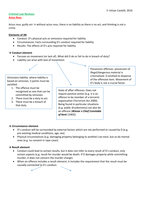
→ Conduct element
• Focuses on movement (or lack of). What did D do or fail to do in breach of duty?
• Liability can arise with lack of movement:
Possession offences: possession of
illegal/dangerous material is
criminalised. D omitted to dispense
Omissions liability: where liability is
of the offensive item. Movement of
based on omission, 3 points must be
D’s body is not a crucial factor.
satisfied:
1. The offence must be
recognised as one that can be State of affair offences: Does not
committed by omission. require positive action (e.g. it is an
2. There must be a duty to act. offence to be member of a terrorist
3. There must be a breach of organisation (Terrorism Act 2000).
that duty. Being found in particular situations
(e.g. public drunkenness) can also be
an offence (Winzar v Chief Constable
of Kent [1983])
→ Circumstance element
• D’s conduct will be surrounded by external factors which are not performed or caused by D (e.g.
pre-existing medical conditions, age, sex)
• Physical circumstances (e.g. damaging property belonging to another) can exist, but so do mental
ones (e.g. no consent in rape cases)
→ Result element
• Conduct could lead to certain results, but it does not refer to every result of D’s conduct, only
certain aspects (e.g. result for murder would be death. If D damages property while committing
murder, it does not concern the murder charge).
• When an offence includes a result element, it includes the requirement that the result must be
causally connected to D’s conduct.
Criminal Law Revision
Actus Reus
Actus reus: guilty act → without actus reus, there is no liability as there is no act, and thinking is not a
crime.
Elements of AR
• Conduct: D’s physical acts or omissions required for liability
• Circumstances: Facts surrounding D’s conduct required for liability
• Results: The effects of D’s acts required for liability.
→ Conduct element
• Focuses on movement (or lack of). What did D do or fail to do in breach of duty?
• Liability can arise with lack of movement:
Possession offences: possession of
illegal/dangerous material is
criminalised. D omitted to dispense
Omissions liability: where liability is
of the offensive item. Movement of
based on omission, 3 points must be
D’s body is not a crucial factor.
satisfied:
1. The offence must be
recognised as one that can be State of affair offences: Does not
committed by omission. require positive action (e.g. it is an
2. There must be a duty to act. offence to be member of a terrorist
3. There must be a breach of organisation (Terrorism Act 2000).
that duty. Being found in particular situations
(e.g. public drunkenness) can also be
an offence (Winzar v Chief Constable
of Kent [1983])
→ Circumstance element
• D’s conduct will be surrounded by external factors which are not performed or caused by D (e.g.
pre-existing medical conditions, age, sex)
• Physical circumstances (e.g. damaging property belonging to another) can exist, but so do mental
ones (e.g. no consent in rape cases)
→ Result element
• Conduct could lead to certain results, but it does not refer to every result of D’s conduct, only
certain aspects (e.g. result for murder would be death. If D damages property while committing
murder, it does not concern the murder charge).
• When an offence includes a result element, it includes the requirement that the result must be
causally connected to D’s conduct.


