
Criminal law:
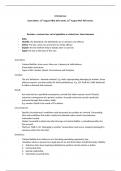
Exam Dates: 11th August ORAL 60% marks, 15th August MCT 40% marks.
Revision:- common law: not in legislation or statute law. Same elements
- IDEA:
- Identify: the defendant, the defendants act or omission, the offence
- Define: The law, actus reus and mens rea of the offence
- Explain: the law with the help of statute and/ or case law
- Apply: the law to the facts of the case.
Actus Reus:
- Criminal liability: Actus reus+ Mens rea + absence of valid defence
- Prosecution must prove
- Types of AR: Conduct, Result, Circumstance and Omission
Conduct:
- The act/ behaviour : deemed unlawful. E.g. theft: appropriating belonging to another. Some
offences require: acts that satisfy AR. AKA prohibited act. E.g. s21 Theft Act 1968: blackmail:
d makes a demand with menaces.
Result:
- Act must lead to a specified consequence- proved that action caused: result. Physical
outcome/ consequence of a person’s actions. Accused must have caused a particular
outcome through their actions: liable.
- E.g. murder. Death is the result of D’s actions.
Circumstances:
- Specific circumstances/ conditions must be present to consider act criminal. Surrounding
facts and conditions that make a lawful act unlawful under certain circumstances.
Antecedent record.
- Makes it essential to determine the full scope of criminal liability + potential penalties for
the accused.
- Theft act 1968 s1 (1): ‘belonging to another’ prosecution must prove: property belonged to
someone other than the thief.
Omissions:
- Criminal liability from failure to act. Not doing something required by law.
- Situations where a person has a legal duty to act and their failure to fulfil that duty: liability:
1- Statutory duty: laws requiring individuals to perform certain actions or duties
2- Contractual duty
3- Special relationship
4- Voluntarily assumed duty:
Exam Dates: 11th August ORAL 60% marks, 15th August MCT 40% marks.
Revision:- common law: not in legislation or statute law. Same elements
- IDEA:
- Identify: the defendant, the defendants act or omission, the offence
- Define: The law, actus reus and mens rea of the offence
- Explain: the law with the help of statute and/ or case law
- Apply: the law to the facts of the case.
Actus Reus:
- Criminal liability: Actus reus+ Mens rea + absence of valid defence
- Prosecution must prove
- Types of AR: Conduct, Result, Circumstance and Omission
Conduct:
- The act/ behaviour : deemed unlawful. E.g. theft: appropriating belonging to another. Some
offences require: acts that satisfy AR. AKA prohibited act. E.g. s21 Theft Act 1968: blackmail:
d makes a demand with menaces.
Result:
- Act must lead to a specified consequence- proved that action caused: result. Physical
outcome/ consequence of a person’s actions. Accused must have caused a particular
outcome through their actions: liable.
- E.g. murder. Death is the result of D’s actions.
Circumstances:
- Specific circumstances/ conditions must be present to consider act criminal. Surrounding
facts and conditions that make a lawful act unlawful under certain circumstances.
Antecedent record.
- Makes it essential to determine the full scope of criminal liability + potential penalties for
the accused.
- Theft act 1968 s1 (1): ‘belonging to another’ prosecution must prove: property belonged to
someone other than the thief.
Omissions:
- Criminal liability from failure to act. Not doing something required by law.
- Situations where a person has a legal duty to act and their failure to fulfil that duty: liability:
1- Statutory duty: laws requiring individuals to perform certain actions or duties
2- Contractual duty
3- Special relationship
4- Voluntarily assumed duty:


