Waves - Key / summary notes
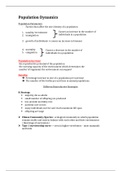
- Wavelength – distance between the same points on two consecutive waves
- Amplitude – distance from equilibrium line to the maximum displacement (crest or
trough)
- Frequency – the number of waves that pass a single point per second
- Period – the time taken for a whole wave to completely pass a single point
Relationships:
- Frequency increases , velocity increases
- Wavelength increases, velocity increases
- Period is inversely proportional to frequency
- Smaller period, higher frequency, greater velocity
Types of Waves:
- Transverse waves
- Longitudinal waves
- Remember: for both types, the wave moves and not whatever it passes through
-a water wave has a moving wave, but the water doesn’t keep moving with it
Measuring velocity
Interactions:
Waves can be reflected, absorbed, or transmitted at the boundary between two
different materials.
, Reflection:
- Waves will reflect off a flat surface
- The smoother the surface, the stronger the reflected wave is
- Rough surfaces scatter the light in all directions, so they appear matt and not
reflective.
- The angle of incidence = angle of reflection
- Light will reflect if the object is opaque and is not absorbed by the material
- The electrons will absorb the light energy, then reemit it as a reflected wave
Transmission:
- Waves will pass through a transparent material
- The more transparent, the more light will pass through the material
- It can still refract, but the process of passing through the material and still emerging
is transmission
Absorption:
- If the frequency of light matches the energy levels of the electrons
- The light will be absorbed by the electrons and not reemitted
- They will be absorbed, and then re emitted over time as heat
- So that particular frequency has been absorbed
- If a material appears green, only green light has been reflected, and the rest of the
- Wavelength – distance between the same points on two consecutive waves
- Amplitude – distance from equilibrium line to the maximum displacement (crest or
trough)
- Frequency – the number of waves that pass a single point per second
- Period – the time taken for a whole wave to completely pass a single point
Relationships:
- Frequency increases , velocity increases
- Wavelength increases, velocity increases
- Period is inversely proportional to frequency
- Smaller period, higher frequency, greater velocity
Types of Waves:
- Transverse waves
- Longitudinal waves
- Remember: for both types, the wave moves and not whatever it passes through
-a water wave has a moving wave, but the water doesn’t keep moving with it
Measuring velocity
Interactions:
Waves can be reflected, absorbed, or transmitted at the boundary between two
different materials.
, Reflection:
- Waves will reflect off a flat surface
- The smoother the surface, the stronger the reflected wave is
- Rough surfaces scatter the light in all directions, so they appear matt and not
reflective.
- The angle of incidence = angle of reflection
- Light will reflect if the object is opaque and is not absorbed by the material
- The electrons will absorb the light energy, then reemit it as a reflected wave
Transmission:
- Waves will pass through a transparent material
- The more transparent, the more light will pass through the material
- It can still refract, but the process of passing through the material and still emerging
is transmission
Absorption:
- If the frequency of light matches the energy levels of the electrons
- The light will be absorbed by the electrons and not reemitted
- They will be absorbed, and then re emitted over time as heat
- So that particular frequency has been absorbed
- If a material appears green, only green light has been reflected, and the rest of the