Chapter 2 Motion in Two Dimensions
2.1 Motion in Two Dimensions – A Scale Diagram Approach
Direction in Two Dimensions: The Compass Rose
The compass rose, shown in Figure 2, has been used for ceuntries to describe direction. It has
applications on land, on the sea, and in the air. Recall that when we draw vectors, they have two ends,
the tip (with the arrowhead) and the tail.
In Figure 3, the vector that is shown pointing east in the second figure is rotated by 20° toward north.
A standard convention for representing vectors that point in directions between the primary compass
directions (north, south, east and west) to describe the direction of this vector.
Figure 3 shows how the convention can be applied to this vector.
The rotated vector’s direction as [E 20° N], which can be read as ‘point east, and then turn 20° toward
north”
Notice that in Figure 3 the complementary angle is 70° as complementary angle are two angles that add
to 90°. Therefore, another way of describing this vector’s direction is [N 70° E], which can be read
as’point north, and then turn 70° toward east.
Both directions are the same, and the notation is interchangeable. When using a Cartesian grid, north
and east correspons to the positive 𝑦 − 𝑎𝑥𝑖𝑠 and the positive 𝑥 − 𝑎𝑥𝑖𝑠 respectively.
When we are adding vectos in two dimensions, the vectors will not always point due north, south, east,
or west.
Resultant Vector: a vector that result from adding two or more given vectors.
1
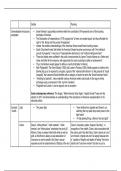
, In a scale such as 1 cm: 100m, think of the ratio as”diagram measurement to real-world measurement”.
Therefore, a diagram measurement of 5.4 cm = 5.4 x (1cm) represents an actual measurement of 5.4 x
(100m) = 540m. (Table 1)
Summary
Objects can move in two dimensions, such as in a horizontal plane and a vertical plane.
The compass rose can be used to express directions in a horizontal plane, such as [N 40° W].
To determine total displacement in two dimensions, displacement vectors can be added together
using a scale diagram. To add two or more vectors together, join them tip to tail and draw the
resultant vector from the tail of the first vector to the tip of the last vector.
2
2.1 Motion in Two Dimensions – A Scale Diagram Approach
Direction in Two Dimensions: The Compass Rose
The compass rose, shown in Figure 2, has been used for ceuntries to describe direction. It has
applications on land, on the sea, and in the air. Recall that when we draw vectors, they have two ends,
the tip (with the arrowhead) and the tail.
In Figure 3, the vector that is shown pointing east in the second figure is rotated by 20° toward north.
A standard convention for representing vectors that point in directions between the primary compass
directions (north, south, east and west) to describe the direction of this vector.
Figure 3 shows how the convention can be applied to this vector.
The rotated vector’s direction as [E 20° N], which can be read as ‘point east, and then turn 20° toward
north”
Notice that in Figure 3 the complementary angle is 70° as complementary angle are two angles that add
to 90°. Therefore, another way of describing this vector’s direction is [N 70° E], which can be read
as’point north, and then turn 70° toward east.
Both directions are the same, and the notation is interchangeable. When using a Cartesian grid, north
and east correspons to the positive 𝑦 − 𝑎𝑥𝑖𝑠 and the positive 𝑥 − 𝑎𝑥𝑖𝑠 respectively.
When we are adding vectos in two dimensions, the vectors will not always point due north, south, east,
or west.
Resultant Vector: a vector that result from adding two or more given vectors.
1
, In a scale such as 1 cm: 100m, think of the ratio as”diagram measurement to real-world measurement”.
Therefore, a diagram measurement of 5.4 cm = 5.4 x (1cm) represents an actual measurement of 5.4 x
(100m) = 540m. (Table 1)
Summary
Objects can move in two dimensions, such as in a horizontal plane and a vertical plane.
The compass rose can be used to express directions in a horizontal plane, such as [N 40° W].
To determine total displacement in two dimensions, displacement vectors can be added together
using a scale diagram. To add two or more vectors together, join them tip to tail and draw the
resultant vector from the tail of the first vector to the tip of the last vector.
2