Of Mice and Men study guide
Of Mice and Men study guide 2034 Chapter - 1. Reread the first paragraph of the novel. How does the passage function? What purpose does Steinbeck fulfill by beginning the novel in this way? - ANS-The novel begins with a rich description of the setting. Steinbeck uses descriptive language to indicate that the area is a place of rest. The specific colors, foliage, and animals that are mentioned create a respite, even for those boys and men from the ranches who beat a path to the water. For example, Steinbeck uses the following images to suggest that this place is a place of comfort and that the Salinas River is a sanctuary. 2. Compare and contrast the men who come into the clearing by the river. What do you think Steinbeck wants the reader to infer about the men based on their descriptions? - ANS-The two men who come into the clearing are similar in the way in which they are dressed and what they carry with them. For example, the two men are "dressed in denim trousers and in denim coats with brass buttons." (p. 2) They also both carry blanket rolls with them. Physically the men are very different. One man is "small and quick, dark of face, with restless eyes and sharp, strong features." (p. 2) The other man is huge and fair-skinned. 3. Steinbeck uses several animal images to describe Lennie. Cite two examples of images that are used and explain their effects on Lennie's characterization. - ANS- "Lennie dabbled his big paw in the water and wiggled... and came back again."(pg 3) "...dragging his feet a little, the way a bear drags his paws."(pg 3) 4. When George and Lennie reach a clearing, George gives Lennie instructions about the water. When Lennie and George sit by the river to rest, what do they talk about? What does Steinbeck achieve through the conversation? What can we learn about Lennie from their conversation? What can we learn about George. - ANS-George explains to Lennie where they are going. Lennie has forgotten about "watchin' that blackboard." (p. 5) The reader can infer from their conversation that Lennie is simple. He may be a large man, but he cannot remember things as basic as where he is going. George is obviously Lennie's protector; George even keeps track of Lennie's work card. Steinbeck is continuing to establish the interdependent relationship between Lennie and George 5. Read the following line from the novel and explain the phrase " watchin' that blackboard." How does it contribute to the characterization of George and Lennie. "You remember settin' in that gutter on Howard street and watching' that blackboard." - ANS- "Watchin' that blackboard" refers to the Depression era when employers would post jobs in front of their offices. Those men who were seeking work would check the blackboards to find any new jobs. Steinbeck is emphasizing the characters' economic status, as well as the mindset that George and Lennie must have after moving across the country looking for work. 6. What information about Lennie's character is revealed to the reader through George's discovery of the dead mouse in Lennie's pocket? - ANS-The reader learns that Lennie is pacified through simple things. He likes the touch of soft items. The reader also learns that Lennie is not bothered by the idea that the mouse is dead, but he is worried that George will think that he killed i 7. Describe George's plan for getting the job at the ranch. What do we learn about Lennie from this plan? - ANS-George tells Lennie that he does not want Lennie to speak. George is going to give the boss their work tickets, while Lennie stands in the background. George wants Lennie to be quiet because he is afraid that the boss will not hire them if he knows that Lennie is "a crazy bastard." The reader can infer that Lennie is a hard worker (perhaps because of his size), but he is likely to say the wrong thing. 8. Why does Steinbeck mention that George and Lennie had problems in Weed but then not develop the story? As George and Lennie are waiting to go to the camp, George states, "God, you're a lot of trouble. I could get along so easy and so nice if I didn't have you on my tail. I could live so easy and maybe have a girl." a)Explain what this statement illustrates about George's feelings toward Lennie. b)How is George's statement ironic given the time period in which the novel is set? c)What does the reader learn about George and his dreams? - ANS-Steinbeck is creating dramatic interest and foreshadowing by mentioning Weed without divulging the details of what happened there. The reader can assume that the specific information will be revealed later. A) George is frustrated with Lennie because he requires so much care. It is understandable that Lennie's handicap sometimes interferes with their friendship. B) George's attitude is ironic, considering how most men in their situation are lonely and long for a companion, a friend. C) We learn that George is the same as most people; he dreams about settling down and getting married, something that most transients are unable to do. 9. Even though Lennie's mentality keeps him from fully understanding the world around him, he is very sensitive to George's feelings. Describe an incident that shows Lennie's compassion for George. - ANS-Example: While warming beans over the fire, Lennie says how he would like to have ketchup with his supper. This statement provokes George and he erupts with anger, wishing he could be alone, without having to watch over Lennie. Following the episode, Lennie makes his way closer to George and says, "I was only foolin', George. I don't want no ketchup. I wouldn't eat no ketchup if it was right here beside me. ...I wouldn't eat none, George. I'd leave it all for you. You could cover your beans with it and I wouldn't touch none of it." (p. 12) 10. After George erupts in anger about the responsibility of taking care of Lennie, Lennie offers to run away and leave George alone. Why do you think George does not take Lennie up on his offer? - ANS-George seems to regret the way he talks to Lennie. He even asks Lennie if he has been mean to him. Because George has taken care of Lennie for so long, George feels a great responsibility for Lennie's well-being. George is worried that Lennie would not survive if he was not with him. 11. What literary techniques does Steinbeck use in the passage that begins " 'You crazy son-of-a bitch. You keep me in hot water all the time.' " The passage ends with "He looked across the fire at Lennie's anguished face, and then he looked ashamedly at the flames." - ANS-Steinbeck employs several literary techniques. First, Steinbeck uses George's character to fill in narrative gaps. The reader does not know what happened in Weed, but through George's conversation with Lennie, Steinbeck is able to relate a few of the details without using a flashback. Second, Steinbeck is establishing some foreshadowing of events to come. The reader should pay attention to the fact that Weed has now been mentioned twice, which would imply that it is a fairly significant event. Finally, Steinbeck is able to reveal part of George's personality. The reader learns that George is sympathetic to Lennie and remorseful for making Lennie feel badly. This revealing characteristic comes after George berates Lennie. 12. Why does Lennie like George to tell the story of the ranch, even though he already knows it by heart? Why does George so readily agree to tell the story, even though he has just gotten angry with Lennie a few minutes before? What does this story reveal about one of the themes in the novel? - ANS-Lennie, having the mentality of a child, is reassured by George's retelling. George does not mind telling the story because it reinforces their dreams and the fact that they have a solid relationship. Lennie likes feeling the reassurance that George will look after him and he will look after George. Steinbeck uses George and Lennie's dream to illustrate the nature of the American dream. The characters throughout the novel discuss the dreams that they have to be able to be free to pursue their own happiness. It reveals "my brother's keeper" because George is protecting both of their job opportunities. 13. Explain the expression "live off the fatta the lan'." - ANS-To live off of the fat of the land implies that the land will offer people whatever they need to survive. Lennie and George discuss this because they are hopeful that eventually they will be prosperous and will not have to travel and work various, temporary jobs in order to survive. 14. Why does George tell Lennie to remember the spot where they are camping? What might this conversation foreshadow? - ANS-George tells Lennie to remember where they are in case something happens at the camp. George specifically suggests that Lennie may get in trouble as he did at a previous job site. This conversation might foreshadow that something bad is going to happen. 15. By the end of Chapter 1, there are two themes that are easily identified. Using specific examples, describe these themes. - ANS-Friendship is shown when George doesn't want Lennie to leave and cares about his safety. My Brother's keeper is shown by how George protects Lennie. Chapter - ANS-Two 1. In this chapter, Steinbeck again begins with a description of the setting. Explain how this description is different from the description at the beginning of the previous chapter. What does this description tell us about George and Lennie's life? - ANS-In the first section of the novel, Steinbeck begins with a pleasant description of the lush area along the Salinas River. The reader is introduced to the book through a calming setting. At the beginning of this section, the reader sees the living quarters that Lennie and George will share. The reader is awakened to the realities of George and Lennie's life, and better understands Lennie and George's dreams of a better life. 2. What happens when George and Lennie arrive at the camp? What do they learn? - ANS-When George and Lennie arrive at the camp, they are shown to their bunks. They learn that the boss is already angry with them because he was expecting them the night before. 3. Explain the purpose of including the story about the blacksmith who used to work at the ranch. - ANS-Steinbeck includes the story of the blacksmith to illustrate the nature of the men who come to work at the ranches. The blacksmith suddenly quits. Candy says, "Why...he...just quit, the way a guy will.... Just wanted to move" (p. 19). These men have no ties, so they come and go on a whim; they are without roots
Connected book
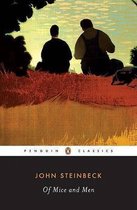
- Unknown
- 9780140186420
- 1
Written for
- Institution
- Of Mice and Men study guid 2034
- Module
- Of Mice and Men study guid 2034
Document information
- Uploaded on
- August 9, 2023
- Number of pages
- 22
- Written in
- 2023/2024
- Type
- Exam (elaborations)
- Contains
- Questions & answers
Subjects
-
of mice and men study guide