MAN2106
Corporate Finance Notes
Module Lecturer
• Fang Y.
• Email:
• Office: 34MS02
Module Assessment
• Assessment 1:
o Mid-Term Test.
o Week 7.
o Weighting = 30%.
o Content = Weeks 1-4.
• Assessment 2:
o Weighting = 70%.
Module Textbook
• Fundamentals of Corporate Finance
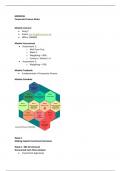
Module Schedule
Week 1
Making Capital Investment Decisions
Week 1- SBS On Demand
Discounted Cash Flow Analysis
• Investment Appraisals
, • Discounted Cash Flow Model
• Cash Flows
• Project Cash Flows
• Variations of Operating Cash Flow Approaches
• Inflation and Investment
• Taxation and Investment
Investment Appraisals
• Net Present Value (NPV)
• Payback Period
• Average Accounting Return
• Internal Rate of Return (IRR)
• Profitability Index (PI)
Net Present Value (NPV)
• The difference between an investment’s market value and its cost.
• NPV is the present value of the future cash flows at investor required rate of return
minus the initial investment.
• NPV > 0, Accept.
• NPV < 0, Reject.
Incremental Cash Flows
• The difference between a firm’s future cash flows with a project and those without
the project.
o The changes in the firm’s overall future cash flow that is the direct
consequence of taking the project.
o Incremental cash flows is after-tax incremental cash flow by default in our
context.
• Relevant costs:
o E.g., Opportunity costs, positive or negative side effects, Net Working Capital
(NWC).
• Irrelevant Costs:
o E.g., Sunk Costs, Financing Costs.
Stand-Alone Principle
• The assumption that evaluation of a project may be based on the project’s
incremental cash flows.
• View a project as a ‘mini-firm’ with its own future costs and revenues, assets, cash
flows.
• We compare the cash flows from the ‘mini-firm’ and the cost of acquiring the cash
flows (i.e., NPV).
Sunk Costs
• A cost that has already been incurred and cannot be removed.
o E.g., Consultation service fee on whether a product line should be launched.
,Opportunity Cost
• The most valuable alternative that is given up if a particular investment is
undertaken.
o E.g., Convert an old mill to apartments.
▪ Sale of the Old mill at its current market price is given up- is called the
opportunity cost.
Side Effects
• Also called spillover effects.
o Beneficial Spillover Effects:
▪ E.g., HP main profit from printer consumables like inkjet cartridges,
laser toner cartridges and special paper instead of printer.
• Good or bad side effects.
o Bad Side Effects:
▪ Erosion: the Cash flows of a new project that come at the expense of
a firm’s existing projects.
Net Working Capital
• The difference between current assets (E.g., Cash, Inventory, Trade Receivables) and
Current Liabilities (E.g., Trade Payables, Debts).
• Supply Working Capital at the beginning and recovers it towards the end.
0 1 2 3 4
Net Working 100 200 200 200 0
Capital
Cash Flow (100) (100) 0 0 200
NB: In year 0, to have 100 NWC, cash outflow of 100 is required: in year 1, to have 200
NWWC, an additional cash outflow of 100 is required.
Example:
Income Statement (Simplified)
Sales 500
Costs (310)
Net Income 190
Beginning of Year End of Year Change
Trade Receivables 880 910 +30
Trade Payables 550 605 +55
Net Working Capital 330 305 (25)
Assumptions: no tax, no depreciation, no non-current assets are purchased during the year,
the only components purchased during the year, the only components of NWC are trade
receivables and payables.
, Calculation:
Total Cash Flows = Operating Cash flow – Change in Net Working Capital – Capital Spending
= $190 – (-25) – 0
= $215
Alternative Calculation:
Cash Flow = Cash Inflow – Cash Outflow
= ($500 – $30) – ($310 - $55)
= ($500 - $310) – (30-55)
= Operating Cash Flow – Change in Net Working Capital
= $190 – (-25)
= $215
Financing Costs
• Interest paid or financing costs (E.g., dividends, principals repaid) should not be
included in the relevant cash flows of the project.
• The Financing decision is not relevant to the viability or risk of the project and
therefore should be ignored in investment appraisal.
Pro Forma Financial Statements
• Pro forma financial statements: projecting future years’ operations (E.g., unit sales,
selling price per unit, variable cost per unit, total fixed costs).
Example Table 9.1:
Projected Income Statement £
Sales (50,000 Units at £4/ Unit) 200,000
Variable Costs (£2.50/ Unit) (125,000)
Gross Profit 75,000
Fixed Costs (12,000)
Depreciation (£90,000/ 3) (30,000)
Profit Before Taxes 33,000
Taxes (34%) (11,220)
Net Income 21,780
Project Cash Flows
• Three components of net cash flow: Operating Activities, Financing Activities
(irrelevant) and Investing Activities.
• Project Cash Flow = Project Operating Cash Flow – Project Capital Spending
• Operating Cash Flow = Net Income + Depreciation – Increase (+ Decrease) in Working
Capital
o Depreciation should be non-cash items which we adjust back in the operating
activities in the cash flow statement E.g., depreciation, stock compensation,
deferred income taxes. Here we focus on depreciation.
o The alterative definition of OCF will be discussed later.
Corporate Finance Notes
Module Lecturer
• Fang Y.
• Email:
• Office: 34MS02
Module Assessment
• Assessment 1:
o Mid-Term Test.
o Week 7.
o Weighting = 30%.
o Content = Weeks 1-4.
• Assessment 2:
o Weighting = 70%.
Module Textbook
• Fundamentals of Corporate Finance
Module Schedule
Week 1
Making Capital Investment Decisions
Week 1- SBS On Demand
Discounted Cash Flow Analysis
• Investment Appraisals
, • Discounted Cash Flow Model
• Cash Flows
• Project Cash Flows
• Variations of Operating Cash Flow Approaches
• Inflation and Investment
• Taxation and Investment
Investment Appraisals
• Net Present Value (NPV)
• Payback Period
• Average Accounting Return
• Internal Rate of Return (IRR)
• Profitability Index (PI)
Net Present Value (NPV)
• The difference between an investment’s market value and its cost.
• NPV is the present value of the future cash flows at investor required rate of return
minus the initial investment.
• NPV > 0, Accept.
• NPV < 0, Reject.
Incremental Cash Flows
• The difference between a firm’s future cash flows with a project and those without
the project.
o The changes in the firm’s overall future cash flow that is the direct
consequence of taking the project.
o Incremental cash flows is after-tax incremental cash flow by default in our
context.
• Relevant costs:
o E.g., Opportunity costs, positive or negative side effects, Net Working Capital
(NWC).
• Irrelevant Costs:
o E.g., Sunk Costs, Financing Costs.
Stand-Alone Principle
• The assumption that evaluation of a project may be based on the project’s
incremental cash flows.
• View a project as a ‘mini-firm’ with its own future costs and revenues, assets, cash
flows.
• We compare the cash flows from the ‘mini-firm’ and the cost of acquiring the cash
flows (i.e., NPV).
Sunk Costs
• A cost that has already been incurred and cannot be removed.
o E.g., Consultation service fee on whether a product line should be launched.
,Opportunity Cost
• The most valuable alternative that is given up if a particular investment is
undertaken.
o E.g., Convert an old mill to apartments.
▪ Sale of the Old mill at its current market price is given up- is called the
opportunity cost.
Side Effects
• Also called spillover effects.
o Beneficial Spillover Effects:
▪ E.g., HP main profit from printer consumables like inkjet cartridges,
laser toner cartridges and special paper instead of printer.
• Good or bad side effects.
o Bad Side Effects:
▪ Erosion: the Cash flows of a new project that come at the expense of
a firm’s existing projects.
Net Working Capital
• The difference between current assets (E.g., Cash, Inventory, Trade Receivables) and
Current Liabilities (E.g., Trade Payables, Debts).
• Supply Working Capital at the beginning and recovers it towards the end.
0 1 2 3 4
Net Working 100 200 200 200 0
Capital
Cash Flow (100) (100) 0 0 200
NB: In year 0, to have 100 NWC, cash outflow of 100 is required: in year 1, to have 200
NWWC, an additional cash outflow of 100 is required.
Example:
Income Statement (Simplified)
Sales 500
Costs (310)
Net Income 190
Beginning of Year End of Year Change
Trade Receivables 880 910 +30
Trade Payables 550 605 +55
Net Working Capital 330 305 (25)
Assumptions: no tax, no depreciation, no non-current assets are purchased during the year,
the only components purchased during the year, the only components of NWC are trade
receivables and payables.
, Calculation:
Total Cash Flows = Operating Cash flow – Change in Net Working Capital – Capital Spending
= $190 – (-25) – 0
= $215
Alternative Calculation:
Cash Flow = Cash Inflow – Cash Outflow
= ($500 – $30) – ($310 - $55)
= ($500 - $310) – (30-55)
= Operating Cash Flow – Change in Net Working Capital
= $190 – (-25)
= $215
Financing Costs
• Interest paid or financing costs (E.g., dividends, principals repaid) should not be
included in the relevant cash flows of the project.
• The Financing decision is not relevant to the viability or risk of the project and
therefore should be ignored in investment appraisal.
Pro Forma Financial Statements
• Pro forma financial statements: projecting future years’ operations (E.g., unit sales,
selling price per unit, variable cost per unit, total fixed costs).
Example Table 9.1:
Projected Income Statement £
Sales (50,000 Units at £4/ Unit) 200,000
Variable Costs (£2.50/ Unit) (125,000)
Gross Profit 75,000
Fixed Costs (12,000)
Depreciation (£90,000/ 3) (30,000)
Profit Before Taxes 33,000
Taxes (34%) (11,220)
Net Income 21,780
Project Cash Flows
• Three components of net cash flow: Operating Activities, Financing Activities
(irrelevant) and Investing Activities.
• Project Cash Flow = Project Operating Cash Flow – Project Capital Spending
• Operating Cash Flow = Net Income + Depreciation – Increase (+ Decrease) in Working
Capital
o Depreciation should be non-cash items which we adjust back in the operating
activities in the cash flow statement E.g., depreciation, stock compensation,
deferred income taxes. Here we focus on depreciation.
o The alterative definition of OCF will be discussed later.