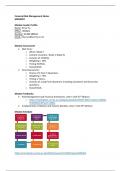
Financial Risk Management Notes
MAN3097
Module Leader Profile:
Name: Xinyu Yu
Office: 73MS02
Number: 01483 688621
Email:
Module Assessment
• Mid-Term:
o When: Week 7.
o Content: (Content- Week 1-Week 5)
o Consists of: 25MCQ.
o Weighting = 30%.
o Timing: 60 Mins.
o Closed Book.
• Final Assessment:
o Choice of 3 from 5 Questions.
o Weighting = 70%.
o Timing: 2 Hours.
o Consists of: Long-Form Questions including calculation and discursive
questions.
o Closed Book.
Module Textbooks
• Risk Management and Financial Institutions, John C Hull (5th Edition)
o https://readinglists.surrey.ac.uk/leganto/public/44SUR_INST/citation/103641
55240002346?auth=SAML
• Fundamentals of Options and Futures Markets, John C Hull (9th Edition)
Module Schedule
https://surreylearn.surrey.ac.uk/d2l/le/lessons/241336/topics/2640356
,Week 1
Introduction to Financial Risk Management
Week 1 SBS on Demand
Recap: Derivatives Markets
Derivatives Markets
What is a Derivative?
• A financial instrument whose payoffs and values are derived from, or depend on,
something else.
Use:
• Hedging:
o Used by companies and financial institutions to reduce/ manage financial risk
due to market price changes.
• Market Making;
o A bank will buy/ sell derivatives to their clients to help them manage their
own risks.
• Arbitrage:
o Making money from misalignment of market prices.
• Speculating:
o Used with the sole aim of making a profit on how an asset’s value will change
in the future.
Some of the largest trading losses in derivatives have occurred because individuals who had
a mandate to be hedgers or arbitragers switched to being speculators.
Two Main Ways of Buying/ Selling Derivatives:
• Exchange Traded:
o Bought/ sold via a dealer on an exchange.
o Standard contract sizes and dates.
o Price movements settled daily, so virtually no credit risk but does create
liquidity risk.
• Over-The-Counter (OTC):
o Bought/ sold directly from a financial institution.
o Individually negotiated, non-standard contracts.
o No margin payments (unless cleared through a CCP).
o Therefore, lower liquidity risk (as no daily settlements required) but create
credit risk (as changes in value can build up during the contract).
Growth in Derivatives Markets:
,Types of Derivatives:
• Futures Contract:
o A futures contract is an agreement between two parties than gives the holder
the right to purchase or sell the underlying asset for a specified price on a
specific date.
• Forward Contract:
o Forward contracts are derivatives that are similar to future contracts but are
sold over the counter rather than through an exchange.
• Options Contract:
o Options contracts are derivative contracts that give buyers the right to buy or
sell the underlying asset on or before a specified date.
• Swaps Contract:
o Swaps are derivative contracts with two holders who exchange the obligatory
financial terms of the contract.
Recap: Fixing Instruments: Forwards and Futures
Fixing Instruments: Forward Contracts
Forward Contracts:
• A forward contract is an agreement to buy or sell an asset at a certain price at a
certain future time.
• Forward contracts trade in the over-the-counter (OTC) market.
Additional Useful Terms:
• Spot Rate:
o Price or exchange rate for virtually immediate delivery.
o Current Rate.
• Forward Rate:
o Price of exchange rate for delivery at an agreed future date.
, Example: Forward Contract- Hedging FX Risk
Required:
i) What forward rate will the company receive?
3-Month Forward = 1.6950
The US company sells GBP forward at the 3-month forward rate of 1.6950 (the company
takes the less favourable side of the rate).
ii) What cash flows are involved.
CFs:
US Company -> Bank = £1,000,000
Bank -> US Company = $1,695,000
Example: Forward Contract- Opportunity Benefit/ Cost of Hedging
Now assume that the spot rate in 3 months – that is on maturity of the forward contracts –
is 1.8000 USD per GBP.
Required:
What was the opportunity gain or loss created by hedging this exposure.
If the company had not hedged the exposure, it would have sold GBP £1,000,000 at the spot
rate of 1.8000 USD per GBP in 3 months’ time and received USD $1,800,000.
However, the company did hedge the exposure using a forward contract and consequently,
only received USD $1,695,000.
Therefore, hedging the exposure therefore created an opportunity cost of USD $105,000
(=USD $1.5m – USD $1.695m) in this scenario.
MAN3097
Module Leader Profile:
Name: Xinyu Yu
Office: 73MS02
Number: 01483 688621
Email:
Module Assessment
• Mid-Term:
o When: Week 7.
o Content: (Content- Week 1-Week 5)
o Consists of: 25MCQ.
o Weighting = 30%.
o Timing: 60 Mins.
o Closed Book.
• Final Assessment:
o Choice of 3 from 5 Questions.
o Weighting = 70%.
o Timing: 2 Hours.
o Consists of: Long-Form Questions including calculation and discursive
questions.
o Closed Book.
Module Textbooks
• Risk Management and Financial Institutions, John C Hull (5th Edition)
o https://readinglists.surrey.ac.uk/leganto/public/44SUR_INST/citation/103641
55240002346?auth=SAML
• Fundamentals of Options and Futures Markets, John C Hull (9th Edition)
Module Schedule
https://surreylearn.surrey.ac.uk/d2l/le/lessons/241336/topics/2640356
,Week 1
Introduction to Financial Risk Management
Week 1 SBS on Demand
Recap: Derivatives Markets
Derivatives Markets
What is a Derivative?
• A financial instrument whose payoffs and values are derived from, or depend on,
something else.
Use:
• Hedging:
o Used by companies and financial institutions to reduce/ manage financial risk
due to market price changes.
• Market Making;
o A bank will buy/ sell derivatives to their clients to help them manage their
own risks.
• Arbitrage:
o Making money from misalignment of market prices.
• Speculating:
o Used with the sole aim of making a profit on how an asset’s value will change
in the future.
Some of the largest trading losses in derivatives have occurred because individuals who had
a mandate to be hedgers or arbitragers switched to being speculators.
Two Main Ways of Buying/ Selling Derivatives:
• Exchange Traded:
o Bought/ sold via a dealer on an exchange.
o Standard contract sizes and dates.
o Price movements settled daily, so virtually no credit risk but does create
liquidity risk.
• Over-The-Counter (OTC):
o Bought/ sold directly from a financial institution.
o Individually negotiated, non-standard contracts.
o No margin payments (unless cleared through a CCP).
o Therefore, lower liquidity risk (as no daily settlements required) but create
credit risk (as changes in value can build up during the contract).
Growth in Derivatives Markets:
,Types of Derivatives:
• Futures Contract:
o A futures contract is an agreement between two parties than gives the holder
the right to purchase or sell the underlying asset for a specified price on a
specific date.
• Forward Contract:
o Forward contracts are derivatives that are similar to future contracts but are
sold over the counter rather than through an exchange.
• Options Contract:
o Options contracts are derivative contracts that give buyers the right to buy or
sell the underlying asset on or before a specified date.
• Swaps Contract:
o Swaps are derivative contracts with two holders who exchange the obligatory
financial terms of the contract.
Recap: Fixing Instruments: Forwards and Futures
Fixing Instruments: Forward Contracts
Forward Contracts:
• A forward contract is an agreement to buy or sell an asset at a certain price at a
certain future time.
• Forward contracts trade in the over-the-counter (OTC) market.
Additional Useful Terms:
• Spot Rate:
o Price or exchange rate for virtually immediate delivery.
o Current Rate.
• Forward Rate:
o Price of exchange rate for delivery at an agreed future date.
, Example: Forward Contract- Hedging FX Risk
Required:
i) What forward rate will the company receive?
3-Month Forward = 1.6950
The US company sells GBP forward at the 3-month forward rate of 1.6950 (the company
takes the less favourable side of the rate).
ii) What cash flows are involved.
CFs:
US Company -> Bank = £1,000,000
Bank -> US Company = $1,695,000
Example: Forward Contract- Opportunity Benefit/ Cost of Hedging
Now assume that the spot rate in 3 months – that is on maturity of the forward contracts –
is 1.8000 USD per GBP.
Required:
What was the opportunity gain or loss created by hedging this exposure.
If the company had not hedged the exposure, it would have sold GBP £1,000,000 at the spot
rate of 1.8000 USD per GBP in 3 months’ time and received USD $1,800,000.
However, the company did hedge the exposure using a forward contract and consequently,
only received USD $1,695,000.
Therefore, hedging the exposure therefore created an opportunity cost of USD $105,000
(=USD $1.5m – USD $1.695m) in this scenario.