C12 - Business LawCase Analysis
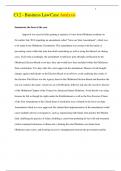
1 C12 - Business LawCase Analysis Summarize the facts of the case Approval was received after gaining a majority of votes from Oklahoma residents on November 2nd, 2010 regarding an amendment called “Save our State Amendment”, which was to be made to the Oklahoma Constitution. This amendment was created with the intent of preventing courts within the state from both considering as well as using the Sharia Law during cases. If all went accordingly, the amendment would have gone through certification by the Oklahoma Election Board seven days later and would have been included within the Oklahoma State constitution. Two days after the voters approved the amendment, Muneer Awad brought charges against individuals on the Election Board in an effort to avoid certifying the results of the election. Paul Ziriax was the Agency head on the Oklahoma Election Board and therefore the suit was stated in his name. Awad was an avid Muslamic follower and also the executive director of the Oklahoma Chapter of the Council on American-Islamic Relations. Awad that he was suing because he felt as though his rights under the Establishment as well as the Free Exercise Clause of the First Amendment of the United States Constitution were violated by the Save our State Amendment which was now approved. He claimed that implementation of the amendment would cause multiple adverse consequences, such as stigmatizing individuals who practice the Muslim faith, inhibiting the practice of Islam, disabling a court from probating his last will and testament (which contained references to Sharia law), limiting the relief Muslims can obtain from Oklahoma state courts, and fostering excessive entanglement between the government and his 2 religion (Bagley, C. E. Managers and the Legal Environment: Strategies for Business.) Awad received approval from the district court and was granted a preliminary injunction which would cease the certification process for the amendment however upon the approval, the members of the Oklahoma Election Board filed for an appeal. Identify the parties and explain each party’s position The plaintiff, Muneer Awad, was suing the Oklahoma Election Board Oklahoma Election Board in an effort to stop the process of certification of votes received from the election regarding the Save our State Amendment. Awad stated that the amendment was in violation of the rights he was entitled to under the Establishment and Free Exercise Clauses of the First Amendment of the United States Constitution. Awad received a preliminary junction from the district court. The defendant, Oklahoma Election Board, brought forward an appeal to the United States Court of Appeals for the Tenth Circuit suggesting that the claims made by the plaintiff were not justiciable and did not meet the requirement for the case to be considered at a preliminary injunction. Outline the case’s procedural history including any appeals The proceeding started on November 4th when Awad brought charges against the Oklahoma Election Board in an effort to stop the certification of the votes for the Save our State Amendment. On November 9th, the Oklahoma District Court agreed to approve a temporary restraining order on the certification process. The court then held an evidentiary hearing on November 22nd to discuss the request made by Awad for a preliminary injunction to which was granted approximately one week later. On December 1, the Oklahoma Election Board filed an appeal, within an appropriate time frame, against the grant of the preliminary injunction. On 3 September 12 of the following year, verbal arguments were given in front of a panel following the request that both parties file simultaneous supplemental briefs in regards to various questions imposed by the court. Both parties completed this request and filed the respective briefs on November 2nd. What is the legal issue in question in this case? The legal issue in question in this case was how state constitutional amendments which forbids the state court from considering the use of Sharia law violate the Establishment or the Free Exercise Clause of the United States Constitution. How did the court rule on the legal issue of this case? It was determined that no abuse of discretion was displayed by the district court when considering factors of the preliminary hearing and concluded that the plaintiff stated at least one justiciable claim. With that decision, the court affirmed. What facts did the court find to be most important in making its decision? After carefully reviewing the specifics of the amendment, the court found that the intentions of the amendment included the prevention of the applicability of the Sharia law as well as imposition of a ban to reference this law in any legal case presented to the courts. The court found that there was a significant lack of evidence proving a compelling interest regarding amendment and also was not able to prove how the state was at risk without the amendment. The court determined that there is a much greater importance in regards to the constitutional rights of Awad and this trumped that of the popular opinion of passing the amendment which was displayed by the voters. Balance-of-harm factors was considered on behalf of Awad and all Muslim followers. 4 Can a U.S. court enforce a clause in a contract specifying that Sharia law will apply? Sharia is a traditional set of Islamic rules and laws which assist in the governance and regulation of Muslamic life. An important aspect of the Islamic law is to ensure that civil law is upheld and interpreted in conjunction with its own. There are three concepts by which the trans and commerce of Islamic practices are governed called Zakat, Riba and Gharar. The Gharar concept is used specifically in Islamic finance for the measurement of legitimacy when there may be a toxic sale as well as an ill-advised investment in regards to the sale of goods, gambling and contract that contain terms which may be unclear. Gharar, in excess, is forbidden under Islamic law as it can lead to various unjust consequences. The U.S. court is able to enforce a clause in a contract specifying that Sharia law will apply however it may be more beneficial for the clause to be included in a closed-ended contract or a contract where both parties are fully aware of what they may receive. When, if ever, should a national court look to decisions of courts in other nations when interpreting its own nation’s constitution? The national court can look to decisions of courts in other nations when interpreting its own nation’s constitution as long as the court is able to exercise the appropriate consideration on the matter at hand under Federal Rule Procedure 44.1 and do not undermine the nations constitutional laws. There have been instances when the United States Supreme Court has had to apply this concept as well as situations where the United States is connected to obligations of the foreign countries. Do you agree or disagree with the court’s decision? If you disagree, provide an explanation of your reasoning. 5 I agree with the decision of the court of appeals in favor of Awad. Though each state has the right of constitutional amendments, there should never be an instance where an amendment will cause a specific group of people or followers of a certain religion to be target and stripped of their rights as this can be defined as discrimination. I feel as though the court was able to rule on the case in a just manner with no favor being given to either side but rather based their decision on the facts and how it will impact people of their state. It was clear that the passing of this amendment is a clear violation of the rights of Islamic followers and the nation must separate matters of law and religion to ensure that all people are receiving the equal right they are entitles to. References 6 Bagley, C. E. Managers and the Legal Environment: Strategies for Business. [VitalSource Bookshelf]. Retrieved from
Written for
- Institution
- C12 - Business LawCase Analysis
- Module
- C12 - Business LawCase Analysis
Document information
- Uploaded on
- July 28, 2023
- Number of pages
- 6
- Written in
- 2022/2023
- Type
- Exam (elaborations)
- Contains
- Questions & answers
Subjects
-
c12 business lawcase analysis
-
1 c12 business lawcase analysis summarize the fa

Also available in package deal