Unit 21: Medical Physics Applications
A: Explore the principles, production, uses and benefits of non-ionising
instrumentation techniques in medical applications
B: Explore the principles, production, uses and benefits of ionising
instrumentation techniques in medical applications
Radiation use in medical diagnosis and treatment
As part of my radiology placement at a local hospital, I have been asked to prepare written briefing notes for a
radiographer and radiologist for three patients suffering from different medical conditions. I will explore how each
application works and evaluate each application so that the radiographer and radiologist can understand why a
certain application may be used instead of a different application.
Non-ionising radiation (NIR)
Non-ionising radiation is a type of radiation that has less energy than ionising radiation. This means that it is unable
to remove an electron from an atom or molecule [1]. It includes visible, infrared, and ultraviolet light; microwaves,
radio waves and radiofrequency energy from cell phones [1].
This report will be focusing on MRI (magnetic resonance imaging) and IRT (infrared thermography).
Magnetic resonance imaging (MRI)
Magnetic resonance imaging (MRI) is a form of scan that produces detailed images of soft tissues by using powerful
magnetic fields and radio waves [2]. Soft tissues that can tolerate exposure to MRIs include the brain and spinal
cord, bones and joints, breasts, heart and blood vessels and internal organs such as the liver, womb or prostate
gland [2]. MRIs can be used to diagnose tumours, soft tissue injuries and joint injury or disease [3].
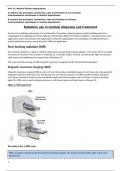
Figure 1: MRI scanner [4]
Procedure for a MRI scan
When a patient is placed under the powerful scanning magnets, the protons in their bodies align in the same
direction [2].
1
, Unit 21: Medical Physics Applications
A: Explore the principles, production, uses and benefits of non-ionising
instrumentation techniques in medical applications
B: Explore the principles, production, uses and benefits of ionising
instrumentation techniques in medical applications
↓
Short bursts of radio waves are then directed at certain parts of the body, causing the protons to become
misaligned [2].
↓
The protons realign when the radio waves are switched off. This emits radio waves that are picked up by
receivers [2].
↓
These signals provide information about the precise position of the protons in the body [2]. They are also helpful
in distinguishing between different types of tissue in the body, because protons in different forms of tissue
realign at different rates and produce diverse signals [2].
Benefits of MRI scans
Ionising radiation is not used in MRI. They use powerful magnetic fields and radio waves to produce images of the
inside of the body [5]. MRI, unlike PET scanning, does not require the injection of contrast agents into the body,
which might be dangerous for some patients with kidney problems or allergies [5]. As a result, magnetic resonance
imaging (MRI) is a risk-free technique for people of all ages, including children and pregnant women [5]. Another
advantage of MRI over other types of medical imaging is that it is completely non-invasive, which means no needles
or incisions are required during the procedure [5]. The patient lies still on a table while an MRI machine generates
detailed images from various angles using magnetic energy pulses [5]. This allows clinicians to get a clear picture
without resorting to more invasive procedures like biopsies [5].
Limitations of MRI scans
The MRI scanning area is small and tight, making some people feel claustrophobic even if they are not normally
afraid of enclosed spaces [6]. Some obese people may have difficulty fitting through the scanner [6]. Open MRI
scanners have a larger interior and an open side [6]. People may feel less claustrophobic in these and obese
individuals may fit more easily [6]. Depending on the magnet strength, the images produced by open MRI scanners
may be inferior to those produced by enclosed scanners, but they can still be used to make a diagnosis [6].
Another disadvantage of MRI is that it can have an effect on those who have implants in their body because it uses
intense magnetic fields [6]. Implants that can be affected by MRI scans include pacemakers, defibrillators, cochlear
implants and magnetic metallic clips [6]. Implants can shift, overheat or malfunction if exposed to magnetic fields
produced by MRI [6]. If the device was implanted within the previous 6 weeks, it is more likely to be impacted due
to the lack of scar tissue, which can help keep the device in place [6]. The implants also have the ability to change
MRI images [6].
Infrared thermography (IRT)
IRT can be used to diagnose breast cancer, diabetic neuropathy and peripheral vascular diseases. It can also be used
to detect issues in gynaecology, kidney transplantation, dermatology, cardiology, neonatal physiology, fever
screening and brain imaging [7].
Figure 2: How infrared thermography works [8]
2
A: Explore the principles, production, uses and benefits of non-ionising
instrumentation techniques in medical applications
B: Explore the principles, production, uses and benefits of ionising
instrumentation techniques in medical applications
Radiation use in medical diagnosis and treatment
As part of my radiology placement at a local hospital, I have been asked to prepare written briefing notes for a
radiographer and radiologist for three patients suffering from different medical conditions. I will explore how each
application works and evaluate each application so that the radiographer and radiologist can understand why a
certain application may be used instead of a different application.
Non-ionising radiation (NIR)
Non-ionising radiation is a type of radiation that has less energy than ionising radiation. This means that it is unable
to remove an electron from an atom or molecule [1]. It includes visible, infrared, and ultraviolet light; microwaves,
radio waves and radiofrequency energy from cell phones [1].
This report will be focusing on MRI (magnetic resonance imaging) and IRT (infrared thermography).
Magnetic resonance imaging (MRI)
Magnetic resonance imaging (MRI) is a form of scan that produces detailed images of soft tissues by using powerful
magnetic fields and radio waves [2]. Soft tissues that can tolerate exposure to MRIs include the brain and spinal
cord, bones and joints, breasts, heart and blood vessels and internal organs such as the liver, womb or prostate
gland [2]. MRIs can be used to diagnose tumours, soft tissue injuries and joint injury or disease [3].
Figure 1: MRI scanner [4]
Procedure for a MRI scan
When a patient is placed under the powerful scanning magnets, the protons in their bodies align in the same
direction [2].
1
, Unit 21: Medical Physics Applications
A: Explore the principles, production, uses and benefits of non-ionising
instrumentation techniques in medical applications
B: Explore the principles, production, uses and benefits of ionising
instrumentation techniques in medical applications
↓
Short bursts of radio waves are then directed at certain parts of the body, causing the protons to become
misaligned [2].
↓
The protons realign when the radio waves are switched off. This emits radio waves that are picked up by
receivers [2].
↓
These signals provide information about the precise position of the protons in the body [2]. They are also helpful
in distinguishing between different types of tissue in the body, because protons in different forms of tissue
realign at different rates and produce diverse signals [2].
Benefits of MRI scans
Ionising radiation is not used in MRI. They use powerful magnetic fields and radio waves to produce images of the
inside of the body [5]. MRI, unlike PET scanning, does not require the injection of contrast agents into the body,
which might be dangerous for some patients with kidney problems or allergies [5]. As a result, magnetic resonance
imaging (MRI) is a risk-free technique for people of all ages, including children and pregnant women [5]. Another
advantage of MRI over other types of medical imaging is that it is completely non-invasive, which means no needles
or incisions are required during the procedure [5]. The patient lies still on a table while an MRI machine generates
detailed images from various angles using magnetic energy pulses [5]. This allows clinicians to get a clear picture
without resorting to more invasive procedures like biopsies [5].
Limitations of MRI scans
The MRI scanning area is small and tight, making some people feel claustrophobic even if they are not normally
afraid of enclosed spaces [6]. Some obese people may have difficulty fitting through the scanner [6]. Open MRI
scanners have a larger interior and an open side [6]. People may feel less claustrophobic in these and obese
individuals may fit more easily [6]. Depending on the magnet strength, the images produced by open MRI scanners
may be inferior to those produced by enclosed scanners, but they can still be used to make a diagnosis [6].
Another disadvantage of MRI is that it can have an effect on those who have implants in their body because it uses
intense magnetic fields [6]. Implants that can be affected by MRI scans include pacemakers, defibrillators, cochlear
implants and magnetic metallic clips [6]. Implants can shift, overheat or malfunction if exposed to magnetic fields
produced by MRI [6]. If the device was implanted within the previous 6 weeks, it is more likely to be impacted due
to the lack of scar tissue, which can help keep the device in place [6]. The implants also have the ability to change
MRI images [6].
Infrared thermography (IRT)
IRT can be used to diagnose breast cancer, diabetic neuropathy and peripheral vascular diseases. It can also be used
to detect issues in gynaecology, kidney transplantation, dermatology, cardiology, neonatal physiology, fever
screening and brain imaging [7].
Figure 2: How infrared thermography works [8]
2