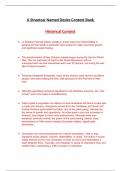
A Streetcar Named Desire Context Bank
Historical Context
● A Streetcar Named Desire unfolds in a time when the United States in
general and the South in particular were poised for major economic growth
and significant social change.
● The transformation of New Orleans actually began during the Second World
War. The city had been hit hard by the Great Depression with an
unemployment rate that sometimes went over 30 percent, but during the war,
New Orleans boomed.
● Factories employed thousands; many of the workers were women and Black
people, who were holding full-time, well-paid jobs for the first time in their
lives.
● Although agriculture remained significant to the Southern economy, the “new
money” was to be made in manufacturing.
● Cities tripled in population as millions of rural inhabitants left farms to take jobs
in trade and industry. Immigrants arrived from the Caribbean and South and
Central America (personified by Pablo, one of the poker gang), attracted by
the sense of growth and opportunity. As cities grew in size and increased in
diversity, they began to have more political force. Although white men
remained dominant overall, the power of the land-owning “planter class,”
descendants of 18th-century western European settlers, significantly
diminished.
● Characters are not just individuals but cultural archetypes—that is, they
represent social classes, cultures, nationalities, or races. The action of social
realist dramas covers how characters co-exist (or don’t) and dramatizes a
clash between them. Typically, one character or group of characters rises and
another falls, symbolizing a shift in society or civilization.
, ● At this time there was widespread controversy regarding the role of women
and the societal boundaries she may cross - including through her education,
sexuality and intellect.
● The ideology of a passionate manhood evolved as a result of WW2. Veterans
returning from the war weren't concerned with proving their manhood but were
focused on living in the way that they desired.
● America was experiencing rapid change, involving processes like
industrialisation, immigration influx and the deepening of capitalism
● When ASND came out there was clashes between different classes and
cultures, immigrants were viewed as 2nd class citizens, lots of prejudice and
judgement on if they were really American
● When Blanche is in New Orleans she is class prejudice which contrasts the
state of the city at the time and her sisters relationship with Stanley. Blanche
belittles Stanley’s polish heritage and his American-ness
● Post-war America reverted to traditional Christian values with the idea that “a
wife must submit to her husband”. Blanche always struggles with the moral
standards.
● In early 20th century America immigrants from Europe were seen as “not-quite-
white” facing prejudice based on class rather than race.
● Many of the insults hurled at Stanley could be related to his status as a
working class immigrant
● Stanley is a representation of the American Dream and the thrust of working
class people who can achieve anything through hard work and individualism.
● WW2 enabled a sense of American heroism to develop based on overcoming
the great depression and defeating the Nazis.
Historical Context
● A Streetcar Named Desire unfolds in a time when the United States in
general and the South in particular were poised for major economic growth
and significant social change.
● The transformation of New Orleans actually began during the Second World
War. The city had been hit hard by the Great Depression with an
unemployment rate that sometimes went over 30 percent, but during the war,
New Orleans boomed.
● Factories employed thousands; many of the workers were women and Black
people, who were holding full-time, well-paid jobs for the first time in their
lives.
● Although agriculture remained significant to the Southern economy, the “new
money” was to be made in manufacturing.
● Cities tripled in population as millions of rural inhabitants left farms to take jobs
in trade and industry. Immigrants arrived from the Caribbean and South and
Central America (personified by Pablo, one of the poker gang), attracted by
the sense of growth and opportunity. As cities grew in size and increased in
diversity, they began to have more political force. Although white men
remained dominant overall, the power of the land-owning “planter class,”
descendants of 18th-century western European settlers, significantly
diminished.
● Characters are not just individuals but cultural archetypes—that is, they
represent social classes, cultures, nationalities, or races. The action of social
realist dramas covers how characters co-exist (or don’t) and dramatizes a
clash between them. Typically, one character or group of characters rises and
another falls, symbolizing a shift in society or civilization.
, ● At this time there was widespread controversy regarding the role of women
and the societal boundaries she may cross - including through her education,
sexuality and intellect.
● The ideology of a passionate manhood evolved as a result of WW2. Veterans
returning from the war weren't concerned with proving their manhood but were
focused on living in the way that they desired.
● America was experiencing rapid change, involving processes like
industrialisation, immigration influx and the deepening of capitalism
● When ASND came out there was clashes between different classes and
cultures, immigrants were viewed as 2nd class citizens, lots of prejudice and
judgement on if they were really American
● When Blanche is in New Orleans she is class prejudice which contrasts the
state of the city at the time and her sisters relationship with Stanley. Blanche
belittles Stanley’s polish heritage and his American-ness
● Post-war America reverted to traditional Christian values with the idea that “a
wife must submit to her husband”. Blanche always struggles with the moral
standards.
● In early 20th century America immigrants from Europe were seen as “not-quite-
white” facing prejudice based on class rather than race.
● Many of the insults hurled at Stanley could be related to his status as a
working class immigrant
● Stanley is a representation of the American Dream and the thrust of working
class people who can achieve anything through hard work and individualism.
● WW2 enabled a sense of American heroism to develop based on overcoming
the great depression and defeating the Nazis.