

BRAIN ANATOMY
Adapted from Human Anatomy & Physiology by Marieb and Hoehn (9th ed.)
The anatomy of the brain is often discussed in terms of either the embryonic scheme or the medical scheme.
The embryonic scheme focuses on developmental pathways and names regions based on embryonic origins.
The medical scheme focuses on the layout of the adult brain and names regions based on location and
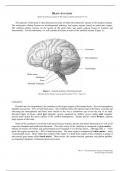
functionality. For this laboratory, we will consider the brain in terms of the medical scheme (Figure 1):
Figure 1: General anatomy of the human brain
Marieb & Hoehn (Human Anatomy and Physiology, 9th ed.) – Figure 12.2
CEREBRUM:
Divided into two hemispheres, the cerebrum is the largest region of the human brain – the two hemispheres
together account for ~ 85% of total brain mass. The cerebrum forms the superior part of the brain, covering and
obscuring the diencephalon and brain stem similar to the way a mushroom cap covers the top of its stalk.
Elevated ridges of tissue, called gyri (singular: gyrus), separated by shallow groves called sulci (singular:
sulcus) mark nearly the entire surface of the cerebral hemispheres. Deeper groves, called fissures, separate
large regions of the brain.
Much of the cerebrum is involved in the processing of somatic sensory and motor information as well as all
conscious thoughts and intellectual functions. The outer cortex of the cerebrum is composed of gray matter –
billions of neuron cell bodies and unmyelinated axons arranged in six discrete layers. Although only 2 – 4 mm
thick, this region accounts for ~ 40% of total brain mass. The inner region is composed of white matter – tracts
of myelinated axons. Deep within the cerebral white matter is a third basic region of the cerebrum, a group of
sub-cortical gray matter called basal nuclei. These nuclei, the caudate nucleus, putamen, and globus pallidus,
are important regulators of skeletal muscle movement.
BI 335 – Advanced Human Anatomy and Physiology
Western Oregon University
, Below are listed the major anatomical regions / landmarks of the cerebrum with their corresponding
functions (Figures 2 & 3):
REGION / LANDMARK FUNCTION
Longitudinal fissure Deep fissure that separates the two hemispheres (right and left) of the cerebrum.
Region of the cerebrum located under the frontal bone; contains the primary
Frontal lobe
motor cortex (precentral gyrus) and is involved in complex learning.
Region of the cerebrum located under parietal bone; contains the primary
Parietal lobe
sensory cortex (postcentral gyrus) and is involved in language acquisition.
Deep groove that separates the frontal lobe from the parietal lobe of the
Central sulcus
cerebrum.
Region of the cerebrum located under occipital bone; processes visual
Occipital lobe
information and is related to our understanding of the written word.
Groove on medial surface of hemisphere that separates the parietal lobe from the
Parieto-occipital sulcus
occipital lobe of the cerebrum.
Region of the cerebrum located under temporal bone; processes information
Temporal lobe
associated with hearing and equilibrium.
Deep groove that separates the frontal and parietal lobes from the temporal lobe
Lateral sulcus
of the cerebrum.
Region of the cerebrum deep within the lateral sulcus; processes information
Insula
associated with hearing and equilibrium.
Transverse fissure Deep fissure that separates the cerebrum from the cerebellum.
The major bridge of white fibers that connects the two hemispheres of the
Corpus callosum
cerebrum.
Bridge of white matter inferior to the corpus callosum; links regions of the
Fornix
limbic system (‘emotional’ brain) together.
Bridge of white fibers found near the anterior tip of the corpus callosum;
Anterior commissure
connects the two hemispheres of the cerebrum.
Basal nucleus; initiates voluntary movements and coordinates slow skeletal
Caudate nucleus
muscle contractions (e.g., posture and balance)
Basal nucleus; initiates voluntary movements and coordinates slow skeletal
Putamen
muscle contractions (e.g., posture and balance)
Basal nucleus; initiates voluntary movements and coordinates slow skeletal
Globus pallidus
muscle contractions (e.g., posture and balance)
BI 335 – Advanced Human Anatomy and Physiology
Western Oregon University
, Figure 2: Transverse section of cerebrum showing major regions of cerebral hemispheres
Marieb & Hoehn (Human Anatomy and Physiology, 9th ed.) – Figure 12.9
Figure 3: Lobes, sulci, and fissures of the cerebral hemispheres (longitudinal fissure not pictured)
Marieb & Hoehn (Human Anatomy and Physiology, 9th ed.) – Figure 12.4
BI 335 – Advanced Human Anatomy and Physiology
Western Oregon University
Adapted from Human Anatomy & Physiology by Marieb and Hoehn (9th ed.)
The anatomy of the brain is often discussed in terms of either the embryonic scheme or the medical scheme.
The embryonic scheme focuses on developmental pathways and names regions based on embryonic origins.
The medical scheme focuses on the layout of the adult brain and names regions based on location and
functionality. For this laboratory, we will consider the brain in terms of the medical scheme (Figure 1):
Figure 1: General anatomy of the human brain
Marieb & Hoehn (Human Anatomy and Physiology, 9th ed.) – Figure 12.2
CEREBRUM:
Divided into two hemispheres, the cerebrum is the largest region of the human brain – the two hemispheres
together account for ~ 85% of total brain mass. The cerebrum forms the superior part of the brain, covering and
obscuring the diencephalon and brain stem similar to the way a mushroom cap covers the top of its stalk.
Elevated ridges of tissue, called gyri (singular: gyrus), separated by shallow groves called sulci (singular:
sulcus) mark nearly the entire surface of the cerebral hemispheres. Deeper groves, called fissures, separate
large regions of the brain.
Much of the cerebrum is involved in the processing of somatic sensory and motor information as well as all
conscious thoughts and intellectual functions. The outer cortex of the cerebrum is composed of gray matter –
billions of neuron cell bodies and unmyelinated axons arranged in six discrete layers. Although only 2 – 4 mm
thick, this region accounts for ~ 40% of total brain mass. The inner region is composed of white matter – tracts
of myelinated axons. Deep within the cerebral white matter is a third basic region of the cerebrum, a group of
sub-cortical gray matter called basal nuclei. These nuclei, the caudate nucleus, putamen, and globus pallidus,
are important regulators of skeletal muscle movement.
BI 335 – Advanced Human Anatomy and Physiology
Western Oregon University
, Below are listed the major anatomical regions / landmarks of the cerebrum with their corresponding
functions (Figures 2 & 3):
REGION / LANDMARK FUNCTION
Longitudinal fissure Deep fissure that separates the two hemispheres (right and left) of the cerebrum.
Region of the cerebrum located under the frontal bone; contains the primary
Frontal lobe
motor cortex (precentral gyrus) and is involved in complex learning.
Region of the cerebrum located under parietal bone; contains the primary
Parietal lobe
sensory cortex (postcentral gyrus) and is involved in language acquisition.
Deep groove that separates the frontal lobe from the parietal lobe of the
Central sulcus
cerebrum.
Region of the cerebrum located under occipital bone; processes visual
Occipital lobe
information and is related to our understanding of the written word.
Groove on medial surface of hemisphere that separates the parietal lobe from the
Parieto-occipital sulcus
occipital lobe of the cerebrum.
Region of the cerebrum located under temporal bone; processes information
Temporal lobe
associated with hearing and equilibrium.
Deep groove that separates the frontal and parietal lobes from the temporal lobe
Lateral sulcus
of the cerebrum.
Region of the cerebrum deep within the lateral sulcus; processes information
Insula
associated with hearing and equilibrium.
Transverse fissure Deep fissure that separates the cerebrum from the cerebellum.
The major bridge of white fibers that connects the two hemispheres of the
Corpus callosum
cerebrum.
Bridge of white matter inferior to the corpus callosum; links regions of the
Fornix
limbic system (‘emotional’ brain) together.
Bridge of white fibers found near the anterior tip of the corpus callosum;
Anterior commissure
connects the two hemispheres of the cerebrum.
Basal nucleus; initiates voluntary movements and coordinates slow skeletal
Caudate nucleus
muscle contractions (e.g., posture and balance)
Basal nucleus; initiates voluntary movements and coordinates slow skeletal
Putamen
muscle contractions (e.g., posture and balance)
Basal nucleus; initiates voluntary movements and coordinates slow skeletal
Globus pallidus
muscle contractions (e.g., posture and balance)
BI 335 – Advanced Human Anatomy and Physiology
Western Oregon University
, Figure 2: Transverse section of cerebrum showing major regions of cerebral hemispheres
Marieb & Hoehn (Human Anatomy and Physiology, 9th ed.) – Figure 12.9
Figure 3: Lobes, sulci, and fissures of the cerebral hemispheres (longitudinal fissure not pictured)
Marieb & Hoehn (Human Anatomy and Physiology, 9th ed.) – Figure 12.4
BI 335 – Advanced Human Anatomy and Physiology
Western Oregon University


