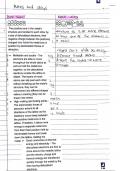
The positive ions in the metal's ·
• structure are bonded to each other by 'L Gr M.~'< el~-s
a sea of delocalised electrons, their t.H \.Q~-st (j/\...12.._ 0J.(_ tle .e,\~~ ·
negative charge between the positively
charged ions holds the metal ions i n ~..:... --1-°__
" IJ.AQ,
_ lc,_ ,_·_ _ _ _ _ _ _ _ _ _ __
. position by electrostatic forces of
, attraction. . 5
Malleable and ductile - The
electrons are able to move
throughout the whole lattice as
well as hold the metal ions
together, so the delocalised
' (
electrons enable the lattice to
distort. The layers of metal
atoms can slip past each other
without breaking up the metal's ; '\:..
'-"'-'=:++------ - - - - - -- - - - -
structure, they can be
hammered into different shapes
without cracking (they can be ·-
CS. -
.... + - - - - - - - - - - - -- - - - -
drawn into wires}. . fC,l.IJ.t'tOr\
• High melting and boiling points - - ,.~- - ' - - - - - - - - - - - -- - - -
9
The electrostatic forces of _ - ~--"-~
" " - - - - - - - - - - - -- - - --
G attraction extend to all
directions of the lattice as the
electrons move freely between
the positive metal ions in the
lattice. Therefore, it takes more
energy to separate metal ions
from their fixed position held by
electrostatic forces and break
down the lattice, melting the
metal. • Good conductors of thermal
energy and electricity - The
delocalised electrons are free to
move around the metallic lattice
---------------
and the electric charge and
thermal energy are transferred
quickly through the metal by the
free moving delocalised !I
electrons.
• structure are bonded to each other by 'L Gr M.~'< el~-s
a sea of delocalised electrons, their t.H \.Q~-st (j/\...12.._ 0J.(_ tle .e,\~~ ·
negative charge between the positively
charged ions holds the metal ions i n ~..:... --1-°__
" IJ.AQ,
_ lc,_ ,_·_ _ _ _ _ _ _ _ _ _ __
. position by electrostatic forces of
, attraction. . 5
Malleable and ductile - The
electrons are able to move
throughout the whole lattice as
well as hold the metal ions
together, so the delocalised
' (
electrons enable the lattice to
distort. The layers of metal
atoms can slip past each other
without breaking up the metal's ; '\:..
'-"'-'=:++------ - - - - - -- - - - -
structure, they can be
hammered into different shapes
without cracking (they can be ·-
CS. -
.... + - - - - - - - - - - - -- - - - -
drawn into wires}. . fC,l.IJ.t'tOr\
• High melting and boiling points - - ,.~- - ' - - - - - - - - - - - -- - - -
9
The electrostatic forces of _ - ~--"-~
" " - - - - - - - - - - - -- - - --
G attraction extend to all
directions of the lattice as the
electrons move freely between
the positive metal ions in the
lattice. Therefore, it takes more
energy to separate metal ions
from their fixed position held by
electrostatic forces and break
down the lattice, melting the
metal. • Good conductors of thermal
energy and electricity - The
delocalised electrons are free to
move around the metallic lattice
---------------
and the electric charge and
thermal energy are transferred
quickly through the metal by the
free moving delocalised !I
electrons.