

Land Law - Easements
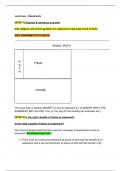
[STEP 1] Diagram & introduce scenario
N.B. diagram will not be graded, it is optional to help keep track of facts
EDIT DIAGRAM TO FIT FACTS
ROAD / PATH
P FIELD
A
T
H
HOUSE
The issue here is whether [INSERT C] has an easement to / of [INSERT WHAT THE
EASEMENT MAY ALLOW]. If so, [C can stop D from building an extension etc.].
[STEP 2] Is the right capable of being an easement?
Is the right capable of being an easement?
The Court of Appeal held that there are four necessary characteristics to be an
easement (Re Ellenborough Park):
1) There must be a dominant tenement (a parcel of land with the benefit of an
easement) and a servient tenement (a parcel of land with the burden of it);
, 2) An easement must accommodate (i.e. benefit) the dominant tenement;
3) The dominant and servient tenements must not be owned and occupied by the
same person; and
4) The right must be capable of forming the subject matter of a grant.
Dominant and servient tenement
There cannot be an easement where an owner of land grants a right to a non-owner of
land, i.e. ‘There can be no such thing as an easement in gross’ (Rangeley v Midland
Railway Co). This would amount to a licence.
Accommodate/benefit
Benefit means that the right is connected with the normal enjoyment of the land, which
is a question of fact (Re Ellenborough Park).
- As Byles J remarked, ‘a right of way over land in Northumberland cannot
accommodate land in Kent’ (Bailey v Stephens).
Not owned and occupied by the same person
- A lease arrangement where a landlord grants a lease of part of his property to a
tenant counts, as although the dominant and servient tenants would be owned by
the same person, they are occupied by different people.
- The right may be a quasi-easement if one person owns and occupies both pieces
of land. This can then be implied as a full easement upon the conveyance of the
land in question (see below).
Right capable of forming the subject matter of a grant?
There must be a capable grantor with the power to grant the right, and grantee with the
power to receive the right. X has the power to grant the [INSERT EASEMENT RIGHT]
and Y has the power to receive it.
The are three further questions that must be considered (set out in Re Ellenborough):
1) Is the nature of the right claimed sufficiently clear, and not too wide or vague?
Case law examples:
[STEP 1] Diagram & introduce scenario
N.B. diagram will not be graded, it is optional to help keep track of facts
EDIT DIAGRAM TO FIT FACTS
ROAD / PATH
P FIELD
A
T
H
HOUSE
The issue here is whether [INSERT C] has an easement to / of [INSERT WHAT THE
EASEMENT MAY ALLOW]. If so, [C can stop D from building an extension etc.].
[STEP 2] Is the right capable of being an easement?
Is the right capable of being an easement?
The Court of Appeal held that there are four necessary characteristics to be an
easement (Re Ellenborough Park):
1) There must be a dominant tenement (a parcel of land with the benefit of an
easement) and a servient tenement (a parcel of land with the burden of it);
, 2) An easement must accommodate (i.e. benefit) the dominant tenement;
3) The dominant and servient tenements must not be owned and occupied by the
same person; and
4) The right must be capable of forming the subject matter of a grant.
Dominant and servient tenement
There cannot be an easement where an owner of land grants a right to a non-owner of
land, i.e. ‘There can be no such thing as an easement in gross’ (Rangeley v Midland
Railway Co). This would amount to a licence.
Accommodate/benefit
Benefit means that the right is connected with the normal enjoyment of the land, which
is a question of fact (Re Ellenborough Park).
- As Byles J remarked, ‘a right of way over land in Northumberland cannot
accommodate land in Kent’ (Bailey v Stephens).
Not owned and occupied by the same person
- A lease arrangement where a landlord grants a lease of part of his property to a
tenant counts, as although the dominant and servient tenants would be owned by
the same person, they are occupied by different people.
- The right may be a quasi-easement if one person owns and occupies both pieces
of land. This can then be implied as a full easement upon the conveyance of the
land in question (see below).
Right capable of forming the subject matter of a grant?
There must be a capable grantor with the power to grant the right, and grantee with the
power to receive the right. X has the power to grant the [INSERT EASEMENT RIGHT]
and Y has the power to receive it.
The are three further questions that must be considered (set out in Re Ellenborough):
1) Is the nature of the right claimed sufficiently clear, and not too wide or vague?
Case law examples:



