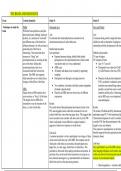
THE BRAIN AND BEHAVIOUR
Focus Central claim(ish) Study #1 Study #2
`Techniques to study the fMRIs Passamonti et al Perry and Pollard
brain When the brain performs a task (like
playing the piano, thinking, looking at Aim: Aim:
pictures, etc.) neurons are “activated” To determine the relationship between serotonin levels To measure brain growth in neglected (chaot
and different areas of the brain have (neurotransmission) and violent behaviour. children in order to determine if negligence h
different functions. So with each task a relationship with the development of the bra
particular part of the brain is Method and procedure:
functioning. This means that those Lab experiment Method and procedure:
neurons are “firing” and ● Repeated measures design, double blind (neither IV: type of neglect
neurotransmission is occurring in that participants nor the experimenters knew which control DV: measure of brain
area of the brain. During this was placebo and vice versa), randomised ● Age: 0-17 year old
neurotransmission, there is an ● fMRI scans ● Participants were referred to Child T
increased blood flow between the ● 30 healthy individuals were recruited by opportunity by Child Protective Services (CPS)
neurons. The fMRI uses magnetic sampling
fields and radio waves to detect these ● Participants went through a screening interview ● Measures of physical development (
changes in blood flow in the brain. FOC), psychiatric evaluations, prena
● Two conditions: (a) drank a drink that contain tryptophan determine any prenatal drug exposur
MRIs (b) drank a placebo drink possible, records from service worke
Images from an MRI machine show ● Placed in an fMRI and were shown faces of different members and the police. Neuroimag
cross-sections, or “slices” of the brain. expressions and or MRI scans, were interpreted b
The images from an MRI allow neuroradiologists.
researchers to see the structure of the Results:
brain, i.e. what it looks like. The results showed that participants had reduced activity in the Results:
PFC and amygdala circuits when their serotonin levels were The results of Pollard and Perry demonstrate
reduced while they were observing angry faces. This suggests that participants (aged 0-17) who experienced glo
lower serotonin levels correlate with lower activity in the PFC "abnormal development of cortex" and brain
which would make it more difficult to regulate impulsive a smaller FOC than those participants with c
aggressive behaviour in response to social threats. (neglect in just one domain).
This connects to neuroplasticity as the brain
Link back: literally impacted from the repeated environm
A common procedure is to have participants view images of faces (domestic abuse).
on the screen while they lay in the fMRI. The computer can tell
which parts of the brain are activated as the participant sees a Link back:
happy face, or a sad, angry, fearful face or neutral face. This Perry and Pollard’s use of the MRI in their s
procedure is often used when studying emotions and reaction. In these imaging techniques can be used to stud
particular, they can be useful when researchers are trying to see in this case show how brain structure may be
how chemical messengers (e.g. neurotransmitters or hormones) because of environmental stimuli.
affect brain activity when processing emotion.
+ Data triangulation → internal validit
, Passamonti’s use of the fMRI allowed them to see the activations relationship
in different areas of the brain, allowing them to come to the - Correlational study → may be extran
conclusion that there was reduced communication between the influencing such as diet etc. (seroton
PFC and amygdala. internal validity is simultaneously w
This study shows the use of fMRI scanning to investigate the brain
processes correlated with the behaviour of aggression when
serotonin is lowered.
The fMRI scan was useful in determining the relationship between
the two variables.
+ Lab experiment → internal validity
- Low construct validity → is it actually measuring
aggressive behaviour?
Brain localisation effect on Behaviour: aggression Goetz et al Grafman et al
behaviour ● Behaving with the intent to
harm another individual with Aim: Aim:
little forethought To investigate how levels of testosterone can affect the To examine the relationship between brain d
functioning of the amygdala. aggression level (examined the relationship b
The theory that specific parts of the lobe lesions and the presence of aggressive a
brain are responsible for specific Method and procedure: behaviour)
behaviours. ● 16 participants (“young, healthy men”)
● Repeated measure design (participants participated in both Method and procedure:
PFC: The prefrontal cortex is conditions) This experiment is a natural experiment, as t
associated with decision making, First day: participants were injected with testosterone cannot be randomly allocated and the IV is n
planning and controlling our impulsive Second day: participants were injected with a placebo occurring.
behaviours. After the injection, participants were placed in a fMRI and showed ● IV: damage in the brain
faces portraying different emotions (e.g. neutral, angry, sad etc.) ● DV: levels of aggression rated by th
HOLISTIC their family
Although adopting a localization Results: Fifty-seven normal controls and 279 veteran
approach in the quest to understand the Results had demonstrated that with an increase in testosterone age, education, and time in Vietnam, who ha
brain has undeniably meant that condition, the reactivity of the amygdala was much higher than penetrating head injuries during their service
scientific knowledge about the brain when the participants were shown the angry face. were studied
and behaviour is currently very Angry face increases testosterone and results in the increase of There were two groups of participants; the c
advanced, other researchers have urged amygdala and hypothalamus activation treatment group were observed for their aggr
caution in adopting what they feel is a no impact on amygdala levels when viewing the other facial through self-filled and family-filled reports.
‘jigsaw’ type perspective of the brain. expressions
The complexity of cognitive processes Results:
in terms of how they interact and Link back: Veterans with damage at the PFC demonstra
influence each other cannot be ignored This supports the brain localisation theory as the amygdala has levels of aggression than other conditions.
hence more holistic accounts of how been associated with perceived social threat. The social threat
the brain works should be used in manifested itself in an angry face, as this angry expression would Link back:
conjunction with the localization signal aggression and danger to the individual. When there was PFC is related to self-regulation of behaviou
approach. this social threat present, through fMRI imaging, the activity of veterans with brain damage to vm(PFC) wer
, Too reductionist → need to consider the amygdala was heightened, thus demonstrating brain regulate their aggression as that ability was i
the connectivity between different localisation theory. damage. Therefore, it can be seen that this st
areas of the brain (AMYGDALA AND with the brain localisation theory as those wi
PFC WORK TOGETHER) + Internal validity is a lab experiment are exhibiting more aggressive behaviour.
- Construct validity → aggression is not actually measured
but rather a social threat that could stimulate this + Data triangulation increases internal
behaviour Reliability is strengthened as the sel
questionnaires were triangulated wit
observations.
- Participant reactivity → Veterans kn
being tested from self reporting ques
may have changed their answers to a
desirability as aggression is not soci
Brain localisation Lab experiment: experiments are used Lab experiment Correlation study
methodology to determine the cause and effect
relationship between two variables Aim: Aim:
(independent (IV) and dependent (DV) To determine the relationship between serotonin levels To examine the relationship between brain d
variables). (neurotransmission) and violent behaviour. aggression level (examined the relationship b
Strict control over variables lobe lesions and the presence of aggressive a
Easy to replicate Method and procedure: behaviour)
High reliability and validity Lab experiment
Permits elimination of irrelevant How? Method and procedure:
factors. ● Repeated measures design, double blind (neither How?
participants nor the experimenters knew which control This experiment is a correlational study, as t
Because of the artificial environment, was placebo and vice versa), randomised and DV and no task performed by the partici
it lacks ecological validity due to the Why? Furthermore, data has been triangulated whi
artificial environment and nature of it. Allows for the environment to be controlled → increase internal practice in correlational studies.
When the situation is created, it is validity Why?
unlikely to occur in a real life Decreases chance of researcher bias → researchers misinterpreting Researchers used this because they could no
situation, so one has to wonder if there the results due to their preconceived ideas. variables (i.e. could not cause brain damage
is any validity in the findings. because of obvious ethical considerations), s
● fMRI scans measuring the strength of a relationship betw
It is considered/perceived to be the ● 30 healthy individuals were recruited by opportunity the brain and levels of aggression.
most scientific research method sampling
● Participants went through a screening interview Fifty-seven normal controls and 279 veteran
age, education, and time in Vietnam, who ha
● Two conditions: (a) drank a drink that contain tryptophan penetrating head injuries during their service
(b) drank a placebo drink were studied
● Placed in an fMRI and were shown faces of different There were two groups of participants; the c
expressions treatment group were observed for their aggr
through self-filled and family-filled reports.
Results:
The results showed that participants had reduced activity in the Results:
PFC and amygdala circuits when their serotonin levels were Veterans with damage at the PFC demonstra
Focus Central claim(ish) Study #1 Study #2
`Techniques to study the fMRIs Passamonti et al Perry and Pollard
brain When the brain performs a task (like
playing the piano, thinking, looking at Aim: Aim:
pictures, etc.) neurons are “activated” To determine the relationship between serotonin levels To measure brain growth in neglected (chaot
and different areas of the brain have (neurotransmission) and violent behaviour. children in order to determine if negligence h
different functions. So with each task a relationship with the development of the bra
particular part of the brain is Method and procedure:
functioning. This means that those Lab experiment Method and procedure:
neurons are “firing” and ● Repeated measures design, double blind (neither IV: type of neglect
neurotransmission is occurring in that participants nor the experimenters knew which control DV: measure of brain
area of the brain. During this was placebo and vice versa), randomised ● Age: 0-17 year old
neurotransmission, there is an ● fMRI scans ● Participants were referred to Child T
increased blood flow between the ● 30 healthy individuals were recruited by opportunity by Child Protective Services (CPS)
neurons. The fMRI uses magnetic sampling
fields and radio waves to detect these ● Participants went through a screening interview ● Measures of physical development (
changes in blood flow in the brain. FOC), psychiatric evaluations, prena
● Two conditions: (a) drank a drink that contain tryptophan determine any prenatal drug exposur
MRIs (b) drank a placebo drink possible, records from service worke
Images from an MRI machine show ● Placed in an fMRI and were shown faces of different members and the police. Neuroimag
cross-sections, or “slices” of the brain. expressions and or MRI scans, were interpreted b
The images from an MRI allow neuroradiologists.
researchers to see the structure of the Results:
brain, i.e. what it looks like. The results showed that participants had reduced activity in the Results:
PFC and amygdala circuits when their serotonin levels were The results of Pollard and Perry demonstrate
reduced while they were observing angry faces. This suggests that participants (aged 0-17) who experienced glo
lower serotonin levels correlate with lower activity in the PFC "abnormal development of cortex" and brain
which would make it more difficult to regulate impulsive a smaller FOC than those participants with c
aggressive behaviour in response to social threats. (neglect in just one domain).
This connects to neuroplasticity as the brain
Link back: literally impacted from the repeated environm
A common procedure is to have participants view images of faces (domestic abuse).
on the screen while they lay in the fMRI. The computer can tell
which parts of the brain are activated as the participant sees a Link back:
happy face, or a sad, angry, fearful face or neutral face. This Perry and Pollard’s use of the MRI in their s
procedure is often used when studying emotions and reaction. In these imaging techniques can be used to stud
particular, they can be useful when researchers are trying to see in this case show how brain structure may be
how chemical messengers (e.g. neurotransmitters or hormones) because of environmental stimuli.
affect brain activity when processing emotion.
+ Data triangulation → internal validit
, Passamonti’s use of the fMRI allowed them to see the activations relationship
in different areas of the brain, allowing them to come to the - Correlational study → may be extran
conclusion that there was reduced communication between the influencing such as diet etc. (seroton
PFC and amygdala. internal validity is simultaneously w
This study shows the use of fMRI scanning to investigate the brain
processes correlated with the behaviour of aggression when
serotonin is lowered.
The fMRI scan was useful in determining the relationship between
the two variables.
+ Lab experiment → internal validity
- Low construct validity → is it actually measuring
aggressive behaviour?
Brain localisation effect on Behaviour: aggression Goetz et al Grafman et al
behaviour ● Behaving with the intent to
harm another individual with Aim: Aim:
little forethought To investigate how levels of testosterone can affect the To examine the relationship between brain d
functioning of the amygdala. aggression level (examined the relationship b
The theory that specific parts of the lobe lesions and the presence of aggressive a
brain are responsible for specific Method and procedure: behaviour)
behaviours. ● 16 participants (“young, healthy men”)
● Repeated measure design (participants participated in both Method and procedure:
PFC: The prefrontal cortex is conditions) This experiment is a natural experiment, as t
associated with decision making, First day: participants were injected with testosterone cannot be randomly allocated and the IV is n
planning and controlling our impulsive Second day: participants were injected with a placebo occurring.
behaviours. After the injection, participants were placed in a fMRI and showed ● IV: damage in the brain
faces portraying different emotions (e.g. neutral, angry, sad etc.) ● DV: levels of aggression rated by th
HOLISTIC their family
Although adopting a localization Results: Fifty-seven normal controls and 279 veteran
approach in the quest to understand the Results had demonstrated that with an increase in testosterone age, education, and time in Vietnam, who ha
brain has undeniably meant that condition, the reactivity of the amygdala was much higher than penetrating head injuries during their service
scientific knowledge about the brain when the participants were shown the angry face. were studied
and behaviour is currently very Angry face increases testosterone and results in the increase of There were two groups of participants; the c
advanced, other researchers have urged amygdala and hypothalamus activation treatment group were observed for their aggr
caution in adopting what they feel is a no impact on amygdala levels when viewing the other facial through self-filled and family-filled reports.
‘jigsaw’ type perspective of the brain. expressions
The complexity of cognitive processes Results:
in terms of how they interact and Link back: Veterans with damage at the PFC demonstra
influence each other cannot be ignored This supports the brain localisation theory as the amygdala has levels of aggression than other conditions.
hence more holistic accounts of how been associated with perceived social threat. The social threat
the brain works should be used in manifested itself in an angry face, as this angry expression would Link back:
conjunction with the localization signal aggression and danger to the individual. When there was PFC is related to self-regulation of behaviou
approach. this social threat present, through fMRI imaging, the activity of veterans with brain damage to vm(PFC) wer
, Too reductionist → need to consider the amygdala was heightened, thus demonstrating brain regulate their aggression as that ability was i
the connectivity between different localisation theory. damage. Therefore, it can be seen that this st
areas of the brain (AMYGDALA AND with the brain localisation theory as those wi
PFC WORK TOGETHER) + Internal validity is a lab experiment are exhibiting more aggressive behaviour.
- Construct validity → aggression is not actually measured
but rather a social threat that could stimulate this + Data triangulation increases internal
behaviour Reliability is strengthened as the sel
questionnaires were triangulated wit
observations.
- Participant reactivity → Veterans kn
being tested from self reporting ques
may have changed their answers to a
desirability as aggression is not soci
Brain localisation Lab experiment: experiments are used Lab experiment Correlation study
methodology to determine the cause and effect
relationship between two variables Aim: Aim:
(independent (IV) and dependent (DV) To determine the relationship between serotonin levels To examine the relationship between brain d
variables). (neurotransmission) and violent behaviour. aggression level (examined the relationship b
Strict control over variables lobe lesions and the presence of aggressive a
Easy to replicate Method and procedure: behaviour)
High reliability and validity Lab experiment
Permits elimination of irrelevant How? Method and procedure:
factors. ● Repeated measures design, double blind (neither How?
participants nor the experimenters knew which control This experiment is a correlational study, as t
Because of the artificial environment, was placebo and vice versa), randomised and DV and no task performed by the partici
it lacks ecological validity due to the Why? Furthermore, data has been triangulated whi
artificial environment and nature of it. Allows for the environment to be controlled → increase internal practice in correlational studies.
When the situation is created, it is validity Why?
unlikely to occur in a real life Decreases chance of researcher bias → researchers misinterpreting Researchers used this because they could no
situation, so one has to wonder if there the results due to their preconceived ideas. variables (i.e. could not cause brain damage
is any validity in the findings. because of obvious ethical considerations), s
● fMRI scans measuring the strength of a relationship betw
It is considered/perceived to be the ● 30 healthy individuals were recruited by opportunity the brain and levels of aggression.
most scientific research method sampling
● Participants went through a screening interview Fifty-seven normal controls and 279 veteran
age, education, and time in Vietnam, who ha
● Two conditions: (a) drank a drink that contain tryptophan penetrating head injuries during their service
(b) drank a placebo drink were studied
● Placed in an fMRI and were shown faces of different There were two groups of participants; the c
expressions treatment group were observed for their aggr
through self-filled and family-filled reports.
Results:
The results showed that participants had reduced activity in the Results:
PFC and amygdala circuits when their serotonin levels were Veterans with damage at the PFC demonstra