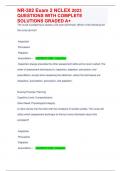
NR-302 Exam 2 NCLEX 2023 QUESTIONS WITH COMPLETE SOLUTIONS GRADED A+
The nurse is preparing to assess a 55-year-old female. Which of the following will the nurse do first? Inspection Percussion Palpation Auscultation - CORRECT ANS Inspection Inspection always precedes the other assessment skills and is never rushed. The order of assessment techniques is: inspection, palpation, percussion, and auscultation, except when assessing the abdomen, where the techniques are inspection, auscultation, percussion, and palpation. Nursing Process: Planning Cognitive Level: Comprehension Client Need: Physiological Integrity A client comes into the clinic with the complaint of swollen ankles. The nurse will utilize which assessment technique to find out more information about this complaint? Inspection Percussion Palpation Auscultation - CORRECT ANS Palpation Palpation is the use of touch to assess specific body characteristics, which include size, shape, location, mobility, position, vibration, temperature, texture, moisture, tenderness, and edema. Palpating the ankle will give the nurse information about tenderness, temperature, mobility, and edema characteristics. Visual inspection is also included in the assessment of the ankles, but palpation will yield the most information. Percussion and auscultation are not techniques used to assess the ankles. Nursing Process: Assessment Cognitive Level: Synthesis Client Need: Physiological Integrity A client comes into the clinic with acute right lower quadrant abdominal pain. During the abdominal assessment of this client, the nurse realizes that: This area should be palpated first. This area should be palpated last. This area should be assessed using deep palpation techniques. This area should not be palpated. - CORRECT ANS This area should be palpated last. Known-painful areas of the body are usually the last areas to be palpated. Deep palpation should be used with caution, especially if one suspects that there is inflammation, peritonitis, or ectopic pregnancy. The area should be assessed using light to moderate palpation. Nursing Process: Planning Cognitive Level: Application Client Need: Physiological Integrity The nurse is preparing to assess a client with flank pain and discomfort and pink-tinged urine. Which of the following assessment techniques would be appropriate for the nurse to use? Direct percussion Reflexive percussion Indirect percussion Blunt percussion - CORRECT ANS Blunt percussion Blunt percussion is used for assessing pain and tenderness in the gallbladder, liver, and kidneys. With blunt percussion, the palm of the nondominant hand is flat against the body and a closed fist is used to strike the hand on the body. Direct percussion is tapping the body directly to examine the sinuses or the thorax of an infant. Reflexive percussion is not an assessment technique. Indirect percussion is the most common method used to produce sounds within the body. To perform indirect percussion, the middle finger of the nondominant hand is placed firmly over the area being examined. The middle finger of the dominant hand quickly strikes the middle finger of the nondominant hand, producing vibrations and a sound. Nursing Process: Assessment Cognitive Level: Application Client Need: Physiological Integrity During the percussion of a client's abdomen, the nurse hears a loud, high-pitched, drumlike tone. The nurse would document this sound as being: Resonance Hyperresonance Tympany Flatness - CORRECT ANS Tympany Tympany is a loud, high-pitched, drumlike tone of medium duration commonly heard over the stomach or intestines. Resonance is a loud, low-pitched sound heard over the lungs. Hyperresonance is a loud, long sound heard when air is trapped in the lungs. Flatness is a soft, short sound heard over solid tissue such as bone. Nursing Process: Assessment Cognitive Level: Comprehension Client Need: Physiological Integrity After auscultating the bowel sounds of a client, the nurse realizes the sounds were long. Which of the following would be appropriate for the nurse to use to document this finding? Intensity Pitch Duration Quality - CORRECT ANS Duration Duration refers to the length of time of the produced sound. This time frame ranges from very short to very long with variation in between. Intensity refers to the softness or loudness of the sound. Pitch refers to the number of vibrations of sound per second. Quality refers to the overtones produced by the vibration such as clear, hollow, muffled, or dull. Nursing Process: Evaluation Cognitive Level: Knowledge Category: Physiological Integrity The nurse is preparing to use a stethoscope while assessing a client. The bell is going to be placed on the client. Which of the following would the nurse assess with the bell of the stethoscope? Heart murmur Lung sounds Normal heart sounds Abdominal sounds - CORRECT ANS Heart murmur The bell detects low-frequency sounds such as heart murmurs. Lung sounds, normal heart sounds, and abdominal sounds are all considered high-pitched sounds and would be assessed using the diaphragm of the stethoscope. Nursing Process: Assessment Cognitive Level: Application Client Need: Physiological Integrity A client complaining of a sore elbow
Written for
- Institution
- NR-302 Exm 2 NCLEX 2023
- Module
- NR-302 Exm 2 NCLEX 2023
Document information
- Uploaded on
- July 12, 2023
- Number of pages
- 36
- Written in
- 2022/2023
- Type
- Exam (elaborations)
- Contains
- Questions & answers
Subjects
-
nr 302 exam 2 nclex 2023
-
nr 302 exam 2 nclex
-
nr 302 nclex 2023
-
nr 302 exam 2 nclex 2023 questions with complete s
-
the nurse is preparing to assess a 55 year old fem

Also available in package deal