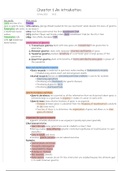
XIV. Categories of being: properties, predicates & levels of being
XIV. a. Introduction
- Definition of property-type dependent on property as universal/trope
o Properties as universals: property-types = universals
o Properties as tropes: property-types = sets of exactly resembling tropes
- Question number of existing property-types
- Existence conditions for universals: U1 existing if & only if…
- Identity conditions for universals: U1 identical with U2 if & only if…
- Implications for philosophy of mind: existence of mental properties & identity
mental/physical properties
- General account of property existence & identity required for all branches of
philosophy
XIV. b. Predicates & properties: definitions
- Example: scarlet round heavy ball ball assigned predicates (= referring
expressions = linguistic entities)
- Predicate = referring expression = linguistic entity assigned to object in virtue of
properties of object
- Property = ontological entity
- Property for every predicate & predicate for every property (?) nature of
relationship between predicate & property (?)
- Example: ball = scarlet ball = red & coloured predicating three different
properties of ball
o Ball having three properties of being scarlet/red/coloured / ball having single
property allowing for correct predicating of three different things (i.e., scarlet,
red & coloured) (?)
XIV. c. Semantic accounts of properties
- Link predicates/properties
- Predicate = linguistic entity semantic account of property existence & identity
- Different strengths of semantic accounts
1) Universals = meaning of predicates
- Existence condition: Universal U1 existing if & only if predicate P1 existing &
Object O1 having U1 if & only if O1 falling under P1
o Problem: implausibility + contradicting Aristotelian account of properties
existing only if instantiated ( meaningful predicates ≠ necessarily picking out
property)
2) Property existing only when instantiated
- U1 existing if & only if U1 instantiated
o Problem: quantifying over-universals
3) O1 instantiating U1 if & only if O1 falling under predicate P1
o Example: universal of redness existing if & only if ‘red’ predicable by object
o Compatibility with Aristotelian claim: account providing necessary condition for
substance instantiating universal without claiming ontological significance of
predicates that substance ≠ falling under
XIV. a. Introduction
- Definition of property-type dependent on property as universal/trope
o Properties as universals: property-types = universals
o Properties as tropes: property-types = sets of exactly resembling tropes
- Question number of existing property-types
- Existence conditions for universals: U1 existing if & only if…
- Identity conditions for universals: U1 identical with U2 if & only if…
- Implications for philosophy of mind: existence of mental properties & identity
mental/physical properties
- General account of property existence & identity required for all branches of
philosophy
XIV. b. Predicates & properties: definitions
- Example: scarlet round heavy ball ball assigned predicates (= referring
expressions = linguistic entities)
- Predicate = referring expression = linguistic entity assigned to object in virtue of
properties of object
- Property = ontological entity
- Property for every predicate & predicate for every property (?) nature of
relationship between predicate & property (?)
- Example: ball = scarlet ball = red & coloured predicating three different
properties of ball
o Ball having three properties of being scarlet/red/coloured / ball having single
property allowing for correct predicating of three different things (i.e., scarlet,
red & coloured) (?)
XIV. c. Semantic accounts of properties
- Link predicates/properties
- Predicate = linguistic entity semantic account of property existence & identity
- Different strengths of semantic accounts
1) Universals = meaning of predicates
- Existence condition: Universal U1 existing if & only if predicate P1 existing &
Object O1 having U1 if & only if O1 falling under P1
o Problem: implausibility + contradicting Aristotelian account of properties
existing only if instantiated ( meaningful predicates ≠ necessarily picking out
property)
2) Property existing only when instantiated
- U1 existing if & only if U1 instantiated
o Problem: quantifying over-universals
3) O1 instantiating U1 if & only if O1 falling under predicate P1
o Example: universal of redness existing if & only if ‘red’ predicable by object
o Compatibility with Aristotelian claim: account providing necessary condition for
substance instantiating universal without claiming ontological significance of
predicates that substance ≠ falling under