
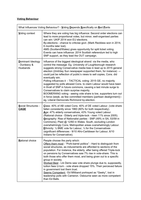
Voting Behaviour
o
What Influences Voting Behaviour? - V ting Depends S
pecifically on R
ed Pants
Voting context Where they are voting has big influence: Second order elections can
lead to more proportional votes, but minor, well-organised parties
can win: UKIP 2014 won EU elections.
By-elections - chance to criticise govt. (Mark Reckless won in 2014,
6 months later lost).
AMS (Scotland/Wales) gives opportunity for split ticket voting.
Events can have influence: 2014 Scottish referendum led to high
SNP support, as they lead the OUT campaign.
Dominant Ideology Influence of the biggest ideological strand: via the media, who
- Dunleavy & control the message: Eg. University of Loughborough research
Husbands suggests strong Conservative media bias in lead up to 2015 general
election (2mil/day Sun newspaper supported them, for instance) →
could just be reflection of public’s views to sell copies, Cons. did
eventually win.
Polling influences it - TACTICAL voting: 2015 GE, no majority
suggested by polls allowed Cons. to claim Labour would have been
in thrall of SNP in future commons, causing a last minute surge to
Conservatives to claim surprise majority.
BOOMERANG voting - seeing vote share is low, supporters turn out
in force (weak, as few committed members (partisan dealignment)) -
eg. Liberal Democrats Richmond by-election.
Social Structures - Class: 40% of AB voted Cons. 40% of DE voted Labour. (vote share
CAGE fallen consistently since 1960 (80% for both respectively).
Age: 47% elderly conservatives, 43% Young voted Labour.
(Rational choice - Elderly and triple-lock - risen 11% since 2005).
Geography: Rise of Nationalist parties - SNP (49% in SA, 53/59 in
Commons); Plaid @ 12/60 in Wales. South, excluding London
overwhelmingly Cons; Metropolitan areas overwhelmingly Labour.
Ethnicity: ½ BME vote for Labour, ⅓ for the Conservatives
(significant differences - 9/10 Afro-Caribbean for Labour, 6/10
Indians for Conservative).
Rational choice People choose the party which:
Offers them most - “Pork-barrel politics” - Hard to distinguish from
social structures, as inducements are afforded to sections of the
population. For instance, the elderly, after being offered Triple-lock
on pensions by Conservatives saw 7% rise in vote-share. This is
both those who offer them most, and being given out to a specific
group in society.
Worked Best - Lib Dems saw vote share plunge due to, supposedly,
tuition fees U-turn - vote share dropped 15%. Their percieved failure
in government lost them trust.
Seems Competent - Ed MIliband portrayed as “Geeky”, lost in
leadership polls with Cameron. Osbourne seen as more competent
than Ed Balls.
o
What Influences Voting Behaviour? - V ting Depends S
pecifically on R
ed Pants
Voting context Where they are voting has big influence: Second order elections can
lead to more proportional votes, but minor, well-organised parties
can win: UKIP 2014 won EU elections.
By-elections - chance to criticise govt. (Mark Reckless won in 2014,
6 months later lost).
AMS (Scotland/Wales) gives opportunity for split ticket voting.
Events can have influence: 2014 Scottish referendum led to high
SNP support, as they lead the OUT campaign.
Dominant Ideology Influence of the biggest ideological strand: via the media, who
- Dunleavy & control the message: Eg. University of Loughborough research
Husbands suggests strong Conservative media bias in lead up to 2015 general
election (2mil/day Sun newspaper supported them, for instance) →
could just be reflection of public’s views to sell copies, Cons. did
eventually win.
Polling influences it - TACTICAL voting: 2015 GE, no majority
suggested by polls allowed Cons. to claim Labour would have been
in thrall of SNP in future commons, causing a last minute surge to
Conservatives to claim surprise majority.
BOOMERANG voting - seeing vote share is low, supporters turn out
in force (weak, as few committed members (partisan dealignment)) -
eg. Liberal Democrats Richmond by-election.
Social Structures - Class: 40% of AB voted Cons. 40% of DE voted Labour. (vote share
CAGE fallen consistently since 1960 (80% for both respectively).
Age: 47% elderly conservatives, 43% Young voted Labour.
(Rational choice - Elderly and triple-lock - risen 11% since 2005).
Geography: Rise of Nationalist parties - SNP (49% in SA, 53/59 in
Commons); Plaid @ 12/60 in Wales. South, excluding London
overwhelmingly Cons; Metropolitan areas overwhelmingly Labour.
Ethnicity: ½ BME vote for Labour, ⅓ for the Conservatives
(significant differences - 9/10 Afro-Caribbean for Labour, 6/10
Indians for Conservative).
Rational choice People choose the party which:
Offers them most - “Pork-barrel politics” - Hard to distinguish from
social structures, as inducements are afforded to sections of the
population. For instance, the elderly, after being offered Triple-lock
on pensions by Conservatives saw 7% rise in vote-share. This is
both those who offer them most, and being given out to a specific
group in society.
Worked Best - Lib Dems saw vote share plunge due to, supposedly,
tuition fees U-turn - vote share dropped 15%. Their percieved failure
in government lost them trust.
Seems Competent - Ed MIliband portrayed as “Geeky”, lost in
leadership polls with Cameron. Osbourne seen as more competent
than Ed Balls.


