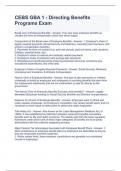
CEBS GBA 1 - Directing Benefits Programs Exam
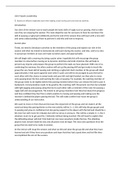
Broad view of Employee Benefits - Answer- This view sees employee benefits as virtually any form of compensation other than direct wages. Components of the Broad view of Employee Benefits - Answer- 1. Employer's share of legally required payments (Social Security and Medicare, unemployment insurance, and worker's compensation benefits) 2. Payments for time not worked (e.g. paid rest periods, paid sick leave, paid vacations, holidays, parental leave, etc). 3. Employer's share of medical and medically related payments 4. Employer's share of retirement and savings plan payments. 5. Miscellaneous benefit payments (inducing employee discounts, severance pay, educational expenditures, and child care). Employer's Share of Legally Required Payments - Answer- Social Security, Medicare, Unemployment Insurance, & Workers Compensation Narrow View of Employee Benefits - Answer- Any type of plan sponsored or initiated unilaterally or jointly by employers and employees in providing benefits that stem from the employment relationship that are not underwritten or paid for directly by the government. The Narrow View of Employee Benefits Excludes what benefits? - Answer- Legally Mandated (Employer funding for Social Security Benefits and Workers' compensation). Reasons for Growth of Employee Benefits - Answer- Employers want to attract and retain capable employees. An Employer's competition has certain benefit plans, and it is necessary to have equal or better plans to attract and retain employees. Taft-Harley Act - Answer- Also known as the Labor-Management Relations Act, or LMRA. It has established the distinction between retirement benefits and welfare benefits such as life and health insurance. The statute sets forth the basic regulatory framework under which both of these major categories of benefits are to be jointly administered with the collective bargaining process. Major Federal Tax Advantages Associated with Employee Benefit Plans - Answer- 1. Most contributions to employee benefit plans by employers are deductible as long as they are reasonable business expenses. 2. Within certain limits, these employer contributions are generally not considered income to employees. 3. In certain types of retirement and capital accumulation plans, benefits accumulate tax-free to the employee until distributed. Efficiency in Employment-Based Benefits - Answer- Employment-based insurance is convenient for employees. They don't need to search for individual coverage, and it is often less expensive. Providers and suppliers find it more convenient and simpler to communicate and marker employee benefits through an employers. Major Federal Tax Advantages - Answer- 1. Most contributions to employee benefit plans by employers are deductible as long as they are reasonable business expenses. 2. Within certain limits, these employer contributions are generally not considered income to employees. 3. In certain types of retirement and capital accumulation plans, benefits accumulate tax-free to the employee until distributed. Employee Benefit Mechanism - Answer- Employment-based insurance is convenient for employees. They don't need to search for individual coverage, and it is often less expensive. Providers and suppliers find it more convenient and simpler to communicate and market employee benefits through an employer. Setting objectives in employee benefit planning - Answer- 1. What benefits should be provided? 2. Who should be covered by the benefit plan? 3. Should employees have benefit options? 4. How should the benefit plan be financed? 5. How should the benefit plan be administered? 6. How should the benefit plan be communicated? Eligibility Requirements - Answer- Besides full-time employees, other categories of individuals to consider are part-time employees, retirees, dependents of eligible employees and survivors of deceased eligible employees. In addressing this question, employers need to ensure that eligibility requirements adhere to federal, state, and local laws and regulations. Funding Options - Answer- 1. Noncontributory approach (Financing may be provided entirely by the employer) 2. Contributory approach (Financing may be on a shared basis by employer and employee) Functional Approach to Employee Benefits - Answer- The application of a systematic method of analysis to an employer's total employee benefits program. It analyzes the organization's employee benefit program as a coordinated whole in terms of its ability to meet various employees' needs and to manage loss exposures within the employer's overall compensation goals and cost perimeters. Total Compensation Philosophy - Answer- 1. Average compens
Written for
- Institution
- CEBS GBA 1
- Module
- CEBS GBA 1
Document information
- Uploaded on
- July 3, 2023
- Number of pages
- 4
- Written in
- 2022/2023
- Type
- Exam (elaborations)
- Contains
- Questions & answers
Subjects
-
cebs gba 1 directing benefits programs exam

Also available in package deal