

Unit 8C
Assignment title: Nutrition and health
Aim C: Explore the physiology of the digestive system and the use of corrective treatments for
dietary-related diseases.
Summary:
This report consists of an illustrated explanation of both the functions and structure of the
digestive system, a detailed description of the signs and symptoms of an individual suffering
from a nutritional deficiency, an explanation of the role and location of digestive organs and
an evaluation of the effect on human health of a dietary disease and the treatments used to
correct them.
Introduction:
Key-stage five students have been given a project designed to raise awareness of dietary-
related diseases and deliver findings to younger peers. My role in this project is to produce a
report and PowerPoint presentation that provide clear guidance on the anatomy and
physiology of the digestive system, sources and uses of various important nutrients and
associated symptoms of nutrient deficiency linked to the consequences of, and treatments
for, dietary-related diseases.
Structure & Function of the digestive system:
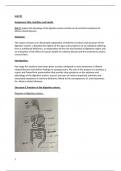
Diagram of digestive system:
1
, Digestive Organ Function Chemicals produced
Mouth The mouth enables chewing Amylase which breaks down
and breakdown of food starch into maltase
Oesophagus The oesophagus enables There are no chemicals
smooth passage for food produced in the Oesophagus
Stomach The stomach digests food HCL (hydrochloric acid) mucus
and bicarbonate
Liver The liver breaks down Bile (alkali)
balances
Gall Bladder The gall bladder stores bile There are no chemicals
produced by the gall bladder
Pancreas The pancreas produces a wide Insulin, glucagon, gastrin and
range of hydrolytic enzymes to amylin
assist the process of digestion
of all food types
Small intestine The small intestine helps The small intestine secretes
further digest food coming mucus, peptidase, maltase &
from the stomach lipase.
The digestive system involves many organs (such as the mouth, salivary glands, oesophagus,
stomach, large and small intestines) where the food is broken down into smaller soluble
molecules and is absorbed into the bloodstream or the lymph system. There are also
accessory organs such as the pancreas, the liver and the gall bladder where food is not
passed through however it may store chemicals that assist digestion or deal with some of
the products of digestion before its utilised by body tissues. The liver plays a big part in
digestion as it produces a chemical known as bile which helps with the digestion of lipids
(fat).
The small intestine is adapted to its function as it has villi which have a huge surface area
and a thin layer that helps in the absorption of nutrients and breakdown of food. It also has
a rich blood supply and short diffusion distance to blood vessels which greatly increases
diffusion and active transport of food into blood.
Diffusion VS active transport:
Diffusion Active transport
high to low concentration Low to high concentration
Requires no energy Requires energy
Through concentration gradient Goes against the concentration gradient
There are four main functions of the digestive system which are motility, secretion,
digestion and absorption. In motility, the food passes through the digestive tract because of
peristalsis which is when muscles move in the GI tract where the food is passed via the
digestive system which includes ingested nutrients being broken down and blended
throughout the disposal of undigested waste from the human body.
In secretion, hormones alongside enzymes and other substances which assist digestion of
food being consumed are released. These hormones inform the brain when an individual is
2
Assignment title: Nutrition and health
Aim C: Explore the physiology of the digestive system and the use of corrective treatments for
dietary-related diseases.
Summary:
This report consists of an illustrated explanation of both the functions and structure of the
digestive system, a detailed description of the signs and symptoms of an individual suffering
from a nutritional deficiency, an explanation of the role and location of digestive organs and
an evaluation of the effect on human health of a dietary disease and the treatments used to
correct them.
Introduction:
Key-stage five students have been given a project designed to raise awareness of dietary-
related diseases and deliver findings to younger peers. My role in this project is to produce a
report and PowerPoint presentation that provide clear guidance on the anatomy and
physiology of the digestive system, sources and uses of various important nutrients and
associated symptoms of nutrient deficiency linked to the consequences of, and treatments
for, dietary-related diseases.
Structure & Function of the digestive system:
Diagram of digestive system:
1
, Digestive Organ Function Chemicals produced
Mouth The mouth enables chewing Amylase which breaks down
and breakdown of food starch into maltase
Oesophagus The oesophagus enables There are no chemicals
smooth passage for food produced in the Oesophagus
Stomach The stomach digests food HCL (hydrochloric acid) mucus
and bicarbonate
Liver The liver breaks down Bile (alkali)
balances
Gall Bladder The gall bladder stores bile There are no chemicals
produced by the gall bladder
Pancreas The pancreas produces a wide Insulin, glucagon, gastrin and
range of hydrolytic enzymes to amylin
assist the process of digestion
of all food types
Small intestine The small intestine helps The small intestine secretes
further digest food coming mucus, peptidase, maltase &
from the stomach lipase.
The digestive system involves many organs (such as the mouth, salivary glands, oesophagus,
stomach, large and small intestines) where the food is broken down into smaller soluble
molecules and is absorbed into the bloodstream or the lymph system. There are also
accessory organs such as the pancreas, the liver and the gall bladder where food is not
passed through however it may store chemicals that assist digestion or deal with some of
the products of digestion before its utilised by body tissues. The liver plays a big part in
digestion as it produces a chemical known as bile which helps with the digestion of lipids
(fat).
The small intestine is adapted to its function as it has villi which have a huge surface area
and a thin layer that helps in the absorption of nutrients and breakdown of food. It also has
a rich blood supply and short diffusion distance to blood vessels which greatly increases
diffusion and active transport of food into blood.
Diffusion VS active transport:
Diffusion Active transport
high to low concentration Low to high concentration
Requires no energy Requires energy
Through concentration gradient Goes against the concentration gradient
There are four main functions of the digestive system which are motility, secretion,
digestion and absorption. In motility, the food passes through the digestive tract because of
peristalsis which is when muscles move in the GI tract where the food is passed via the
digestive system which includes ingested nutrients being broken down and blended
throughout the disposal of undigested waste from the human body.
In secretion, hormones alongside enzymes and other substances which assist digestion of
food being consumed are released. These hormones inform the brain when an individual is
2


