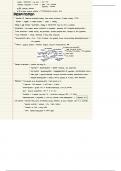
aerobic respiration 36
=
ATP CO2
=
H20
+
2 ATP (O2 ethand
+
ocerobic respiration: yeass=
=
lactate
monmals=
↓
gwusepatallyoxideacceptor No
- Mirochondrial reaction re
Respiration
-transfer of chemical potential energy from which molecules ->
cable energy (ATP)
-
Glucose oxygen
+ -> Cabon dioxide +
Water +
Energy
-energy created/destroyed, energy
is transformed
is from are form to another
(oxidative phosphorylation)
-
mitochondria rod shaped, aerobic respiration enharycles, syncleise ATP
=
in
↳
Inner membrane folded
=
cristal, les permeable, electron transport chain, location of ATP
synthase
↳
oule membrane- smooth, permeable to many small molecules
↳>
internembrace space ↓ pH, I conce protons, congrader corred during oxidative photophosphorylation
= =
ATP synthesis
↳
Matrix ribosores, circular mitochondrial DNA
aqueous solution,
=
enzymes,
oxidative phosphorylation
->
arnnemerw
attm
large SA cristae=
due to
riboscre ->
hold may ETC proteins ATP
+
synthases
I e
-Aerobic respiration produce =
ATP using 02
=Glycolysis =
plosphorylation
+
glucose splitting, cell cytoplasm
-link reaction:decarboxylation dehydrogenation of pywuate, mitochondrial matrix
+
=Krebs cycle =
cyclical pathway enzyme
+
controlled reaction, mitochondrial matrix
-oxidative phosphorylation produce
= ATP via oxidation of Haloms, inner membrace
Glycolysis
-
-
traps glue all
in
by plosphorylation split
+
glucose 2
in
=2 (3C) molecules, 2 ATP (net), 2 NADH
pyruvate
=posplocylation =
glucose (6C) -> fructose bisphosphate (6C)(by 2ATP)
=lysis fructose
=
bisphosphate (6C) -> 2 Tp 13C)
=Oxidation:
A removed from each TP +
transfered coenzyme
to NAD -> 2 NADH
=Deplosphorylation plosphates
=
-> 4 ATP via substrate -
linked phosphorylation
->
2Pywral (3C)
-
Link reaction pynuate
m oves
=
across mitochondria double membrace via active transport when O2 is available
-pyrvate oxidised =
acerate +
CO2 (NAD -
MADH)
=combine W/ COA acetyl
=
COA
-COA supplies acely/group
=
krebs
to
cycle
=
ATP CO2
=
H20
+
2 ATP (O2 ethand
+
ocerobic respiration: yeass=
=
lactate
monmals=
↓
gwusepatallyoxideacceptor No
- Mirochondrial reaction re
Respiration
-transfer of chemical potential energy from which molecules ->
cable energy (ATP)
-
Glucose oxygen
+ -> Cabon dioxide +
Water +
Energy
-energy created/destroyed, energy
is transformed
is from are form to another
(oxidative phosphorylation)
-
mitochondria rod shaped, aerobic respiration enharycles, syncleise ATP
=
in
↳
Inner membrane folded
=
cristal, les permeable, electron transport chain, location of ATP
synthase
↳
oule membrane- smooth, permeable to many small molecules
↳>
internembrace space ↓ pH, I conce protons, congrader corred during oxidative photophosphorylation
= =
ATP synthesis
↳
Matrix ribosores, circular mitochondrial DNA
aqueous solution,
=
enzymes,
oxidative phosphorylation
->
arnnemerw
attm
large SA cristae=
due to
riboscre ->
hold may ETC proteins ATP
+
synthases
I e
-Aerobic respiration produce =
ATP using 02
=Glycolysis =
plosphorylation
+
glucose splitting, cell cytoplasm
-link reaction:decarboxylation dehydrogenation of pywuate, mitochondrial matrix
+
=Krebs cycle =
cyclical pathway enzyme
+
controlled reaction, mitochondrial matrix
-oxidative phosphorylation produce
= ATP via oxidation of Haloms, inner membrace
Glycolysis
-
-
traps glue all
in
by plosphorylation split
+
glucose 2
in
=2 (3C) molecules, 2 ATP (net), 2 NADH
pyruvate
=posplocylation =
glucose (6C) -> fructose bisphosphate (6C)(by 2ATP)
=lysis fructose
=
bisphosphate (6C) -> 2 Tp 13C)
=Oxidation:
A removed from each TP +
transfered coenzyme
to NAD -> 2 NADH
=Deplosphorylation plosphates
=
-> 4 ATP via substrate -
linked phosphorylation
->
2Pywral (3C)
-
Link reaction pynuate
m oves
=
across mitochondria double membrace via active transport when O2 is available
-pyrvate oxidised =
acerate +
CO2 (NAD -
MADH)
=combine W/ COA acetyl
=
COA
-COA supplies acely/group
=
krebs
to
cycle