

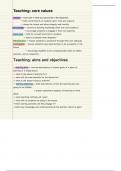
Teaching: core values
Integrity → have care in what you say and do in the classroom
→ fulfil commitments to students (earn trust and respect)
→ always be honest and show integrity and humility
Knowledge → commit to building knowledge (their own and students')
→ encourage students to engage in their own learning
Hard work → hold for yourself and instil in students
→ lead by example (work diligently)
Perseverance → inspire students to persevere through their own setbacks
Compassion → ensure students have opportunities to be successful in the
future
→ encourage students to be compassionate, listen to others
opinions, and be respectful.
Teaching: aims and objectives
→ learning aims = concise descriptions of overall goals of a piece of
learning or a single lesson
→ what is the piece of learning for?
→ what will the main benefits for the learner be?
→ what is the lesson trying to achieve?
→ learning objectives = brief descriptions of how the learning aims are
going to be fulfilled
= explain operational aspects of teaching in more
detail
→ what teaching methods will I use?
→ what will my students be doing in the lesson
→what warning activities will they engage in?
→what new knowledge and understanding do the learners intend to gain?
, → Differentiation = diverse series of teaching techniques aimed as engaging a
wide variety of students
= uplift the output and success of all students
Learning styles:
→ visual-spatial learner = those who learn via observation.
→ aural-auditory learner =these who prefer learning via sound and music.
→ verbal-linguistic learner = those who prefer using words (speech and
writing)
→ physical-kinesthetic learner = those who prefer to use their body/
hands / sense of touch
→ logical-mathematical learner = those who prefer to learn via numbers
and reasoning.
→ social-interpersonal learner =those who prefer to work in groups and
with others
→ solitary -intrapersonal learner =those who prefer self study and to work
alone
Special education needs:
→ Developmental = down syndrome, autism, dyslexia, processing disorders.
→ Behavioural / Emotional = ADD, bipolar, oppositional defiance disorder
→ Sensory impaired =blind, visually impaired, deaf, limited hearing
→ Physical =muscular dystrophy, MS, chronic asthma, epilepsy
→ limit distractions
→ consider inflexion of your voice (encourage and inspire those with
special needs)
→ break instructions down into smaller and more manageable tasks
→ utilise multi sensory strategies (stimulates brain in many ways)
→maintain an organised classroom
Integrity → have care in what you say and do in the classroom
→ fulfil commitments to students (earn trust and respect)
→ always be honest and show integrity and humility
Knowledge → commit to building knowledge (their own and students')
→ encourage students to engage in their own learning
Hard work → hold for yourself and instil in students
→ lead by example (work diligently)
Perseverance → inspire students to persevere through their own setbacks
Compassion → ensure students have opportunities to be successful in the
future
→ encourage students to be compassionate, listen to others
opinions, and be respectful.
Teaching: aims and objectives
→ learning aims = concise descriptions of overall goals of a piece of
learning or a single lesson
→ what is the piece of learning for?
→ what will the main benefits for the learner be?
→ what is the lesson trying to achieve?
→ learning objectives = brief descriptions of how the learning aims are
going to be fulfilled
= explain operational aspects of teaching in more
detail
→ what teaching methods will I use?
→ what will my students be doing in the lesson
→what warning activities will they engage in?
→what new knowledge and understanding do the learners intend to gain?
, → Differentiation = diverse series of teaching techniques aimed as engaging a
wide variety of students
= uplift the output and success of all students
Learning styles:
→ visual-spatial learner = those who learn via observation.
→ aural-auditory learner =these who prefer learning via sound and music.
→ verbal-linguistic learner = those who prefer using words (speech and
writing)
→ physical-kinesthetic learner = those who prefer to use their body/
hands / sense of touch
→ logical-mathematical learner = those who prefer to learn via numbers
and reasoning.
→ social-interpersonal learner =those who prefer to work in groups and
with others
→ solitary -intrapersonal learner =those who prefer self study and to work
alone
Special education needs:
→ Developmental = down syndrome, autism, dyslexia, processing disorders.
→ Behavioural / Emotional = ADD, bipolar, oppositional defiance disorder
→ Sensory impaired =blind, visually impaired, deaf, limited hearing
→ Physical =muscular dystrophy, MS, chronic asthma, epilepsy
→ limit distractions
→ consider inflexion of your voice (encourage and inspire those with
special needs)
→ break instructions down into smaller and more manageable tasks
→ utilise multi sensory strategies (stimulates brain in many ways)
→maintain an organised classroom


