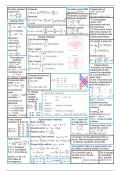
Function gradient Cartesian: 1st order Linear ODE Tangent line of
is given by:
at a is:
Spherical: Parametric surfaces:
Elliptical paraboloid:
-To find tangent
Solving IVP’s: vector, find
Standard model: parameters and sub
Tangent plane is given by: Elliptical cylinder: into derivative.
-To find normal vector,
Law of cooling: take cross product of
partial derivatives with
Double integrals: subbed parameters.
Resistors:
-Can be permutated:
Arc length is given by:
Capacitors:
Type 1 region:
Inductors:
Surface area is:
Homogenous
solutions:
Type 2 region:
-Distinct root:
Independence:
-Multiple root: -Functions are linearly
independent if they
-Complex root: cannot be expressed
Cartesian function on as a combination of
polar rectangle: each other.
Conversion from -A set of functions are
polar: linearly independent if
their Wronskian is 0.
Conversion to
polar: To change
function
Jacobian = variable,
multiply by For ,
Conversion to Jacobian:
spherical: equilibrium points,
are constant
solutions.
If and are
continuous at ,
Jacobian =
then ,
Triple integral Approximation methods: An nth order IVP has a unique
Jacobian is given by: Euler method: is equivalent to solution.
the 1st order IVP: A direction field is the
Absolute error: plot of the vectors:
Relative error:
Improved Euler method: -A function can be determined from a
Ratio test is: vector field by testing various points.
‘ - defines a gradient vector field.
Runge-Kutta method:
If L>1: divergent. -Summation index of a power series can
If L<1: convergent. be shifted, enabling addition of series’.
If L=1: inconclusive. For a function over a For a change
smooth curve, the line of variables
Solve L<1 for x to integral is: to t, bounds
find radius of are 0 ≤ t ≤ 1.
convergence. If k=0:
is given by:
at a is:
Spherical: Parametric surfaces:
Elliptical paraboloid:
-To find tangent
Solving IVP’s: vector, find
Standard model: parameters and sub
Tangent plane is given by: Elliptical cylinder: into derivative.
-To find normal vector,
Law of cooling: take cross product of
partial derivatives with
Double integrals: subbed parameters.
Resistors:
-Can be permutated:
Arc length is given by:
Capacitors:
Type 1 region:
Inductors:
Surface area is:
Homogenous
solutions:
Type 2 region:
-Distinct root:
Independence:
-Multiple root: -Functions are linearly
independent if they
-Complex root: cannot be expressed
Cartesian function on as a combination of
polar rectangle: each other.
Conversion from -A set of functions are
polar: linearly independent if
their Wronskian is 0.
Conversion to
polar: To change
function
Jacobian = variable,
multiply by For ,
Conversion to Jacobian:
spherical: equilibrium points,
are constant
solutions.
If and are
continuous at ,
Jacobian =
then ,
Triple integral Approximation methods: An nth order IVP has a unique
Jacobian is given by: Euler method: is equivalent to solution.
the 1st order IVP: A direction field is the
Absolute error: plot of the vectors:
Relative error:
Improved Euler method: -A function can be determined from a
Ratio test is: vector field by testing various points.
‘ - defines a gradient vector field.
Runge-Kutta method:
If L>1: divergent. -Summation index of a power series can
If L<1: convergent. be shifted, enabling addition of series’.
If L=1: inconclusive. For a function over a For a change
smooth curve, the line of variables
Solve L<1 for x to integral is: to t, bounds
find radius of are 0 ≤ t ≤ 1.
convergence. If k=0: