Chapter 6: Money, Prices, and Exchange rates in the Long Run
1. Overview
Exchange rate = the price of our money in terms of other monies.
Nominal exchange rate = the price of one money in terms of another
Real exchange rate = tries to address the notion of what money can actually buy in the
two countries being compared. It involves adjusting the nominal exchange rate for price
levels at home and abroad.
2. Money and the Neutrality Principle
Neutrality principe = suggest that prices and the nominal exchange rate should grow at the
same rate as money (in the long run).
Assume that people hold cash as a proportion k of their income in each period, measured in
money units. For a country as a whole, total income is measured by GDP. Denoting the real
GDP as Y and the price level P, the nominal GDP is PY, so we now state that the total
demand for money, denoted M, is proportional to the nominal GDP:
M = kPY
This equation is known as the Cambridge equation (= demand for money equation).
Since the purchasing power of money is inversely proportional to the price level, it can be
written as the ratio M/P. This is also called real value of money (or real money). M/P
measures the purchasing power of the money stock M. So:
M/P = kY
! The monetary neutrality principle says that, in the long run, real GDP is unaffected (money
has no long-run effect on output, and more generally, has no long-run effect on any real
variable).
The neutrality principle implies that inflation π is equal to the growth rate of money:
π = ∆M/M (inflation = money growth) (*6.3)
This is because if the nominal money stock M doubles, the left side of (M/P) = kY also
doubles, all other things equal. The right-hand side remains unchanged – because of the
monetary neutrality principle. So this equation can only work if k or P changes. K is constant,
so P must perform the balancing act.
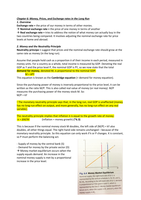
- Supply of money by the central bank (S)
- Demand for money by the private sector (D)
Money market equilibrium occurs when the
supply equals demand. An increase in the
nominal money supply is met by a proportional
increase in the price level.
1. Overview
Exchange rate = the price of our money in terms of other monies.
Nominal exchange rate = the price of one money in terms of another
Real exchange rate = tries to address the notion of what money can actually buy in the
two countries being compared. It involves adjusting the nominal exchange rate for price
levels at home and abroad.
2. Money and the Neutrality Principle
Neutrality principe = suggest that prices and the nominal exchange rate should grow at the
same rate as money (in the long run).
Assume that people hold cash as a proportion k of their income in each period, measured in
money units. For a country as a whole, total income is measured by GDP. Denoting the real
GDP as Y and the price level P, the nominal GDP is PY, so we now state that the total
demand for money, denoted M, is proportional to the nominal GDP:
M = kPY
This equation is known as the Cambridge equation (= demand for money equation).
Since the purchasing power of money is inversely proportional to the price level, it can be
written as the ratio M/P. This is also called real value of money (or real money). M/P
measures the purchasing power of the money stock M. So:
M/P = kY
! The monetary neutrality principle says that, in the long run, real GDP is unaffected (money
has no long-run effect on output, and more generally, has no long-run effect on any real
variable).
The neutrality principle implies that inflation π is equal to the growth rate of money:
π = ∆M/M (inflation = money growth) (*6.3)
This is because if the nominal money stock M doubles, the left side of (M/P) = kY also
doubles, all other things equal. The right-hand side remains unchanged – because of the
monetary neutrality principle. So this equation can only work if k or P changes. K is constant,
so P must perform the balancing act.
- Supply of money by the central bank (S)
- Demand for money by the private sector (D)
Money market equilibrium occurs when the
supply equals demand. An increase in the
nominal money supply is met by a proportional
increase in the price level.